Messier 9
Globular cluster in Ophiuchus, discovered by Charles Messier in 1764.

Messier 9 (NGC 6333) is a globular cluster found in the constellation Ophiuchus, sitting within a dark dust cloud called Barnard 64. It is located in the southern part of the constellation, southwest of the star Eta Ophiuchi. The cluster was first spotted by French astronomer Charles Messier on June 3, 1764, who recorded it as a "nebula without stars." Later, in 1783, English astronomer William Herschel used a reflector telescope to pick out individual stars within it, noting that the cluster spans about 7 to 8 arcminutes across, with stars tightly packed toward the center.
With an apparent magnitude of 7.9 and an angular size of 9.3 arcminutes, M9 is visible through a small telescope. It lies about 25,800 light-years from Earth and is one of the nearer globular clusters to the Milky Way's center, at a distance of roughly 5,500 light-years from the Galactic Center. The cluster's total luminosity is about 120,000 times that of the Sun, giving it an absolute magnitude of −8.04. Its brightest individual stars shine at an apparent magnitude of 13.5, making them accessible in moderately sized telescopes.
Within M9, 24 variable stars have been identified: 21 are RR Lyrae variables, along with one long-period variable, one Type II Cepheid, and one eclipsing binary. No blue stragglers or SX Phoenicis variables have been found. Based on the periods of its RR Lyrae stars, the cluster is classified as an Oosterhoff type II globular, which rules out an extragalactic origin. About 1.3 degrees northeast of M9 lies the fainter globular cluster NGC 6356, and a similar distance to the southeast is another globular, NGC 6342.
Quick Facts
- Epoch
- J2000
- Class
- VIII
- Constellation
- Ophiuchus
- Ra
- 17 · 19 · 11.78
- Dec
- –18 · 30 · 58.5
- Dist Ly
- 25.8 kly
- Appmag V
- 7.7
- Radius Ly
- 45 ly
- Metal Fe
- –1.77
- Age
- 12.0 Gyr
- Names
- HD 156587, NGC 6333
Facts from the source article.
Lore & Background
Messier 9 was discovered by French astronomer Charles Messier on June 3, 1764, who described it as a 'nebula without stars'. In 1783, English astronomer William Herschel used his reflector telescope to resolve individual stars within the cluster, estimating its diameter to be 7–8′ with stars densely packed near the center. The cluster is positioned atop a dark cloud of dust designated Barnard 64. It is one of the nearer globular clusters to the center of the galaxy, being about 5,500 light-years from the Galactic Center, and its distance from Earth is 25,800 light-years.
Reader's Guide
Messier 9 is notable as a globular cluster that was among the first to be resolved into individual stars by William Herschel in 1783, demonstrating the power of reflector telescopes. Its location atop the dark nebula Barnard 64 adds to its observational interest. The cluster has an apparent magnitude of 7.9 and an angular size of 9.3′, making it visible with a small telescope. Its total luminosity is about 120,000 times that of the Sun, with an absolute magnitude of −8.04. The brightest individual stars in M9 are of apparent magnitude 13.5, visible in moderately sized telescopes. The cluster contains 24 variable stars, including 21 RR Lyrae variables, a long-period variable, a Type II Cepheid, and an eclipsing binary. Based on the periods of the RR Lyr variables, M9 is classified as an Oosterhoff type II globular, which precludes an extra-galactic origin. No blue stragglers or SX Phoenicis variables have been discovered in the cluster. Nearby, about 80′ to the northeast lies the dimmer globular cluster NGC 6356, and about the same distance to the southeast is NGC 6342.
Did You Know?
- Messier 9 was discovered by Charles Messier on June 3, 1764, and initially described as a 'nebula without stars'.
- William Herschel resolved individual stars in M9 in 1783 using his reflector telescope.
A Comet Hunter's Unlikely Legacy
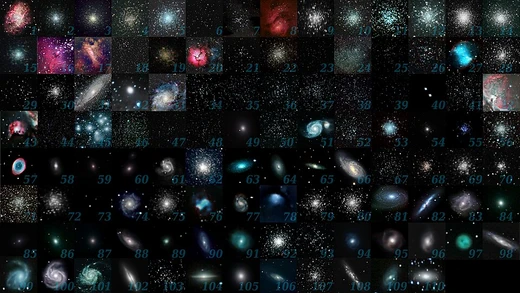
The Messier catalogue, of which M9 is a member, was born from an entirely different purpose. Charles Messier, a French astronomer, was primarily interested in tracking comets. The problem was that fixed objects in the sky—nebulae, star clusters, galaxies—kept being mistaken for comets during his observations. To solve this frustration, he began compiling a list of these non-comet objects so he could quickly identify and ignore them. Working alongside his assistant Pierre Méchain, Messier created what is now one of the most celebrated lists in all of astronomy. Objects on this list are still routinely referenced by their Messier numbers, and the catalogue remains a cornerstone of both professional and amateur astronomy. M9 sits within this collection of 110 deep-sky objects, a testament to how a practical workaround for comet hunting became an enduring catalog of the universe's most spectacular sights.
From 45 to 110: The Growing List
The catalogue that houses M9 did not arrive in its final form overnight. A preliminary version appeared in 1774 in the Memoirs of the French Academy of Sciences, listing 45 unnumbered objects. By 1780 the count had grown to 70, and the definitive edition of 103 objects was published in 1781 in the Connaissance des Temps for the year 1784. Yet the story did not end there. Nicolas Camille Flammarion added M104 in 1921 after discovering a marginal note in Messier's own copy of the 1781 edition. Helen Sawyer Hogg contributed M105 through M107 in 1947, Owen Gingerich added M108 and M109 in 1960, and Kenneth Glyn Jones included M110 in 1967. The controversial M102, observed by Méchain, was long thought to be a duplicate of M101, though some sources identify it as the galaxy NGC 5866. Through these successive additions, the list reached its current total of 110 objects, each a window into the deep sky.
Bright Enough for Paris
The objects in the Messier catalogue, including M9, share a remarkable trait: they are among the brightest and most visually striking examples of their respective deep-sky classes. Messier observed them using a modest refracting telescope of roughly 100 mm aperture, working from the streets of Paris. That they were visible through such a small instrument tells us they are exceptionally luminous and relatively close to Earth. Today, professional instruments can resolve fine structural details in these targets, and they remain heavily studied. For amateur astronomers, the catalogue represents an accessible treasure trove. In early spring, dedicated observers gather for Messier marathons, attempting to view every object in the list over a single night. M9, like its catalogue neighbors, benefits from being one of the closest and most spectacular examples of its type visible from European latitudes, making it a perennial favorite for both visual study and astrophotography.
The Northern Sky's Treasury
Messier conducted his observations from the Hôtel de Cluny in Paris, a location that defined the geographic scope of his catalogue. The list encompasses objects visible from the north celestial pole down to a celestial latitude of approximately minus 35.7 degrees. This means the catalogue deliberately excludes southern-sky wonders such as the Large and Small Magellanic Clouds. The objects it does include span an impressive diversity: diffuse nebulae, planetary nebulae, open clusters, globular clusters, and galaxies. Messier 1 is the Crab Nebula, a supernova remnant, while M31 is the Andromeda Galaxy. The catalogue was published in the Connaissance des Temps, France's official yearly almanac of astronomical ephemerides, giving it an institutional imprimatur. For M9 and its companions, this northern-hemisphere focus means they remain comfortably observable from most of the populated world, cementing their place in both professional research and backyard stargazing.
Frequently Asked Questions
Who is Messier 9?
Messier 9 (also catalogued as NGC 6333) is a globular star cluster nestled in the southern region of the constellation Ophiuchus. It sits embedded within the dark nebula Barnard 64, just southwest of the star Eta Ophiuchi.
What are Messier 9's powers/role?
As a globular cluster, M9 is a dense ball of old stars packed tightly around a bright central core. Herschel noted in 1783 that the stars crowd most densely toward the middle, giving the cluster a compact, luminous heart.
Why is Messier 9 important?
M9 is notable because it is one of the few Messier objects that sits inside a dark nebula, making its surroundings visually striking for observers. Its apparent magnitude of 7.9 also places it within reach of modest binoculars and small telescopes under dark skies.
Where can I find Messier 9 in the sky?
Look in the southern portion of Ophiuchus, a little southwest of the bright star Eta Ophiuchi. The cluster spans roughly 9.3 arcminutes, so it appears as a small, fuzzy ball rather than a sprawling patch of light.
More in Messier Objects 1-24
Spotted an error? Know more?
Reader corrections go straight into our review queue. Suggest an edit · How this site is sourced