Messier 4
The closest globular cluster to the Solar System.

Messier 4 (M4), also cataloged as NGC 6121 and nicknamed the Spider Globular Cluster, lies in the constellation Scorpius. Philippe Loys de Chéseaux first spotted it in 1745, and Charles Messier added it to his catalog in 1764. It holds the distinction of being the first globular cluster where astronomers could make out individual stars.
Even with a very small telescope, M4 appears as a hazy, glowing patch about the size of the full Moon. It’s one of the easiest globular clusters to locate, sitting just 1.3 degrees west of the bright star Antares—both can be seen together in a wide-field telescope. A moderately sized scope begins to resolve its stars, the brightest of which shine at magnitude 10.8.
The cluster is relatively loose, classified as class IX, and spans 75 light-years across. A distinctive bar of 11th-magnitude stars, about 2.5 arcminutes long, cuts across its core; William Herschel first noted this feature in 1783. At least 43 variable stars have been identified within M4. It lies about 6,000 light-years away, making it the closest globular cluster to our Solar System, and is estimated to be 12.2 billion years old.
Its iron abundance relative to hydrogen is [Fe/H] = −1.07±0.1, meaning it has only 8.5% of the Sun’s iron content. This low metallicity, along with other evidence, strongly suggests the cluster contains two distinct stellar populations of different ages, indicating it likely underwent two major phases of star formation. The cluster’s space velocity components are (U, V, W) = (−57±3, −193±22, −8±5) km/s. It orbits the Milky Way with a period of 116±3 million years and an eccentricity of 0.80±0.03, coming as close as 0.6±0.1 kiloparsecs from the galactic center at periapsis and reaching 5.9±0.3 kiloparsecs at apoapsis. Its orbit is inclined 23°±6° to the galactic plane, carrying it up to 1.5±0.4 kiloparsecs above the disk. Each time it passes through the disk (within 5 kiloparsecs of the nucleus), it experiences tidal shocks that can strip away stars, suggesting the cluster may once have been much more massive.
Notable stars within M4 include some of the oldest known in the Milky Way: Hubble Space Telescope images from 1995 revealed white dwarfs aged about 13 billion years. One white dwarf is part of a binary system with the pulsar PSR B1620−26, which hosts a planet 2.5 times the mass of Jupiter.
Quick Facts
- Epoch
- J2000
- Class
- IX
- Constellation
- Scorpius
- Ra
- 16 · 23 · 35.22
- Dec
- −26 · 31 · 32.7
- Dist Ly
- 6.033 kly
- Appmag V
- 5.6
- Age
- (12.2 ± 0.2) Gyr
- Metal Fe
- −1.07
- Notes
- Closest globular cluster
- Names
- NGC 6121
Facts from the source article.
Lore & Background
M4 is a rather loosely concentrated cluster of class IX and measures 75 light-years across. It features a characteristic 'bar' structure across its core, visible to moderate sized telescopes. The structure consists of 11th-magnitude stars and is approximately 2.5′ long and was first noted by William Herschel in 1783. At least 43 variable stars have been observed within M4. M4 is approximately 6,000 light-years away, making it the closest globular cluster to the Solar System. It has an estimated age of 12.2 billion years. The measured abundance of iron is equal to [Fe/H] = −1.07±0.1, meaning the cluster has an abundance of iron equal to 8.5% of the iron abundance in the Sun. This strongly suggests this cluster hosts two distinct stellar populations, differing by age, implying two main cycles or phases of star formation. The space velocity components are (U, V, W) = (−57±3, −193±22, −8±5) km/s, confirming an orbit around the Milky Way of a period of (116±3) million years with eccentricity 0.80±0.03. The cluster undergoes tidal shock during each passage through the galactic disk, which can cause the repeated shedding of stars, so it may have been much more massive.
Reader's Guide
M4 is notable as the first globular cluster in which individual stars were resolved, and it remains one of the easiest globular clusters to find, located only 1.3 degrees west of the bright star Antares. It is conspicuous in even the smallest telescopes as a fuzzy ball of light, appearing about the same size as the Moon in the sky. Modestly sized telescopes will begin to resolve individual stars, the brightest of which are of apparent magnitude 10.8. The view through a good telescope was likened by Robert Burnham Jr. to that of hyperkinetic luminous alpha particles seen in a spinthariscope. Photographs by the Hubble Space Telescope in 1995 found white dwarf stars in M4 that are among the oldest known stars in our galaxy, aged 13 billion years. One star has been found to be a binary with a pulsar companion, PSR B1620−26, and a planet orbiting it with a mass of 2.5 times that of Jupiter. In 2023, an analysis of Hubble and Gaia data revealed an excess mass of roughly 800 solar masses in the center, which could be kinematic evidence for an intermediate-mass black hole, though an unusually compact cluster of compact objects cannot be completely discounted.
Did You Know?
- It is the closest globular cluster to the Solar System, at about 6,000 light-years away.
- M4 contains a binary star with a pulsar (PSR B1620−26) and a planet with 2.5 times Jupiter's mass.
- In 2023, data suggested an intermediate-mass black hole of roughly 800 solar masses may exist at its center.
A Comet Hunter's Unintended Legacy
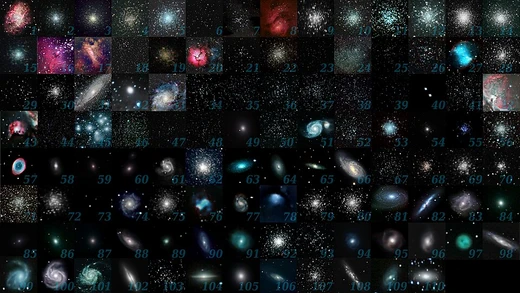
Charles Messier never set out to build an astronomy catalogue. His true obsession was tracking comets across the night sky, and the bright, fixed objects that kept appearing in his telescope—star clusters, nebulae, and distant galaxies—were nothing more than annoying obstacles that mimicked the faint smudges of incoming comets. Working alongside his assistant Pierre Méchain, Messier compiled a running list of these frustrating look-alikes so he could skip them in future surveys. What began as a practical workaround for a single astronomer's pet project grew into one of the most celebrated inventories of the night sky ever assembled. The catalogue spans an extraordinary variety of deep-sky targets, from the Crab Nebula's supernova remnant to the Andromeda Galaxy's sweeping spiral arms, and includes globular clusters like Messier 4. Today, objects across the list are still routinely identified by their M-numbers, a testament to how a comet hunter's irritation produced a reference work that outlived his original purpose by centuries.
From Forty-Five to One Hundred and Ten
The Messier catalogue did not arrive fully formed. A preliminary edition surfaced in 1774 within the Memoirs of the French Academy of Sciences, listing forty-five objects that carried no numerical designations. Eighteen of those had been spotted by Messier himself; the remainder were borrowed from earlier observations by other astronomers. By 1780 the count had swelled to seventy entries, and the definitive version—published in 1781 in the Connaissance des Temps for the year 1784—reached one hundred and three objects. Yet the story did not end there. Marginal notes in Messier's and Méchain's manuscripts revealed that additional targets had been known but never formally published. Nicolas Camille Flammarion recovered Messier 104 in 1921 from a note in a copy of the 1781 edition. Helen Sawyer Hogg added M105 through M107 in 1947, Owen Gingerich contributed M108 and M109 in 1960, and Kenneth Glyn Jones appended M110 in 1967. The long-standing confusion over Messier 102—likely a duplicate sighting of M101, though some scholars identify it with the galaxy NGC 5866—kept the official count at one hundred and two for many years before the full tally of one hundred and ten was accepted.
Bright Enough for a Paris Rooftop
Because Messier studied the sky from the streets of Paris using a modest refracting telescope with an aperture of roughly one hundred millimetres, every object in his catalogue is, by definition, bright enough to be resolved by a small instrument. This single constraint means the list captures nearly all of the most spectacular examples of the five principal deep-sky categories—diffuse nebulae, planetary nebulae, open clusters, globular clusters, and galaxies—visible from European latitudes. Most of these targets also rank among the closest members of their respective classes, which is why professional observatories continue to study them with large-aperture instruments capable of revealing fine structural detail. For the modern amateur astronomer, the catalogue remains an irresistible checklist: the objects are bright, numerous, and distributed across the sky in a way that makes them accessible with larger telescopes than Messier ever possessed. In early spring, dedicated observers even attempt a "Messier marathon," racing to sweep through every entry in a single night, a tradition that underscores how a two-century-old list still serves as a practical observing roadmap.
The Limits of a Parisian Sky
Charles Messier conducted his observations from the Hôtel de Cluny in Paris, a building that today houses the Musée national du Moyen Âge. His position in the French capital imposed a hard geometric limit on what he could see: his catalogue encompasses only objects whose celestial latitudes fall between the north celestial pole and approximately minus thirty-five point seven degrees. Anything lying farther south—most notably the Large and Small Magellanic Clouds—simply never entered his field of view and therefore never made the list. This geographic constraint means the catalogue is, in effect, a northern-hemisphere survey, capturing the deep-sky treasures most readily available to observers in Europe and the northern United States. The result is a collection that skews toward the brightest and most visually rewarding targets in each class, since fainter southern objects were invisible from his Parisian vantage point. For amateur astronomers in the Northern Hemisphere, this makes the Messier list not just a historical curiosity but a genuinely practical guide to what their telescopes can realistically reveal on any given clear night.
Frequently Asked Questions
What is Messier 4?
M4 is a globular cluster in the constellation Scorpius, often nicknamed the Spider Globular Cluster. It also carries the New General Catalog designation NGC 6121.
Where can I find Messier 4 in the sky?
It sits just 1.3 degrees west of the bright star Antares, so both fit comfortably in a single wide-field view. Even a small telescope reveals it as a soft, hazy glow roughly the apparent size of the full Moon.
How far away is Messier 4?
At roughly 6,000 light-years, M4 is the nearest known globular cluster to our Solar System. Its stellar population is estimated to be about 12.2 billion years old.
Who discovered Messier 4 and when?
Swiss astronomer Philippe Loys de Chéseaux first observed it in 1745. Charles Messier later included it in his catalog in 1764, giving it the familiar M4 designation.
What makes Messier 4 special among globular clusters?
M4 was the first globular cluster in which astronomers could resolve individual member stars. Its relatively close distance and easy position near Antares also make it one of the simplest globulars to locate and study.
More in Messier Objects 1-24
Spotted an error? Know more?
Reader corrections go straight into our review queue. Suggest an edit · How this site is sourced