Messier 5
A globular cluster in Serpens, discovered by Gottfried Kirch in 1702.

Messier 5 (NGC 5904) is a globular cluster found in the constellation Serpens. German astronomer Gottfried Kirch first spotted it in 1702 while observing a comet. Under exceptionally clear skies, it can just be seen with the naked eye as a dim point of light, located about 22 arcminutes northwest of the star 5 Serpentis. Binoculars or a small telescope reveal it as a non-stellar object, while larger telescopes bring out individual stars, the brightest of which shine at magnitude 10.6. Charles Messier added it to his catalog of nebulae in 1764, and William Herschel became the first to resolve its individual stars in 1791, counting roughly 200. The cluster is moving away from the Solar System at over 50 km/s.
The cluster hosts 105 known variable stars, 97 of which are RR Lyrae types. These "cluster variables" behave similarly to Cepheid variables and serve as distance indicators because their luminosity and period are well correlated. The brightest variable in M5 fluctuates between magnitudes 10.6 and 12.1 over a period of just under 26.5 days. Two millisecond pulsars reside in the cluster; one is part of a binary system, which has allowed astronomers to measure the cluster’s proper motion. This binary may also help constrain the nature of neutron degenerate matter—if its median mass holds, it rules out any "soft" equation of state for such material. The cluster has also been used to search for magnetic dipole moments in neutrinos, potentially shedding light on hypothetical particles like the axion. Additionally, a dwarf nova has been observed within M5.
Quick Facts
- Epoch
- J2000
- Class
- V
- Constellation
- Serpens
- Ra
- 15 · 18 · 33.22
- Dec
- +02 · 04 · 51.7
- Dist Ly
- 24.5 kly
- Appmag V
- 5.6
- Radius Ly
- 80 ly
- Metal Fe
- –1.12
- Age
- 10.62 Gyr
- Names
- NGC 5904, GCl 34
Facts from the source article.
Lore & Background
Messier 5 was discovered by German astronomer Gottfried Kirch in 1702 while he was observing a comet. Charles Messier noted it in 1764 and, being a studier of comets, cast it as one of his nebulae. William Herschel was the first to resolve individual stars in the cluster in 1791, counting roughly 200. The cluster is receding from the Solar System at a speed over 50 km/s.
Within M5, there are 105 known variable stars, 97 of them belonging to the RR Lyrae type. These stars are similar to Cepheid variables and can be used to measure distances because the relation between their luminosities and periods is well known. The brightest and most easily observed variable in M5 varies from magnitude 10.6 to 12.1 in a period of just under 26.5 days.
The cluster contains two millisecond pulsars, one of which is in a binary, allowing the proper motion of the cluster to be measured. This binary could help our understanding of neutron degenerate matter; the current median mass, if confirmed, would exclude any 'soft' equation of state for such matter. The cluster has also been used to test for magnetic dipole moments in neutrinos, which could shed light on hypothetical particles such as the axion. A dwarf nova has also been observed in this cluster.
Reader's Guide
Messier 5 holds significance as a globular cluster that has been studied for its variable stars, particularly the 97 RR Lyrae variables it contains. These stars are important tools for measuring astronomical distances because their luminosity and period are well correlated. The cluster's brightest variable star, which ranges from magnitude 10.6 to 12.1 over about 26.5 days, provides a clear example for such studies.
The presence of two millisecond pulsars, one in a binary system, allows measurements of the cluster's proper motion and offers insights into the nature of neutron degenerate matter. The median mass derived from this binary, if confirmed, would rule out certain 'soft' equations of state for such matter. Additionally, the cluster has been used in tests for magnetic dipole moments in neutrinos, which could inform the search for hypothetical particles like the axion. The observation of a dwarf nova within M5 adds to its astrophysical interest. Discovered by Gottfried Kirch in 1702 and later cataloged by Charles Messier, the cluster was first resolved into stars by William Herschel in 1791, marking a milestone in the study of such objects.
Did You Know?
- William Herschel was the first to resolve individual stars in M5 in 1791, counting roughly 200.
- The cluster contains 105 known variable stars, 97 of which are of the RR Lyrae type.
Origins in Comet-Hunting
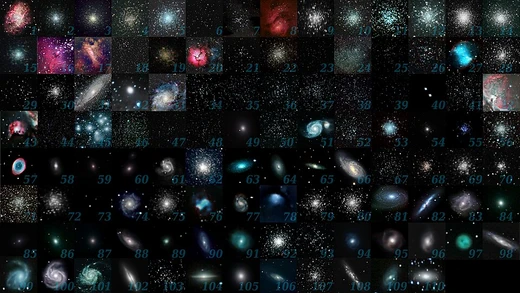
Charles Messier, a French astronomer, compiled his famous catalogue not out of a desire to systematically inventory the sky, but rather to eliminate a persistent source of frustration during his primary pursuit: finding comets. Working alongside his assistant Pierre Méchain, he identified bright, non-comet objects that repeatedly confused his observations. This practical irritation gave birth to what is now one of the most recognized lists in all of astronomy. A preliminary version appeared in 1774 in the Memoirs of the French Academy of Sciences, containing 45 unnumbered objects, eighteen of which Messier himself had discovered while the rest had been noted by earlier observers. The list swelled to 70 entries by 1780, and the final version of 103 objects was published in 1781 in the Connaissance des Temps for the year 1784. Messier carried out this work from the Hôtel de Cluny in Paris, a building that today houses the Musée national du Moyen Âge.
The Growing List Across Generations
The catalogue Messier left behind was far from the final word on deep-sky objects. What he published as 103 entries—long counted as 102 because of the disputed M102—was later expanded to 110 through the efforts of subsequent astronomers who uncovered side notes in Messier's and Méchain's texts. Nicolas Camille Flammarion added M104 in 1921 after spotting a marginal annotation in a copy of the 1781 edition. Helen Sawyer Hogg contributed M105 through M107 in 1947, Owen Gingerich added M108 and M109 in 1960, and Kenneth Glyn Jones included M110 in 1967. The enigmatic M102, originally observed by Méchain, was later judged by Méchain himself to be a re-observation of M101, though some sources identify it as the galaxy NGC 5866. This layered history illustrates how a single catalogue can continue to grow across generations of careful observers.
A Catalogue Bound to the Northern Sky
Messier's list is inherently a northern-hemisphere catalogue. Working from Paris, he could only observe objects spanning from the north celestial pole down to a celestial latitude of roughly −35.7°, which means famous southern targets like the Large and Small Magellanic Clouds never made the list. The catalogue encompasses nearly all the most spectacular examples of five deep-sky object types visible from European latitudes: diffuse nebulae, planetary nebulae, open clusters, globular clusters, and galaxies. Because these objects were bright enough to be resolved through Messier's modest 100-millimeter refracting telescope, they remain among the most attractive targets for modern amateur astronomers. In early spring, dedicated observers even gather for so-called Messier marathons, attempting to view every object in the list over a single night.
Scientific Legacy and Continued Relevance
Though compiled in the eighteenth century, the Messier catalogue remains a cornerstone of both professional and amateur astronomy. The objects it lists are among the closest examples of their respective classes to Earth, making them heavily studied with modern professional instruments capable of resolving fine structural details. A summary of the astrophysics of each object can be found in the Concise Catalog of Deep-sky Objects, and many entries are still routinely referenced by their M-numbers in the literature. The catalogue sits alongside other important lists such as the Caldwell catalogue, the Herschel 400, and the New General Catalogue, yet its cultural recognition is unmatched. From Messier 1, the Crab Nebula supernova remnant, to M31, the great Andromeda Galaxy, the list spans an extraordinary diversity of cosmic phenomena, all catalogued by a man whose original goal was simply to stop mistaking them for comets.
Frequently Asked Questions
What is Messier 5?
Messier 5 is a globular cluster—a tightly packed sphere of ancient stars—located in the constellation Serpens. It also goes by the designation NGC 5904 and sits roughly 22 arcminutes northwest of the star 5 Serpentis.
Who first discovered Messier 5?
German astronomer Gottfried Kirch first spotted it in 1702 while he was actually tracking a comet. Charles Messier later added it to his catalog in 1764, and William Herschel became the first observer to resolve its individual member stars.
Can I see Messier 5 with the naked eye?
Under exceptionally dark, clear conditions it can barely be made out as a faint pinpoint of light. Binoculars or a small telescope turn it into a clearly non-stellar smudge, and larger instruments bring out individual stars down to about magnitude 10.6.
How fast is Messier 5 moving relative to us?
The cluster is receding at a speed of over 50 kilometers per second, meaning it is drifting away from our vantage point within the Milky Way.
Why is Messier 5 a popular target for amateur astronomers?
It is one of the brighter and more easily located globular clusters in the northern sky, sitting just a short distance from a recognizable star. Its long observation history—from Kirch's 1702 sighting through Messier's catalog entry to modern imaging—makes it a well-documented benchmark for studying dense stellar populations.
More in Messier Objects 1-24
Spotted an error? Know more?
Reader corrections go straight into our review queue. Suggest an edit · How this site is sourced