Messier 2
A large, old globular cluster in Aquarius, discovered in 1746.

Messier 2 (NGC 7089) is a globular cluster in the constellation Aquarius, about five degrees north of Beta Aquarii. It was first spotted by French astronomer Jean-Dominique Maraldi in 1746, and ranks among the largest globular clusters known.
The cluster was rediscovered by Charles Messier in 1760, who mistook it for a starless nebula. William Herschel became the first to pick out individual stars within it in 1783. Under excellent conditions, M2 can just be glimpsed with the naked eye; binoculars or a small telescope reveal it as a non-stellar object, while larger instruments resolve its stars, the brightest of which shines at magnitude 12.
M2 lies roughly 37,500 light-years from Earth and spans about 175 light-years across, making it one of the bigger globular clusters. It is rich, compact, and noticeably elliptical in shape. At an estimated 12.5 billion years old, it is among the older globular clusters associated with the Milky Way. The cluster contains around 150,000 stars, including 21 known variable stars. Its brightest members are red and yellow giants, and the overall spectral type is F4.
M2 is part of the Gaia Sausage, the remains of a dwarf galaxy that merged with the Milky Way. Data from the Gaia mission has revealed an extended tidal stream of stars, roughly 45 degrees long and 300 light-years wide, likely linked to M2. This stream may have been disturbed by the Large Magellanic Cloud. Like most globular clusters, M2 resides in the galactic halo, specifically in the southern galactic cap, placing it just below the Milky Way’s southern pole.
In terms of Oosterhoff classification, M2 is a type II globular cluster. This system, devised by Pieter Oosterhoff, separates clusters based on metallicity, age, and the average pulsation period of their type ab RR Lyrae variable stars. A type II cluster typically has a metallicity below −1.6, an age above 13 billion years, and an average RRab Lyrae period around 0.64 days. M2 meets the metallicity (−1.65) and period conditions, but its age of 12.5 billion years falls short of the 13-billion-year cutoff, making it an anomaly. This discrepancy is addressed in a study by Marín-Franch. More recently, Botev et al. proposed a revised lower age limit of 13.2 billion years for M2.
Quick Facts
- Epoch
- J2000
- Class
- II
- Constellation
- Aquarius
- Ra
- 21 · 33 · 27.02
- Dec
- –00 · 49 · 23.7
- Dist Ly
- 11.693 kpc
- Appmag V
- 6.5
- Radius Ly
- 87.3 ly
- Metal Fe
- –1.65
- Age
- 12.5 Gyr
- Names
- NGC 7089
Facts from the source article.
Lore & Background
M2 was discovered by the French astronomer Jean-Dominique Maraldi in 1746 while observing a comet with Jacques Cassini. Charles Messier rediscovered it in 1760, but thought it was a nebula without any stars. William Herschel, in 1783, was the first to resolve individual stars in the cluster. Under extremely good conditions, M2 is just visible to the naked eye; binoculars or a small telescope show it as non-stellar, while larger telescopes resolve individual stars, the brightest of apparent magnitude 12.
The cluster is about 37,500 light-years from Earth and 175 light-years in diameter, making it one of the larger globular clusters known. It is rich, compact, and significantly elliptical. At 12.5 billion years old, it is one of the older globular clusters associated with the Milky Way. M2 contains about 150,000 stars, including 21 known variable stars, with its brightest stars being red and yellow giants. Its overall spectral type is F4.
M2 is part of the Gaia Sausage, the hypothesized remains of a merged dwarf galaxy. Data from Gaia has led to the discovery of an extended tidal stellar stream, about 45 degrees long and 300 light-years wide, likely associated with M2, possibly perturbed by the Large Magellanic Cloud. The cluster is located within the Milky Way's galactic halo, specifically in the southern galactic cap, below the southern pole of the Milky Way.
Reader's Guide
M2 is defined as an Oosterhoff type II globular cluster, a classification based on metallicity, age, and average pulsation period of RR Lyrae variable stars. A cluster with metallicity below −1.6, age above 13 billion years, and average RRab Lyrae pulsation period around 0.64 days indicates type II. M2 has a metallicity of −1.65 and an RRab pulsation period of 0.64 days, fitting the Oosterhoff Gap phenomena—an observed gap in the grouping of type I and type II clusters on a metallicity vs. period plot. However, M2 is an anomaly: its age of 12.5 Gyr is below the 13 Gyr cutoff typical for type II clusters, which is unexpected because age is generally determined from metallicity. This abnormality is explained in an article by Marín-Franch. A recent study by Botev et al. proposed a new lower limit of 13.2 Gyr for M2's age, preserving the uncertainty. The cluster's significance lies in its role as a large, old globular cluster with unusual Oosterhoff properties, contributing to understanding of cluster formation and galactic mergers.
A Comet Hunter's Unlikely Legacy
Charles Messier never set out to build an astronomical catalogue. His true passion was tracking comets across the sky, and the list that bears his name was essentially a catalogue of frustrations—bright smudges of light that kept mimicking the comets he chased but proved to be something else entirely. Working alongside his assistant Pierre Méchain from the Hôtel de Cluny in Paris, Messier began recording these non-comet objects so he would not waste time re-examining them. A preliminary edition of forty-five unnumbered entries appeared in 1774 within the Memoirs of the French Academy of Sciences, eighteen of which Messier had discovered himself. The list swelled to seventy objects by 1780, and the definitive one hundred and three entries were published in 1781 in the Connaissance des Temps, the French government's annual ephemeris almanac. Because Messier observed from a northern latitude, his coverage stretched only from the north celestial pole down to roughly thirty-six degrees south, naturally excluding southern-sky wonders like the Magellanic Clouds. What began as a practical tool for a single comet hunter would become one of the most enduring references in all of astronomy.
A Living Document Across Generations
Long after Messier's death, the catalogue continued to grow as later astronomers uncovered marginalia and side notes in his manuscripts that hinted at objects he and Méchain had known about but never formally listed. In 1921, Nicolas Camille Flammarion spotted a note in a personal copy of the 1781 edition and added Messier 104 to the official count. Helen Sawyer Hogg contributed three more entries—M105 through M107—in 1947, followed by Owen Gingerich's additions of M108 and M109 in 1960, and Kenneth Glyn Jones's inclusion of M110 in 1967, bringing the total to one hundred and ten. The most contentious entry remains M102, which Méchain reported to Messier but later dismissed as a duplicate sighting of M101; some modern sources argue the object was actually the galaxy NGC 5866. For decades the catalogue was cited as containing only one hundred and two objects because of this ambiguity. The story of the Messier list is thus not a single author's achievement but a collaborative, century-spanning effort in which each generation of astronomers peeled back another layer of eighteenth-century notes to reveal what Messier and Méchain had glimpsed but never fully committed to print.
A Cross-Section of the Deep Sky
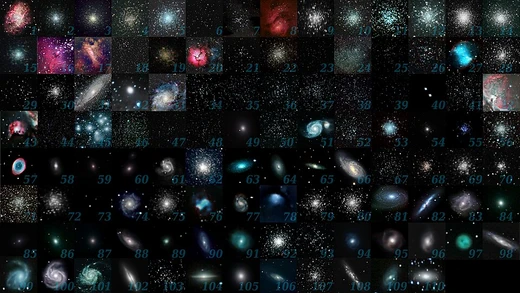
The Messier catalogue is remarkable for the breadth of deep-sky phenomena it captures. Across its entries lie diffuse nebulae, planetary nebulae, open star clusters, dense globular clusters, and entire galaxies, making it a near-complete survey of the five major categories visible from European latitudes. M1, the Crab Nebula, is the remnant of a supernova explosion, while M31 identifies the great Andromeda Galaxy. Crucially, almost every object in the list ranks among the nearest and most luminous members of its respective class, which is why professional observatories have devoted enormous instrument time to resolving fine structural details in them. A dedicated reference, the Concise Catalog of Deep-sky Objects, compiles the astrophysical summary for each entry. The catalogue's practical origin explains its accessibility: Messier identified every one of these targets with a modest refracting telescope of roughly one hundred millimetres aperture, the kind of instrument a dedicated observer in eighteenth-century Paris could manage from downtown. That same combination of brightness, variety, and proximity is what makes the list a cornerstone of both professional research and public astronomy.
From Paris to the World's Backyards
More than two centuries after Messier first recorded them, the objects in his catalogue remain among the most popular targets for amateur astronomers worldwide. Because they are the brightest and most accessible deep-sky objects visible from Earth's Northern Hemisphere, they require nothing more than a modest telescope and a dark sky to reveal their structure, making them ideal for visual study and astrophotography. The catalogue's enduring utility is reflected in the fact that most objects are still referenced by their Messier numbers in both professional and amateur literature. In early spring, when the full range of entries is simultaneously above the horizon, dedicated observers gather for what has become known as a "Messier marathon," attempting to sight all one hundred and ten objects in a single night. The list's status as one of the most famous compilations in astronomy ensures that a teenager in a suburban backyard and a researcher at a major observatory are, in a very real sense, looking at the same sky Messier charted from the Hôtel de Cluny in Paris. The catalogue has become a shared vocabulary and a living bridge between eighteenth-century French astronomy and the global community of stargazers who carry the tradition forward.
Frequently Asked Questions
Who is Messier 2?
Messier 2 is a massive globular cluster sitting in the constellation Aquarius, roughly five degrees north of Beta Aquarii. It was first spotted by Jean-Dominique Maraldi in 1746 and later cataloged by Charles Messier in 1760, who initially mistook it for a starless nebula.
What are Messier 2's powers/role?
M2 ranks among the largest globular clusters known, spanning roughly 175 light-years and hosting stars that are about 12.5 billion years old. It sits approximately 37,500 light-years from Earth, making it a prime target for studying ancient stellar populations.
Why is Messier 2 important?
Its enormous size and ancient age make M2 a key laboratory for understanding how the oldest stellar systems formed and evolved. It also holds a milestone in observational history: William Herschel was the first to resolve individual stars within it in 1783.
How can I see Messier 2?
Under truly dark, clear skies M2 can be barely glimpsed with the unaided eye, while binoculars or a small telescope will reveal it as a soft, non-stellar smudge. Larger instruments can break it apart into a granular field of resolved stars.
More in Messier Objects 1-24
Spotted an error? Know more?
Reader corrections go straight into our review queue. Suggest an edit · How this site is sourced