Messier 7
Southernmost Messier object, visible to the naked eye.

Messier 7 (M7, NGC 6475), also called Ptolemy's Cluster, is an open star cluster located in the constellation Scorpius. It is visible to the naked eye near the "stinger" of Scorpius and, with a declination of −34.8°, holds the title of the southernmost object in the Messier catalog.
The cluster has been recognized since ancient times. The 2nd-century Greek-Roman astronomer Ptolemy recorded it as a nebula in 130 AD. Before 1654, Italian astronomer Giovanni Batista Hodierna observed it and counted 30 stars. Charles Messier added it as the seventh entry in his list of comet-like objects in 1764. John Herschel later described it as a "coarsely scattered cluster of stars." In Chinese astronomy, it is known as Yú, meaning the Fish.
Through a telescope, about 80 stars can be seen within a field of view of 1.3°. At an estimated distance of 980 light-years, this corresponds to an actual diameter of 25 light-years. The cluster's tidal radius is 40.1 light-years, and its total mass is roughly 735 times that of the Sun. Its age is around 200 million years, and its brightest member star has a magnitude of 5.6. The cluster's abundance of elements heavier than hydrogen and helium is similar to that of the Sun.
On August 29, 2006, Messier 7 was used for the first light image of the Long Range Reconnaissance Imager (LORRI) aboard the New Horizons spacecraft, which was bound for Pluto. As of January 2022, M7 remains one of the few Messier objects not photographed by the Hubble Space Telescope, primarily because of its large angular diameter or perceived lack of scientific significance. Many such objects are open clusters with wide angular spans, requiring thousands of Hubble exposures due to its small field of view—for comparison, Hubble's famous panoramic image of the Andromeda Galaxy, covering less than half of that galaxy, needed about 400 individual movements and 7,400 exposures.
The cluster contains over a thousand likely member stars spread across several degrees. Stars brighter than about 8th magnitude have evolved off the main sequence, with the most luminous main-sequence stars around spectral class A0. The brightest stars with a membership probability above 75% are listed in a table.
Quick Facts
- Epoch
- J2000.0
- Constellation
- Scorpius
- Ra
- 17 · 53 · 51.2
- Dec
- −34 · 47 · 34
- Dist Ly
- 980 +/-
- Appmag V
- 3.3
- Mass Msol
- 735
- Radius Ly
- 25 ly
- Age
- 200 Myr
- Names
- Ptolemy Cluster, M7, NGC 6475, Cr 354
Facts from the source article.
Lore & Background
M7 has been known since antiquity; it was first recorded by the 2nd-century Greek-Roman astronomer Ptolemy, who described it as a nebula in 130 AD. Italian astronomer Giovanni Batista Hodierna observed it before 1654 and counted 30 stars in it. In 1764, French astronomer Charles Messier catalogued the cluster as the seventh member in his list of comet-like objects. English astronomer John Herschel described it as 'coarsely scattered clusters of stars'. In Chinese astronomy it is identified as Yú, the Fish.
Telescopic observations of the cluster reveal about 80 stars within a field of view of 1.3° across. At the cluster's estimated distance of 980 light years this corresponds to an actual diameter of 25 light years. The tidal radius of the cluster is 40.1 ly (12.3 pc) and it has a combined mass of about 735 times the mass of the Sun. The age of the cluster is around 200 million years while the brightest member star is of magnitude 5.6. In terms of composition, the cluster contains a similar abundance of elements other than hydrogen and helium as the Sun.
On August 29, 2006, Messier 7 was used for the first light image of the Long Range Reconnaissance Imager (LORRI) telescope on the Pluto-bound New Horizons spacecraft. As of January 2022, Messier 7 is one of the few remaining Messier objects not photographed by the Hubble Space Telescope, mainly due to its large angular diameter or lack of scientific significance.
Reader's Guide
Messier 7 holds significance as one of the few Messier objects known since antiquity, first recorded by Ptolemy in 130 AD. Its inclusion in Charles Messier's 1764 catalog as the seventh object helped establish the foundational list of comet-like objects. The cluster's use for the first light image of the LORRI telescope on the New Horizons spacecraft on August 29, 2006, marks a modern milestone in space exploration. As of January 2022, its status as one of the few Messier objects not photographed by the Hubble Space Telescope highlights a practical limitation: Hubble's small field of view makes imaging large open clusters like M7 (spanning 1.3° across) impractical, requiring thousands of exposures. This contrasts with Hubble's well-known panoramic photo of the Andromeda Galaxy, which required approximately 400 individual movements and 7400 exposures for less than half of that galaxy. The cluster's legacy also includes its identification in Chinese astronomy as Yú, the Fish, and its description by John Herschel as 'coarsely scattered clusters of stars'.
A Place in the Catalogue
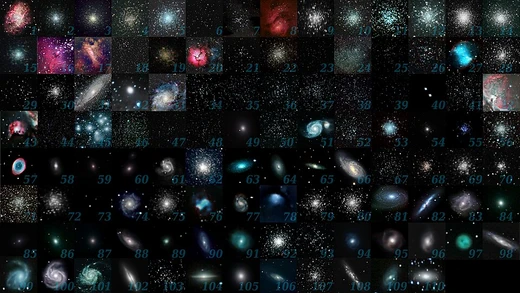
Messier 7 occupies one of 110 slots in what began as a practical workaround for a very specific problem. Charles Messier, a French astronomer whose true passion was tracking comets across the sky, kept losing hours to bright, stationary smudges that resembled comets but were not. To spare himself that frustration, he and his assistant Pierre Méchain compiled a list of these non-comet objects—nebulae, star clusters, and similar deep-sky features—so he could simply skip them during his nightly sweeps. A preliminary edition appeared in 1774 in the Memoirs of the French Academy of Sciences, containing 45 unnumbered objects; eighteen of those had been found by Messier himself, while the remainder were credited to earlier observers. By 1780 the tally had grown to 70, and the definitive 103-object version was published in 1781 in the Connaissance des Temps. M7 sits within that foundational collection, one of the entries that made the catalogue one of the most widely referenced lists in all of astronomy.
The Living Document
The Messier catalogue was never truly finished. After Messier's final 103-object edition was printed in 1781, other astronomers discovered marginal notes in his texts and in Méchain's records that hinted at additional objects the pair had known about but never formally listed. Nicolas Camille Flammarion was the first to act on such a clue, adding Messier 104 in 1921 after spotting a note in a copy of the 1781 edition. Helen Sawyer Hogg contributed M105 through M107 in 1947, Owen Gingerich added M108 and M109 in 1960, and Kenneth Glyn Jones appended M110 in 1967, bringing the total to 110. A persistent controversy surrounds M102, which Méchain reportedly observed and relayed to Messier; Méchain later believed it was merely a duplicate sighting of M101, though some modern sources identify it with the galaxy NGC 5866. M7, as one of the original entries, predates all of these later expansions and remains a fixed point in a catalogue that continued to grow long after its creator's death.
A Target for the Backyard Observatory
One of the reasons M7 endures as a beloved object in the amateur sky is that it belongs to a catalogue assembled specifically from objects bright enough to be seen with modest equipment. Messier worked from the Hôtel de Cluny in Paris using a refracting telescope with an aperture of roughly 100 millimetres, and every object he listed was visible through that small instrument. Because the catalogue covers the sky from the north celestial pole down to a celestial latitude of about minus 35.7 degrees, nearly all of its entries—including M7—are accessible to observers in the Northern Hemisphere. Today, amateur astronomers with larger-aperture telescopes can resolve far more detail, and the objects remain popular subjects for both visual study and astrophotography. In early spring, dedicated observers even attempt Messier marathons, racing to view every catalogue entry in a single night. M7 is one of the stops on that legendary tour.
Among the Brightest and Closest
The Messier catalogue is not merely a random assortment of faint smudges; it gathers what are, in many cases, the most spectacular and nearest examples of each major deep-sky class visible from European latitudes. The collection spans diffuse nebulae, planetary nebulae, open clusters, globular clusters, and galaxies, with entries ranging from the Crab Nebula supernova remnant at M1 to the great spiral Andromeda Galaxy at M31. Because these objects are among the closest in their respective categories, they have been heavily studied with professional-grade instruments capable of resolving fine structural detail, and a summary of the astrophysics of each can be found in the Concise Catalog of Deep-sky Objects. M7 occupies its place within this diverse and scientifically rich family, one of the entries that made the catalogue a cornerstone of both professional research and public fascination with the night sky.
Frequently Asked Questions
What is Messier 7?
M7 (NGC 6475) is an open star cluster located in the tail region of Scorpius, roughly 980 light-years from Earth. It is widely known by the nickname Ptolemy's Cluster.
Where can I find M7 in the sky, and can I see it with the naked eye?
It sits near the stinger of Scorpius at a declination of about −34.8°, making it the southernmost entry in the entire Messier catalog. Because it is bright enough to be spotted without optical aid, it is one of the most accessible Messier objects for observers in the southern hemisphere.
How old is Messier 7, and how massive is it?
The cluster is estimated to be around 200 million years old, which is relatively young for a stellar group. Its combined mass is roughly 735 times that of our Sun.
Why is it called Ptolemy's Cluster?
The 2nd-century astronomer Ptolemy recorded it as a faint nebula in his star catalogue around 130 AD, making it one of the oldest documented deep-sky observations in history. The moniker persisted even after Hodierna, Messier, and others independently catalogued it centuries later.
What makes Messier 7 stand out among other Messier objects?
Its declination of −34.8° gives it the distinction of being the most southerly object in the entire Messier list. Paired with its naked-eye visibility and its claim to the oldest known observation of any Messier entry, it holds a uniquely historic place in the catalogue.
More in Messier Objects 1-24
Spotted an error? Know more?
Reader corrections go straight into our review queue. Suggest an edit · How this site is sourced