Messier 3
One of the largest and brightest globular clusters, with 500,000 stars.

Messier 3 (also cataloged as NGC 5272) is a globular cluster in the northern constellation Canes Venatici, about 33,900 light-years from Earth. It ranks among the largest and brightest globular clusters known, containing roughly 500,000 stars.
Charles Messier discovered it on May 3, 1764—the first object he found himself. He initially thought it was a starless nebula, but William Herschel resolved its individual stars around 1784. Since then, it has become one of the most thoroughly studied globular clusters. American astronomer Solon Irving Bailey began identifying its unusually rich population of variable stars in 1913, and new variable members have continued to be found through 2025.
Amateur astronomers often consider M3 one of the finest northern globular clusters, second only to Messier 13. With an apparent magnitude of 6.2, it is barely visible to the naked eye under dark skies and only with averted vision. However, even in heavily light-polluted areas, a moderate-sized telescope reveals it as a cloudy smudge; darker conditions allow finer detail. To locate it, look roughly halfway along the northwest line connecting Arcturus (α Boötis) and Cor Caroli (α Canum Venaticorum). Through a 25 cm (9.8 in) telescope, the cluster shows a bright core about 6 arcminutes across, with a total span twice that.
M3 is estimated to be 11.4 billion years old. Its center lies 32,600 light-years from Earth. The cluster is quite isolated, sitting 31,600 light-years above the Galactic plane and about 38,800 light-years from the Milky Way’s center. It holds 274 known variable stars—by far the most of any globular cluster—including 133 RR Lyrae variables, roughly a third of which exhibit the Blazhko effect of long-period modulation. Its metallicity (the abundance of elements heavier than hydrogen and helium) ranges from −1.34 to −1.50 dex, meaning it contains about 3.2–4.6% of the Sun’s proportion of such elements. Despite this relatively low value, Messier 3 is the prototype for Oosterhoff type I clusters, which are considered “metal-rich” for globular clusters.
Quick Facts
- Epoch
- J2000
- Class
- VI
- Constellation
- Canes Venatici
- Ra
- 13 · 42 · 11.62
- Dec
- +28 · 22 · 38.2
- Dist Ly
- 33.9 kly
- Appmag V
- 6.39
- Radius Ly
- 103.0 pc
- Radius Tidal Ly
- 113 pc / [mean]
- Metal Fe
- –1.34
- Age
- 11.39 Gyr
- Absmag V
- −8.93
Facts from the source article.
Lore & Background
Messier 3 was discovered on May 3, 1764, and was the first Messier object to be discovered by Charles Messier himself. Messier originally mistook the object for a nebula without stars, a mistake corrected after the stars were resolved by William Herschel around 1784. Since then, it has become one of the best-studied globular clusters. Identification of the cluster's unusually large variable star population was begun in 1913 by American astronomer Solon Irving Bailey, and new variable members continue to be identified up through 2025.
The cluster is quite isolated, located 31.6 kly (9.7 kpc) above the Galactic plane and roughly 38.8 kly (11.9 kpc) from the center of the Milky Way. It contains 274 known variable stars, by far the most found in any globular cluster, including 133 RR Lyrae variables, of which about a third display the Blazhko effect of long-period modulation. The overall abundance of elements other than hydrogen and helium, the metallicity, is in the range of −1.34 to −1.50 dex, giving an actual proportion of 3.2–4.6% of the solar abundance. Messier 3 is the prototype for the Oosterhoff type I cluster, which is considered 'metal-rich' for a globular cluster.
Reader's Guide
Messier 3 is notable as one of the largest and brightest globular clusters, with around 500,000 stars. It was the first Messier object discovered by Charles Messier himself, on May 3, 1764, though he initially mistook it for a starless nebula. William Herschel resolved its stars around 1784, and it has since become one of the best-studied globular clusters. Its variable star population, first systematically identified by Solon Irving Bailey in 1913, remains the largest known in any globular cluster, with 274 variables including many RR Lyrae stars exhibiting the Blazhko effect. The cluster's metallicity, at 3.2–4.6% of the Sun's, makes it relatively metal-rich for a globular cluster, and it serves as the prototype for the Oosterhoff type I classification. For amateur astronomers, M3 is considered one of the finest northern globular clusters, second only to Messier 13, with an apparent magnitude of 6.2. It can be located roughly halfway along the line from Arcturus to Cor Caroli, and through a 25 cm telescope appears as a bright core about 6 arcminutes across, with a total span of double that.
Did You Know?
- It contains 274 known variable stars, the most found in any globular cluster.
- The cluster is located 31.6 kly above the Galactic plane, making it quite isolated.
Born from a Comet Hunter's Frustration
Charles Messier, a French astronomer working out of the Hôtel de Cluny in Paris, never set out to create a landmark catalogue of deep-sky wonders. His true obsession was tracking comets across the sky, and the bright, stationary objects that kept derailing his searches became an unwanted nuisance. To spare himself the trouble of re-identifying them on future nights, he began jotting down their positions alongside his assistant Pierre Méchain. What started as a practical anti-comet list first appeared in 1774 within the Memoirs of the French Academy of Sciences, covering forty-five unnumbered objects, eighteen of which Messier himself had spotted. The remaining entries had already been recorded by earlier observers. By 1780 the tally had swelled to seventy, and the definitive one-hundred-and-three-entry version was printed in the Connaissance des Temps for the year 1784. What was essentially a working note for one man's comet-chasing routine has endured for over two centuries as one of the most widely recognized lists in all of astronomy, with individual entries still routinely cited by their M-numbers in both professional and amateur circles.
A Living List: Two Centuries of Additions
Messier's final published count of one hundred and three entries was far from the last word. A long-standing suspicion that entry M102 was a duplicate observation of M101—though some researchers have argued Méchain actually glimpsed the galaxy NGC 5866—kept the official total at one hundred and two for decades. The true expansion came from later scholars poring over marginalia and side notes in Messier's and Méchain's manuscripts. In 1921, Nicolas Camille Flammarion uncovered a note in a copy of the 1781 edition and formally added M104. Helen Sawyer Hogg contributed M105 through M107 in 1947, Owen Gingerich appended M108 and M109 in 1960, and Kenneth Glyn Jones closed the set with M110 in 1967. The catalogue now stands at one hundred and ten objects, a testament to how a single Parisian observer's scratch notes could seed discoveries that took more than a century to fully acknowledge.
Bright Enough for a Paris Rooftop
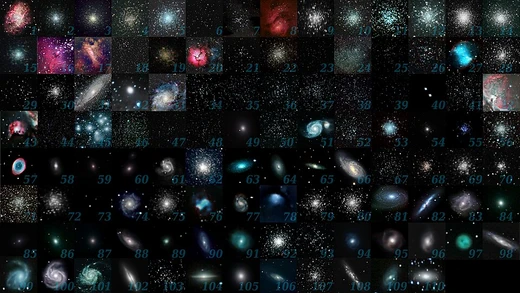
The objects in the Messier catalogue share a remarkable common thread: they are among the nearest and therefore brightest members of their respective deep-sky classes—diffuse nebulae, planetary nebulae, open clusters, globular clusters, and galaxies. Messier studied them with a modest refracting telescope of roughly one hundred millimetre aperture, perched above the rooftops of downtown Paris. That same accessibility is what makes them perennial favourites for modern amateur astronomers, who can resolve fine structure with larger instruments and capture stunning astrophotography. Professional observatories, too, devote significant time to these targets because their proximity allows high-resolution study of internal dynamics and stellar populations. In early spring, when the full set is visible across a single night, communities of observers gather for so-called Messier marathons, racing through all one hundred and ten entries before dawn. The catalogue thus bridges the gap between a casual backyard telescope and the most powerful research instruments in the world.
A Northern-Sky Portrait with Deliberate Boundaries
Messier's catalogue is not a universal inventory of the night sky. Working from his Paris base, he could only survey the region stretching from the north celestial pole down to a celestial latitude of approximately minus thirty-five and a half degrees. Objects that shine exclusively from more southerly latitudes—most notably the Large and Small Magellanic Clouds—simply fell outside his field of view and were never entered. This geographic constraint means the list captures the vast majority of spectacular deep-sky targets visible from Europe and the northern temperate zones, but it is silent on a substantial portion of the southern sky. The catalogue's diversity nonetheless spans an impressive range: from the supernova remnant known as the Crab Nebula (M1) to the great spiral Andromeda Galaxy (M31), from tight globular clusters to wispy planetary nebulae. For northern-hemisphere observers, it remains the single most practical starting point for exploring the deep sky, a curated shortlist of the universe's most photogenic and scientifically rich neighbours.
Frequently Asked Questions
What exactly is Messier 3?
Messier 3 is a massive globular cluster packed with roughly half a million stars, making it one of the largest and brightest of its kind. It sits in the northern sky within the constellation Canes Venatici, about 33,900 light-years from us.
Where in the sky can I spot Messier 3?
Look toward the constellation Canes Venatici, the Hunting Dogs, in the northern hemisphere. At an apparent magnitude of 6.2, it is visible to the naked eye under truly dark skies, though binoculars or a small telescope will reveal its dense star field.
How old is Messier 3?
At approximately 11.4 billion years, Messier 3 predates the bulk of the Milky Way's stellar disk and represents some of the earliest generations of stars in our galaxy.
Who first identified Messier 3 and what did he think it was?
Charles Messier spotted it on May 3, 1764, and it turned out to be the very first object he cataloged on his own. He originally described it as a starless nebula until William Herschel resolved individual stars within it around 1784.
Why is Messier 3 considered special among globular clusters?
Its enormous size, brightness, and unusually rich variety of stellar populations—including a large number of variable stars—have made it a favorite target for astronomers. It has been one of the most thoroughly studied globular clusters since the early twentieth century.
More in Messier Objects 1-24
Spotted an error? Know more?
Reader corrections go straight into our review queue. Suggest an edit · How this site is sourced