Messier 10
A globular cluster in Ophiuchus with moderate metal-poor stars.

Messier 10 (also known as NGC 6254) is a globular star cluster in the equatorial constellation Ophiuchus. French astronomer Charles Messier first spotted it on May 29, 1764, adding it to his catalog as number 10 and calling it a "nebula without stars." German astronomer Johann Elert Bode agreed in 1774, describing it as a "nebulous patch without stars; very pale." Using larger telescopes, William Herschel resolved the cluster into individual stars, calling it a "beautiful cluster of extremely compressed stars." William Parsons, the 3rd Earl of Rosse, thought he saw a dark lane cutting through part of it. Harlow Shapley made the first distance estimate at 33,000 light-years, but modern measurements put it much closer.
The cluster's tidal radius spans 19.3 arcminutes—about two-thirds the Moon's apparent diameter. Through a medium-sized telescope, it looks about half that size (8–9 arcminutes), with a bright core only 35 light-years across. Its core radius is 48 arcseconds, and its half-mass radius is 147 arcseconds (2.5 arcminutes). M10 has a spatial diameter of 83 light-years and lies about 14,300 light-years from Earth. It sits one degree west of 30 Ophiuchi, an orange star at the constellation's center.
In terms of elements heavier than hydrogen and helium—what astronomers call metallicity—M10 is "moderately metal-poor." Its iron abundance, measured as [Fe/H] = –1.45 ± 0.04 dex, is just 3.5% of the Sun's surface iron. The cluster shows signs of enrichment from the s-process in massive stars and Type II supernovae, but little evidence of enrichment from Type Ia supernovae.
Binary stars, being heavier on average than normal stars, tend to drift toward the cluster's center. In the core, about 14% of stars are binaries, dropping to roughly 1.5% in the outer regions. This core also holds a concentration of blue straggler stars formed through interactions, most between 2 and 5 billion years ago. The core's stellar density is about 3.8 solar masses per cubic parsec. Thirty-five variable stars have been found in the cluster, including one RR Lyrae variable, two eclipsing binaries, three W Virginis variables, five semiregular variables, and 16 SX Phoenicis variables. It also contains two known millisecond pulsars.
M10 currently orbits about 5 kiloparsecs (16,000 light-years) from the Milky Way's center.
Quick Facts
- Epoch
- J2000
- Class
- VII
- Constellation
- Ophiuchus
- Ra
- 16 · 57 · 8.92
- Dec
- -04 · 05 · 58.07
- Dist Ly
- 14.3 kly
- Appmag V
- 6.6
- Mass Msol
- 2.25 × 10 / 5
- Radius Ly
- 41.6 ly
- Metal Fe
- –1.25
- Age
- 11.39 Gyr
- Names
- GCl-49, NGC 6254
Facts from the source article.
Lore & Background
Messier 10 was discovered by Charles Messier on May 29, 1764, who described it as a 'nebula without stars.' In 1774, German astronomer Johann Elert Bode called it a 'nebulous patch without stars; very pale.' Using larger instrumentation, William Herschel resolved the cluster into individual stars, describing it as a 'beautiful cluster of extremely compressed stars.' William Parsons, 3rd Earl of Rosse, thought he could distinguish a dark lane through part of the cluster. The first distance estimate was made by Harlow Shapley, who derived 33,000 light-years, much further than the modern value of 14,300 light-years.
The cluster has a tidal radius of 19.3 arcminutes, about two-thirds the apparent diameter of the Moon. Its bright core is only 35 light-years across, and through medium-sized telescopes it appears about half that size (8–9 arcminutes). The core radius is 48 arcseconds, and the half-mass radius is 147 arcseconds. M10 is located about 5 kiloparsecs (16,000 light-years) from the Galactic Center and completes an orbit around the Milky Way every 140 million years, crossing the galactic disk every 53 million years on an eccentric orbit of 0.21.
Reader's Guide
Messier 10 is significant as one of Charles Messier's early discoveries, cataloged in 1764, and it illustrates the progression of astronomical observation from unresolved 'nebulae' to resolved star clusters through improved instrumentation. Its metallicity, measured as [Fe/H] = –1.45 ± 0.04 dex, indicates it is moderately metal-poor, with only 3.5% of the Sun's iron abundance. The cluster shows enrichment from s-process elements and Type II supernovae but little from Type Ia supernovae. The binary star fraction decreases from about 14% in the core to 1.5% in the outer regions, and the core contains blue straggler stars formed 2–5 billion years ago. The cluster hosts 35 variable stars, including RR Lyrae, eclipsing binaries, W Virginis, semiregular, and SX Phoenicis variables, as well as two millisecond pulsars. Its orbit around the Milky Way, with a period of 140 million years and an eccentricity of 0.21, provides context for its dynamical history.
Did You Know?
- Messier 10 was discovered by Charles Messier on May 29, 1764, and described as a 'nebula without stars.'
- The cluster's iron abundance is only 3.5% of that found at the surface of the Sun.
- The binary star fraction in the core is about 14%, decreasing to 1.5% in the outer regions.
- M10 contains 35 variable stars, including two millisecond pulsars.
Born from a Comet Hunter's Frustration
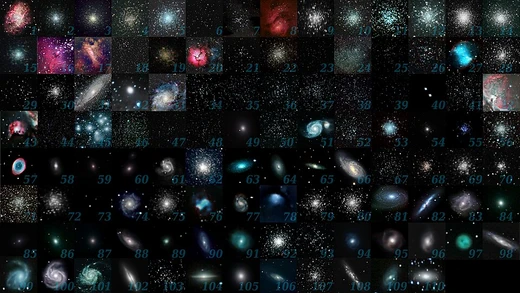
The catalogue to which this object belongs did not spring from a grand ambition to survey the heavens. It grew out of pure irritation. Charles Messier, a French astronomer, was consumed by the pursuit of comets, and every time his telescope caught a fuzzy patch of light that turned out to be a nebula or a star cluster, it wasted precious hours of his search. Together with his assistant Pierre Méchain, he began jotting down these recurring false alarms so he could skip them in future sessions. That grumbling, practical list of non-comet objects eventually became one of the most celebrated references in all of astronomy. A preliminary edition of forty-five unnumbered entries appeared in 1774 within the Memoirs of the French Academy of Sciences, and by 1781 the final version, published in the Connaissance des Temps for the year 1784, had swelled to one hundred and three. Centuries later, astronomers still identify these objects by their Messier numbers, a quiet monument to a comet hunter's workaround becoming an enduring pillar of the field.
A Living Document Expanded Across Centuries
The list that contains this object was never truly closed. Although Messier's 1781 edition enumerated one hundred and three entries, the accepted total for decades was only one hundred and two, because the entry now labelled M102 was long dismissed as a mistaken re-observation of M101, though some later sources argue Méchain actually saw the galaxy NGC 5866. The genuine expansion came from scholars who combed through marginalia in Messier's and Méchain's manuscripts. In 1921, Nicolas Camille Flammarion appended M104 after spotting a note tucked into a copy of the 1781 edition. Helen Sawyer Hogg added M105 through M107 in 1947, Owen Gingerich contributed M108 and M109 in 1960, and Kenneth Glyn Jones tacked on M110 in 1967. Each addition was justified by side notes suggesting that one of the original observers had known of the object but never formally recorded it. This piecemeal growth brought the total to one hundred and ten, demonstrating how a single astronomer's working scribbles could seed discoveries for generations of successors who followed his trail through the night sky.
Observed from a Parisian Courtyard
This object was recorded by an astronomer working from the Hôtel de Cluny in Paris, a building that today houses the Musée national du Moyen Âge. Messier's instrument was modest by contemporary standards: a refracting telescope with an aperture of roughly one hundred millimetres, about four inches across. Yet that small glass, aimed at the sky from a central Paris location, was more than adequate to resolve the deep-sky phenomena that populate the catalogue. Because of his latitude, Messier could observe only objects visible from the north celestial pole down to a celestial latitude of approximately minus thirty-five point seven degrees, which meant southern-sky wonders such as the Magellanic Clouds fell entirely outside his survey. The objects he did record span five major categories—diffuse nebulae, planetary nebulae, open clusters, globular clusters, and galaxies—and are among the closest and brightest examples of each type visible from European latitudes. That combination of proximity and apparent brightness is precisely what made them resolvable through his modest telescope and what keeps them popular targets for observers today.
A Marathon for the Modern Stargazer
Nearly three centuries after Messier first pencilled these objects down in frustration, they remain some of the most sought-after targets in amateur astronomy. Because they are bright, relatively nearby, and distributed across the northern sky, a dedicated observer can in principle view every entry over a single spring night—a tradition now affectionately called a Messier marathon. Amateur astronomers equipped with larger-aperture telescopes than Messier's four-inch refractor can resolve fine structural details invisible to the eighteenth-century eye, and astrophotography has turned these same targets into breathtaking images. Professional instruments have likewise studied them intensively, and a summary of the astrophysics of each object is available in the Concise Catalog of Deep-sky Objects. The catalogue's enduring fame rests not on any single entry but on the fact that it constitutes a complete, manageable survey of the most spectacular deep-sky phenomena visible from the Northern Hemisphere. For a casual stargazer with a modest telescope, working through the list remains one of the most rewarding projects in the hobby.
Frequently Asked Questions
Who is Messier 10?
Messier 10 is a globular star cluster first recorded by Charles Messier on May 29, 1764, who logged it as a faint 'nebula without stars.' It is also catalogued under the New General Catalogue designation NGC 6254.
Where does Messier 10 live?
This dense stellar ball sits in the equatorial constellation Ophiuchus, approximately 14,300 light-years from Earth. Its near-equatorial position makes it a summer target visible from both hemispheres.
What does Messier 10 look like?
Through small instruments it appears as a pale, featureless smudge, which led early observers like Bode to describe it as a starless nebulous patch. Larger telescopes resolve it into a tightly packed sphere of metal-poor stars, and the 3rd Earl of Rosse even reported a dark lane cutting across its core.
How big is Messier 10?
The cluster measures roughly 83 light-years across, with a core radius of about 48 arcseconds and a tidal radius of 19.3 arcminutes. That places it as a moderately compact globular cluster within the Messier catalogue.
Why is Messier 10 important?
As one of the earliest entries in Messier's 1764 list, it helped early astronomers distinguish real star clusters from true nebulae that merely looked alike through small glass. Its moderate metallicity and compact structure also make it a handy benchmark for studying the evolution of ancient stellar populations.
More in Messier Objects 1-24
Spotted an error? Know more?
Reader corrections go straight into our review queue. Suggest an edit · How this site is sourced