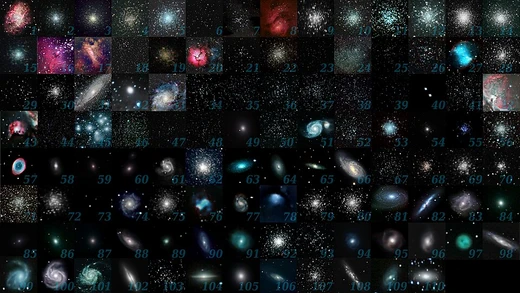
Messier object
A famous catalogue of deep-sky objects compiled by Charles Messier.

Charles Messier, a French astronomer, compiled a list of 110 celestial objects in his *Catalogue des Nébuleuses et des Amas d'Étoiles*. His primary goal was discovering comets, so he cataloged the stationary, comet-like objects that kept getting in his way. Working with his assistant Pierre Méchain, Messier created what is now called the Messier catalogue, one of the most well-known astronomical lists. Many of its entries are still referred to by their Messier numbers. The catalogue contains most of the deep-sky objects easily visible from the Northern Hemisphere, making them frequent targets for amateur astronomers. A preliminary version of the catalogue appeared in 1774, listing 45 objects without numbers. Messier had discovered 18 of these; the rest were previously known. By 1780, the list had grown to 70 objects. The final version, with 103 objects, was published in 1781. For a long time, the total was considered 102 due to the disputed addition of Messier 102. Later astronomers, using notes from Messier and Méchain, expanded the catalogue to 110 objects. The catalogue includes a variety of objects: star clusters, nebulae, and galaxies. For instance, Messier 1 is the Crab Nebula, a supernova remnant, and M31 is the Andromeda Galaxy. The first edition (1774) covered M1 through M45. The 1781 edition had 103 objects, but additions followed. The first such addition came from Nicolas Camille Flammarion in 1921, who added Messier 104 after finding a note Messier made in a copy of the 1781 edition of the catalogue. M105 to M107 were added by Helen Sawyer Hogg in 1947, M108 and M109 by Owen Gingerich in 1960, and M110 by Kenneth Glyn Jones in 1967. M102 was observed by Méchain, who later thought it was a re-observation of M101, though some identify it as NGC 5866. Messier’s final catalogue appeared in the *Connaissance des Temps pour l'Année 1784*. He worked at the Hôtel de Cluny in Paris, observing from the north celestial pole down to a latitude of about −35.7°. He did not include objects visible only from farther south, like the Magellanic Clouds. The catalogue contains nearly all the best examples of five deep-sky types—diffuse nebulae, planetary nebulae, open clusters, globular clusters, and galaxies—visible from European latitudes. Most Messier objects are among the closest in their class, making them heavily studied with professional instruments.
Quick Facts
- Namedafter
- Charles Messier
- Published
- 1774 (preliminary version)
- Onlysourced
- yes
- Editonwikidata
- no
Facts from the source article.
Lore & Background
A preliminary version of the catalogue first appeared in 1774 in the Memoirs of the French Academy of Sciences for the year 1771. The first version of Messier's catalogue contained 45 objects, which were not numbered. Eighteen of the objects were discovered by Messier; the rest had been previously observed by other astronomers. By 1780 the catalogue had increased to 70 objects. The final version of the catalogue containing 103 objects was published in 1781 in the Connaissance des Temps for the year 1784. However, due to what was thought for a long time to be the incorrect addition of Messier 102, the total number remained 102. Other astronomers, using side notes in Messier's texts, eventually expanded the list to 110 objects. The catalogue consists of a diverse range of astronomical objects, from star clusters and nebulae to galaxies. For example, Messier 1 is a supernova remnant, known as the Crab Nebula, and the great spiral Andromeda Galaxy is M31. Further inclusions followed. Messier lived and conducted his astronomical work at the Hôtel de Cluny (now the Musée national du Moyen Âge), in Paris, France. The list he compiled contains only objects found in the sky area he could observe from the north celestial pole to a celestial latitude of about −35.7°. He did not observe or list objects visible only from farther south, such as the Large and Small Magellanic Clouds.
Reader's Guide
The Messier catalogue comprises nearly all of the most spectacular examples of the five types of deep-sky object – diffuse nebulae, planetary nebulae, open clusters, globular clusters, and galaxies – visible from European latitudes. Furthermore, almost all of the Messier objects are among the closest to Earth in their respective classes, which makes them heavily studied with professional class instruments that today can resolve small and visually significant details in them. A summary of the astrophysics of each Messier object can be found in the Concise Catalog of Deep-sky Objects. Since these objects could be observed visually with the relatively small-aperture refracting telescope (approximately 100 mm ≈ 4 inches) used by Messier to study the sky from downtown Paris, they are among the brightest and thus most attractive astronomical objects (of the class popularly called deep-sky objects) observable from Earth, and are popular targets for visual study and astrophotography available to modern amateur astronomers using larger aperture equipment. In early spring, astronomers sometimes gather for 'Messier marathons', when all of the objects can be viewed over a single night.
Did You Know?
- The first edition of the catalogue in 1774 contained 45 objects, which were not numbered.
- M102 was observed by Méchain, who later concluded it was a re-observation of M101, though some sources identify it as NGC 5866.
- The catalogue was expanded to 110 objects through additions by Nicolas Camille Flammarion, Helen Sawyer Hogg, Owen Gingerich, and Kenneth Glyn Jones.
A Comet Hunter's Frustration
The Messier catalogue was born not from a desire to survey the heavens comprehensively, but from a very practical frustration. Charles Messier, a French astronomer working from the Hôtel de Cluny in Paris (the building that today houses the Musée national du Moyen Âge), was primarily a comet hunter. Each time he spotted a fuzzy patch of light through his modest refracting telescope—roughly 100 millimetres in aperture—he had to determine whether it was a new comet or merely a fixed object he had already catalogued. To spare himself and fellow observers that repeated confusion, he began compiling a list of non-comet objects that kept muddying his search. He carried out this work alongside his assistant Pierre Méchain, and the resulting document, titled Catalogue des Nébuleuses et des Amas d'Étoiles, was essentially a do-not-confuse register. Because Messier observed only from European latitudes, his sky stretched from the north celestial pole down to roughly −35.7° celestial latitude, meaning southern-only targets like the Magellanic Clouds never made the list.
From Forty-Five to One Hundred and Ten
What began as a modest 45-entry list in 1774 grew steadily into one of astronomy's most enduring references. The preliminary edition, published in the Memoirs of the French Academy of Sciences for 1771, contained 45 unnumbered objects—18 of them Messier's own discoveries, the rest drawn from earlier work by other astronomers. By 1780 the count had reached 70, and the definitive 103-object version appeared in 1781 within the Connaissance des Temps pour l'Année 1784, France's official yearly ephemeris publication. Marginal notes left by Messier and Méchain, however, hinted at additional objects they had known about but never formally listed. Nicolas Camille Flammarion was the first to act on such a clue, adding M104 in 1921 after spotting a note in a copy of the 1781 edition. Helen Sawyer Hogg contributed M105 through M107 in 1947, Owen Gingerich added M108 and M109 in 1960, and Kenneth Glyn Jones appended M110 in 1967, bringing the total to 110. The enigmatic M102, originally recorded by Méchain, was long dismissed as a duplicate of M101, though some scholars propose it may actually be the galaxy NGC 5866.
A Universe in One List
The catalogue's true strength lies in its remarkable diversity. Rather than focusing on a single class of object, it spans the full spectrum of deep-sky phenomena visible from European latitudes: diffuse nebulae, planetary nebulae, open star clusters, globular clusters, and galaxies. At one end of the range sits M1, the Crab Nebula, a supernova remnant tracing the aftermath of a stellar explosion. At the other, M31, the great spiral Andromeda Galaxy, looms as one of the most iconic targets in the night sky. What unites these vastly different targets is their proximity and brightness. Almost every Messier object ranks among the nearest examples of its particular class, which is precisely why they have become prime subjects for professional telescopes capable of resolving fine structural detail. The Concise Catalog of Deep-sky Objects compiles a summary of the astrophysics behind each entry, and the sheer variety—from glowing nebular gas to entire spiral galaxies—makes the list an almost perfect survey of the universe as seen from Earth's Northern Hemisphere.
A Living Guidebook for Stargazers
Few astronomical catalogues have achieved the cultural penetration of the Messier list. More than two and a half centuries after its creation, objects across the sky are still routinely identified by their M-numbers in both professional literature and casual conversation among stargazers. The reason for this enduring popularity is practical: because Messier selected objects bright enough to be seen through a roughly 100-millimetre refractor from downtown Paris, they remain among the most visually rewarding deep-sky targets available to anyone with a modest telescope. Modern amateur astronomers, armed with larger-aperture instruments, find them ideal for both visual observation and astrophotography. In early spring, a special tradition called the Messier marathon draws dedicated observers who attempt to locate all 110 objects within a single night, exploiting the seasonal geometry that places every entry above the horizon simultaneously. The catalogue thus functions not merely as a historical document but as a living guidebook, connecting today's backyard stargazer to the same patch of sky that Messier and Méchain scanned from the Hôtel de Cluny in the eighteenth century.
Frequently Asked Questions
What is the Messier catalogue?
It is a list of 110 deep-sky objects—galaxies, nebulae, and star clusters—assembled by French astronomer Charles Messier in the 18th century. Each entry carries a 'Messier number' (such as M31 or M42) that stargazers still use as shorthand today.
Why did Messier bother cataloguing these objects in the first place?
Messier was actually hunting for comets, but he kept wasting time re-observing the same fixed, fuzzy patches that looked comet-like. By writing them down, he could skip them in future comet searches and focus on what he really wanted to find.
How many objects are in the Messier catalogue?
The final list contains 110 entries, though Messier's original catalogue described 103 of them. The first edition, published in 1774, covered only 45 objects before the list grew over the following decade.
Did Messier work alone on the catalogue?
Not quite—his assistant Pierre Méchain contributed observations that fed into the final entries. Together they produced what became one of the most widely referenced lists in amateur astronomy.
Why do so many backyard astronomers target Messier objects?
The catalogue was essentially built around what is visible from the Northern Hemisphere, so most entries are reachable with modest telescopes. That makes completing the full 'Messier marathon' a popular seasonal challenge for hobbyists.
More in Messier Objects 1-24
Spotted an error? Know more?
Reader corrections go straight into our review queue. Suggest an edit · How this site is sourced