Messier marathon
An all-night hunt for all 110 Messier objects.

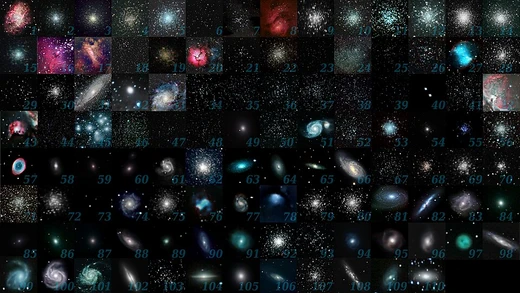
A Messier marathon is a challenge, often organized by amateur astronomers, to spot as many objects from the Messier catalogue as possible in a single night. Charles Messier, a French astronomer, put together this list in the late 1700s. It contains 110 deep-sky objects—galaxies, nebulae, and star clusters—that are relatively bright.
How many of these objects can be seen in one night depends on the observer’s location, the length of daylight and darkness, and the time of year. The positions of the objects shift with the seasons, and night length changes too.
Because Messier worked from a northern latitude, some of his objects are out of reach for observers in the southern hemisphere. Specifically, M81, M82, M52, and M103 sit at a declination of 60° north or higher, making a full marathon difficult from the south. While a marathon can be attempted from any northern latitude, low northern latitudes work best. A latitude near 25° north offers the best chance to complete the marathon at the right time of year.
At such low northern latitudes, especially around 25° north, there is a window of a few weeks from mid-March to early April when all 110 Messier objects can be observed in one night. The best nights during that period are the dark ones near the new moon.
Less complete marathons are possible at other times. The number of objects seen then depends on the season and location. For instance, around the autumnal equinox, a short period allows most of the objects to be viewed.
The Messier Marathon was invented independently in the 1970s by three American astronomers: Tom Hoffelder, Donald Machholz, and Tom Reiland. A typical attempt starts at sundown and runs until sunrise. The observer begins with objects low in the western sky at dusk, trying to catch them before they set, then works eastward across the sky. By dawn, the successful observer is hunting the last few objects low on the eastern horizon, hoping to see them before the sky brightens with the rising sun. The night tests stamina and willpower, depending on weather and the observer’s physical condition. Crowded areas like the Virgo Cluster and the Milky Way’s Galactic Center are especially tricky, and a marathon schedule usually sets aside extra time for them.
Local astronomy clubs or societies often organize marathons as a special type of star party, typically held at least once a year.
- Catalogue compiler
- Charles Messier
- Catalogue size
- 110
- Best latitude
- around 25° north
- Best season
- mid-March to early April
- Inventors
- Tom Hoffelder, Donald Machholz, Tom Reiland
- Invention decade
- 1970s
Lore & Background
The Messier Marathon was invented independently by American astronomers Tom Hoffelder, Donald Machholz, and Tom Reiland in the 1970s. Typically an observer attempting a marathon begins at sundown and observes through the night until sunrise, starting with objects low in the western sky at sunset and working eastward. By sunrise, the successful observer will be observing the last few objects low on the eastern horizon, hoping to see them before the sky becomes too bright due to the rising sun.
Reader's Guide
The Messier marathon is notable as a test of stamina and willpower, depending on weather conditions and the physical fitness of the observer. Particularly crowded regions of the sky, namely the Virgo Cluster and the Milky Way's Galactic Center, can prove challenging, and a marathon will generally budget time for these regions accordingly. Marathons are typically organized by a local astronomy organization or astronomical society as a special type of star party, usually attempted at least once every year. Some clubs issue certificates or awards either for participation or for achieving a set number of objects. The marathon's significance lies in its ability to engage amateur astronomers in a systematic, night-long observation of Charles Messier's catalog, with the best chance of seeing all 110 objects occurring at low northern latitudes around 25° north during a window from mid-March to early April, especially on dark nights near the new moon.
Did You Know?
- The Messier marathon was invented independently by three American astronomers in the 1970s.
- A latitude of around 25° north offers the best possibility to complete a marathon at the right time of year.
- The optimal season for a full marathon is a few weeks from mid-March to early April.
- Some clubs issue certificates or awards for participation or achieving a set number of objects.
Born from a Comet Hunter's Frustration
The Messier catalogue was born not from a grand ambition to map the cosmos, but from sheer irritation. Charles Messier, a French astronomer of the eighteenth century, was consumed by the search for comets. Yet every faint smudge he spotted demanded hours of verification to rule out a fixed nebula, cluster, or galaxy. To spare himself this recurring ordeal, he began assembling a list of non-comet objects that kept derailing his observations. Working alongside his assistant Pierre Méchain, Messier compiled what would become one of the most celebrated inventories in all of astronomy. A preliminary edition appeared in 1774 with forty-five unnumbered entries, the list grew to seventy by 1780, and the final version of one hundred and three objects was published in 1781. What started as a personal nuisance list has endured for over two centuries as the definitive reference for deep-sky observation, with its entries still universally cited by their M-numbers to this day.
The Marathon: One Night, One Hundred and Ten Targets
In early spring, a distinctive astronomical tradition draws observers of every experience level together for what is popularly called a Messier marathon. The ambition is considerable: to visually locate all one hundred and ten Messier objects within a single night. This is feasible because the catalogue was assembled from the vantage point of Paris, spanning the sky from the north celestial pole down to roughly thirty-five point seven degrees south celestial latitude, so the targets rise and set in a sequence that tracks the progress of the night. What makes the marathon especially welcoming is that these targets were originally identified with a modest refracting telescope of about one hundred millimeters aperture. They rank among the brightest and most visually striking deep-sky objects in their respective categories, so modern observers with larger instruments can resolve remarkable fine detail. The event underscores that some of the universe's most spectacular structures remain accessible to the human eye, linking present-day stargazers to an eighteenth-century French comet hunter's daily frustrations.
A List That Grew After Its Author
Messier's final published catalogue in 1781 listed one hundred and three objects, yet the story did not end there. For decades the total was commonly cited as one hundred and two, owing to what was long regarded as an erroneous inclusion of Messier 102. Méchain had observed an object and relayed his notes to Messier, but later concluded it was simply a re-observation of M101, though some sources identify the target as the galaxy NGC 5866. The genuine expansion of the list came from later astronomers who uncovered side notes in Messier's and Méchain's manuscripts. In 1921, Nicolas Camille Flammarion added M104 after spotting a note in Messier's personal copy of the 1781 edition. Helen Sawyer Hogg contributed M105 through M107 in 1947, Owen Gingerich added M108 and M109 in 1960, and Kenneth Glyn Jones included M110 in 1967. These additions, drawn from marginalia and unpublished observations, brought the total to one hundred and ten, demonstrating how a single astronomer's working notes could reshape a catalogue for generations of observers.
Scientific Depth Meets Backyard Accessibility
The Messier catalogue is remarkable not only for its size but for the breadth of celestial phenomena it encompasses. Among its one hundred and ten entries are diffuse nebulae, planetary nebulae, open star clusters, globular clusters, and galaxies, essentially the full spectrum of what astronomers call deep-sky objects. Messier 1, the Crab Nebula, is the remnant of a supernova explosion, while M31 is the great Andromeda Galaxy, a spiral system. Crucially, nearly all Messier objects are among the closest members of their respective classes to Earth. This proximity means they have been intensively studied with professional-grade instruments capable of resolving fine structural details invisible to the unaided eye, and the Concise Catalog of Deep-sky Objects compiles astrophysical summaries for each entry. Yet despite their scientific depth, these objects remain fundamentally visual targets, bright enough to be seen with modest glass, making them the enduring bridge between professional astrophysics and the backyard telescope.
Frequently Asked Questions
What is a Messier marathon?
A Messier marathon is an all-night observational challenge in which an amateur astronomer tries to locate every one of the 110 deep-sky objects listed in Charles Messier's 18th-century catalogue. Participants race against the rising sun to spot galaxies, nebulae, and star clusters before daylight ends the session.
Who came up with the idea of the Messier marathon?
The concept was devised in the 1970s by three amateur astronomers—Tom Hoffelder, Donald Machholz, and Tom Reiland—who wanted to create a structured, repeatable target for serious visual observers. Their framework turned Messier's original loss-avoidance list into a fun competitive event.
When is the best time of year to attempt a full Messier marathon?
Mid-March through early April is widely regarded as the optimal window, because the seasonal positions of the 110 objects align so that all of them are above the horizon during a single dark night. Observers situated near 25 degrees north latitude get the most favorable geometry for this stretch.
How many objects does a Messier marathon cover?
The catalogue contains exactly 110 entries, spanning galaxies, emission and reflection nebulae, and open or globular star clusters. Because Messier worked from a northern-hemisphere site, many of the fainter southern entries are barely visible or impossible to reach from typical marathon locations.
Why is the Messier marathon considered a rite of passage for amateur astronomers?
It demands a full night of continuous scanning, rapid target acquisition, and familiarity with every region of the sky, making it one of the most comprehensive tests of an observer's skill. Successfully logging all 110 objects in a single sitting has long been treated as a badge of honor in the visual-astronomy community.
More in Messier Objects 1-24
Spotted an error? Know more?
Reader corrections go straight into our review queue. Suggest an edit · How this site is sourced