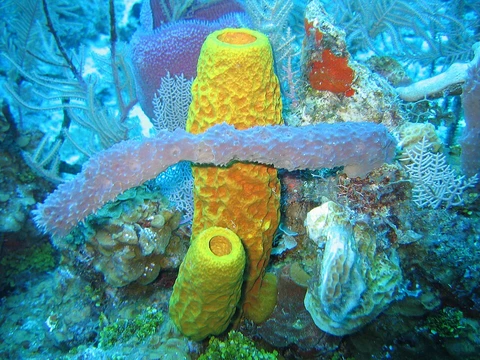
Tetilla capillosa
A southern African demosponge with a fuzzy coat of spicules.

Tetilla capillosa, commonly known as the furry sponge, is a species of demosponge found off the coasts of southern Africa. It is notable for its surface completely covered in outward-projecting spicules that give it a soft, fuzzy appearance.
Quick Facts
- Genus
- Tetilla (sponge)
- Species
- capillosa
Facts from the source article.
Lore & Background
This sponge is firm and tough, growing to about 60 mm wide, with a single large oscule (4-6 mm) at the top. Its surface is entirely covered in projecting spicules up to 4 mm long, which are soft and fuzzy—the origin of its common name. The cortex is undifferentiated.
The skeleton consists of several spicule types: protriaenes (with three short prongs) and prodiaenes (with two prongs), both having straight branches pointing upward and a shaft that curves toward the base; anatrienes (one long and three short rays) that may be curved at the end; straight, noticeably asymmetrical oxeas; and very thin, slightly rough sigmaspires. Tracts of protriaenes, anatrienes, and oxeas form a radial or spiral skeleton that pierces the ectosome, with scattered oxeas between the tracts and abundant sigmaspires throughout.
Reader's Guide
Tetilla capillosa is a distinctive demosponge from southern African waters, recognized by its furry surface created by projecting spicules. Its firm, hemispherical to ovoid body and single large oscule are typical features. The species inhabits depths of 227-474 m off the coasts of South Africa and Namibia, on both the south and west coasts. The spicule complement—including protriaenes, prodiaenes, anatrienes, oxeas, and sigmaspires—defines its skeletal architecture, with tracts forming a radial or spiral arrangement. The common name 'furry sponge' directly reflects the soft, fuzzy texture of the projecting spicules. This species contributes to the understanding of demosponge diversity in southern African marine ecosystems, particularly in deeper shelf and slope environments. Its presence in both South African and Namibian waters indicates a relatively broad distribution along the region's continental margin.
Did You Know?
- The common name 'furry sponge' comes from its surface being completely covered in soft, fuzzy projecting spicules.
- It has a single large oscule measuring 4-6 mm at the top.
- Its spicules include protriaenes, prodiaenes, anatrienes, oxeas, and sigmaspires.
More in Marine Sponges 1-23
Spotted an error? Know more?
Reader corrections go straight into our review queue. Suggest an edit · How this site is sourced