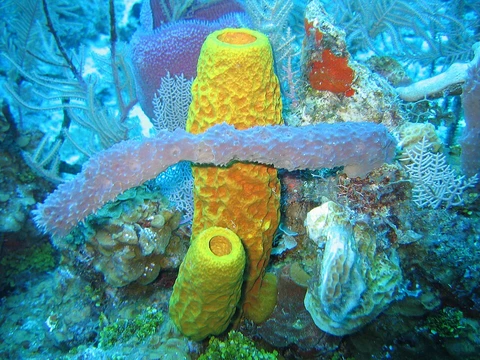
Inflatella belli
A southern-hemisphere demosponge with pharmaceutical potential.

Inflatella belli, called the gooseberry sponge, is a demosponge found only in the southern hemisphere, where it is widely distributed. Its range stretches from the coast of Namibia and the Indo-Pacific region down into Subantarctic and Antarctic waters. This sponge is green to yellow-brown, growing in a semi-spherical or ovoid shape, reaching up to 50 mm wide. Its outer surface is tough and leathery, while the interior is soft and pulpy, with the inner layer darker than the outer ones. Long, trumpet-shaped protrusions cover the surface.
The sponge’s spicules—pointed at both ends—are straight or slightly curved, with one end sharply pointed and the other more rounded. In the cortex, these spicules fuse into several overlapping layers. The papillae consist of a dense layer of upright spicules, while those in the choanosome form an irregular network.
A deep-water species, it is most common at greater depths on hard substrates, though it has been found as shallow as 18 m. It occurs off Namibia, South Africa, New Zealand, and is common in Antarctic and Subantarctic regions.
The gooseberry sponge may be parasitised by diatoms, which enter while the sponge feeds. It is unclear why the sponge incorporates them, but their siliceous shells may cause the sponge to mistake them for particles used in skeleton building. In parasitised individuals, carbohydrate concentration is inversely related to chlorophyll-a levels, suggesting the diatoms use the host’s metabolic products as an energy source. This allows the diatoms to survive in low-light habitats while living in a sheltered environment.
Like many sponges, this species contains bioactive compounds of pharmaceutical interest. It inhibits β-amylase activity and shows antibacterial effects against an Antarctic strain of *Pseudomonas*, a lab strain of *E. coli*, *Staphylococcus saprophyticus*, and methicillin-resistant *Staphylococcus pseudintermedius*. It also acts as an antifungal against *Candida parapsilosis*—an emerging pathogen linked to catheter infections and bloodstream diseases in immunocompromised patients—as well as *Debaryomyces hansenii*, *Exophiala dermatitidis*, *Fusarium dimerum*, and *Aureobasidium melanogenum*. Except for *D. hansenii*, which occurs in Arctic seawater, these fungi were isolated from household sources like dishwashers and drinking water.
Quick Facts
- Genus
- Inflatella
- Species
- belli
Facts from the source article.
Lore & Background
The gooseberry sponge grows in a semi-spherical to ovoid form, reaching up to 50 mm in width. Its exterior is tough and leathery, while the interior is soft and pulpy, with the inner layer darker than the outer layers. The surface is covered with long, trumpet-shaped protrusions. Its spicules, called oxeas, are straight or slightly curved, with one end sharply pointed and the other more rounded. The spicules grow together to form several overlapping layers in the cortex, while the papillae consist of a dense layer of upright spicules; in the choanosome, the spicules are arranged in an irregular network.
This species is found on hard substrates in deep water, though it has been recorded as shallow as 18 m. It is far more common at greater depths. The sponge may be parasitised by diatoms, which are taken up during feeding. It is unclear why the diatoms become incorporated, but it has been suggested that their siliceous shells may cause the sponge to mistake them for siliceous particles used in skeleton building. In parasitised sponges, carbohydrate concentration is inversely proportional to chlorophyll-a concentration, suggesting the diatoms use the host's metabolic products as an energy source, allowing them to survive in habitats with insufficient light for photosynthesis.
Reader's Guide
The gooseberry sponge is significant primarily for its bioactive compounds, which have demonstrated pharmaceutical potential. It has been found to inhibit the activity of β-amylase and to act as an effective antibacterial against several strains, including an Antarctic strain of Pseudomonas, a laboratory strain of E. coli, Staphylococcus saprophyticus, and methicillin-resistant Staphylococcus pseudintermedius. Its antifungal properties are particularly notable against Candida parapsilosis, an emerging pathogen responsible for catheter-related infections and opportunistic nosocomial blood-borne diseases in immunocompromised patients. It also reduced the growth of Debaryomyces hansenii, Exophiala dermatitidis, Fusarium dimerum, and Aureobasidum melanogenum. With the exception of Debaryomyces hansenii, which is found in Arctic seawater, these fungal cultures were isolated from normal household sources such as dishwashers and potable water. The sponge's ecological interaction with diatoms also offers insight into niche expansion, as the diatoms use the sponge's metabolism to survive in low-light environments. This combination of biomedical and ecological relevance makes Inflatella belli a subject of ongoing interest.
Did You Know?
- Its bioactive compounds inhibit β-amylase activity.
- It is effective against methicillin-resistant Staphylococcus pseudintermedius.
Morphology and Skeletal Architecture
The gooseberry sponge presents a distinctive visual profile, ranging in colour from green to yellow-brown and taking on a semi-spherical or ovoid shape that can reach roughly fifty millimetres across. Its exterior feels tough and leathery to the touch, while the interior remains soft and pulpy, with the innermost layer appearing noticeably darker than the outer tissue. The most striking surface feature is a covering of long, trumpet-shaped protrusions known as papillae, which give the organism its characteristic textured appearance. Beneath this surface, the skeletal framework is built from oxeas—spicules pointed at both ends, with one tip sharply defined and the other more gently rounded. These spicules may be perfectly straight or exhibit a slight curve. Within the cortex, they interlock to form several overlapping layers, while the papillae themselves are constructed from a dense mat of upright spicules. Deeper in the body, the spicules of the choanosome are arranged in an irregular, loosely woven network rather than a rigid geometric pattern.
Southern Hemisphere Range and Depth Preferences
Inflatella belli is a demosponge whose range is confined to the southern hemisphere, yet within that vast region it is remarkably widespread. Documented occurrences stretch from the coasts of Namibia and South Africa, across the Indo-pacific waters off New Zealand, and down through the Subantarctic and Antarctic zones. This broad distribution underscores the species' adaptability across a wide band of southern ocean and coastal environments. Although records exist of individuals at depths as shallow as eighteen metres, the sponge is overwhelmingly a creature of the deep. It is far more commonly encountered at greater depths, where it anchors itself to hard substrates on the seafloor. This preference for deeper, more stable environments suggests that the species thrives in conditions where light is limited and the substrate offers a firm foundation for its semi-spherical body. The combination of a deep-water lifestyle and a pan-southern distribution makes the gooseberry sponge a notable component of benthic communities across the world's southernmost oceans.
Diatom Parasitism and Metabolic Symbiosis
One of the most ecologically intriguing aspects of the gooseberry sponge is its relationship with diatoms, which appear to parasitise the organism. These microscopic algae are ingested during the sponge's normal feeding process, and researchers have proposed that the sponge inadvertently incorporates them because their siliceous shells closely resemble the siliceous particles the sponge normally uses to construct its own skeleton. Once inside, the diatoms establish a foothold in the host's tissue. Biochemical evidence from parasitised sponges reveals a telling pattern: carbohydrate concentration is inversely proportional to chlorophyll-a levels. This suggests that the diatoms are tapping into the metabolic products of their host for energy, effectively living off the sponge's biochemistry. The arrangement grants the diatoms a significant ecological advantage—they can persist in deep, light-poor habitats where photosynthesis would normally be impossible, while simultaneously enjoying the shelter of the sponge's body. For the sponge, the long-term fitness cost of this parasitism remains an open question.
Pharmaceutical Potential and Bioactive Compounds
Like many marine sponges, Inflatella belli produces a suite of bioactive compounds that have attracted pharmaceutical interest. Laboratory studies have demonstrated that extracts from this species can inhibit the activity of β-amylase, an enzyme of potential therapeutic relevance. Beyond enzymatic inhibition, the sponge has shown notable antibacterial and antifungal properties against a range of pathogenic organisms. On the antibacterial front, the compounds proved effective against an Antarctic isolate of Pseudomonas, a laboratory strain of E. coli, Staphylococcus saprophyticus, and methicillin-resistant Staphylococcus pseudintermedius. The antifungal results are perhaps even more clinically significant: the sponge was particularly effective against Candida parapsilosis, an emerging pathogen linked to catheter-related infections and opportunistic bloodstream diseases in immunocompromised patients. It also suppressed the growth of Debaryomyces hansenii, Exophiala dermatitidis, Fusarium dimerum, and Aureobasidum melanogenum. Notably, with the exception of D. hansenii, which is found in Arctic seawater, the other fungal strains tested were isolated from everyday household sources such as dishwashers and potable water, underscoring the practical relevance of these findings.
Frequently Asked Questions
What is Inflatella belli?
Inflatella belli is a species of demosponge commonly known as the gooseberry sponge. It is a soft-bodied marine organism that anchors itself to hard underwater surfaces in southern-hemisphere waters.
Where can Inflatella belli be found?
This sponge has a broad range stretching from the Namibian coastline through the Indo-Pacific region and down into Subantarctic and Antarctic seas. It has been recorded at depths as shallow as 18 metres, always attached to hard substrates.
What does Inflatella belli look like?
It grows in a rounded, semi-spherical to ovoid form and shows a green to yellow-brown colouration. The exterior is tough and leathery while the interior is soft and pulpy, with the inner tissue appearing darker than the outer layers, and long trumpet-shaped projections dot the surface.
How large does Inflatella belli grow?
Specimens can reach a maximum width of roughly 50 millimetres. Despite that modest size, the body is built around a tough outer shell enclosing a softer, darker core, with straight spicules pointed at both ends reinforcing the structure.
Why is Inflatella belli considered important?
Beyond its role as a widely distributed southern-hemisphere demosponge, researchers have flagged this species as having pharmaceutical potential. Its unique biochemistry makes it a target of interest for drug-discovery programmes.
More in Marine Sponges 1-23
Spotted an error? Know more?
Reader corrections go straight into our review queue. Suggest an edit · How this site is sourced