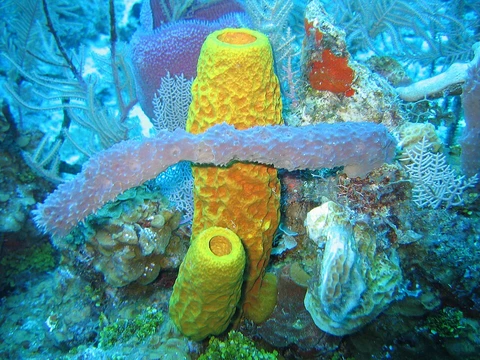
Cliona californiana
A burrowing demosponge that weakens bivalve shells with acid and spicules.

Cliona californiana, known as the yellow boring sponge, sulphur sponge, or simply boring sponge, is a species of demosponge in the family Clionaidae. It is notable for its habit of burrowing into the shell valves of living bivalve molluscs, where only small yellow patches are visible externally.
Quick Facts
- Taxon
- Cliona californiana
Facts from the source article.
Lore & Background
The yellow boring sponge inhabits living bivalve molluscs, boring into the shell valves. Only small yellow patches up to 3 mm in diameter, sometimes containing small oscula, are visible from the outside. Its spicules are silicaceous and consist entirely of megascleres called tylostyles—single-shaft spicules with a point on one end and a knob on the other—which distinguish it from all other sponge species in the locality.
A newly settled young sponge bores into a valve of a mollusc or the plates of a barnacle. It secretes acid to dissolve the shell and breaks off small pieces, moving them to the exterior. When it outgrows its tunnels, it spreads across the valve surface as a thick coating layer. If it becomes too large for its host, it becomes a free-living sponge up to 9 cm long and 6.5 cm tall. It is common on the thick-shelled giant rock scallop (Crassadoma gigantea) and on oysters. The nudibranch Doriopsilla albopunctata preys on this sponge.
Reader's Guide
Cliona californiana holds significance as a bioeroding species that directly impacts bivalve mollusc populations, particularly those of commercial interest. Its tunnelling activity weakens shells, leading scallop and oyster farmers to consider it a pest. The sponge's ability to transition from a burrowing endolith to a free-living form demonstrates a flexible life history strategy. Its spicules, exclusively tylostyles, provide a clear diagnostic feature for identification in the northeastern Pacific. The species is more common in colder northern waters and occurs from the intertidal zone down to about 120 m. Its ecological role includes both shell degradation and serving as prey for the nudibranch Doriopsilla albopunctata, linking it to local food webs. The sponge's distribution from Alaska to Baja California underscores its adaptability across a broad latitudinal range.
Did You Know?
- The sponge secretes acid to dissolve shell material and moves small pieces to the exterior.
- Its spicules are exclusively tylostyles, with a knob on one end and a point on the other.
- It is preyed upon by the nudibranch Doriopsilla albopunctata.
Taxonomic Identity & Classification
Cliona californiana is a species of demosponge classified within the family Clionaidae and the genus Cliona. It was formally described by de Laubenfels in 1932, a period when sponge taxonomy was still expanding rapidly across the world's oceans. As a demosponge, it belongs to one of the major classes of marine invertebrate sponges, sharing the fundamental body plan and ecological niche that define this group. The specific epithet "californiana" ties the species to the Californian region, anchoring it to a particular geographic context along the Pacific coast. Within its genus, it occupies one position among roughly eighty described species, making it a single thread in a richly branched taxonomic lineage. The family Clionaidae serves as the higher-level grouping that unites these sponges under shared structural and ecological traits, setting them apart from other sponge families. De Laubenfels's 1932 description embedded the species in a lineage whose earliest entries date to the 1820s, linking it to nearly two centuries of continuous sponge science.
The Genus Cliona: A Species-Rich Lineage
The genus Cliona stands as one of the more species-rich lineages within the family Clionaidae, encompassing approximately eighty described species. This breadth is reflected in a long and varied list of taxonomic entries spanning from the early nineteenth century to the present day. Describers range from pioneering naturalists such as Hancock (1849), Sollas (1878), and Topsent (1888) to more recent contributors including Calcinai, Bavestrello, and Cerrano (2005), and even Mote, Schönberg, and colleagues (2019). The genus includes species whose names evoke a striking array of geographic and morphological references, from Cliona adriatica and Cliona caribbaea to Cliona chilensis and Cliona californiana. This nomenclatural spread suggests that Cliona sponges have been encountered and catalogued across a remarkable range of marine environments worldwide. The continued addition of new species, with descriptions appearing as recently as 2019, underscores that the genus still yields surprises to sponge taxonomists.
A Century of Sponge Description
The 1932 description of Cliona californiana by de Laubenfels sits at a particular moment in the long arc of sponge classification. The genus Cliona's species list reveals a continuous thread of taxonomic work stretching from 1822, when Cliona patera was first named by Hardwicke, through the prolific efforts of nineteenth-century naturalists like Hancock, Ridley, and Topsent, into the twentieth and twenty-first centuries. De Laubenfels's contribution came in a year that also saw other Cliona entries, including Cliona aethiopicus by Burton and Cliona ecaudis and Cliona janitrix by Topsent, indicating a period of active sponge description. The species has remained within the genus without apparent reclassification, maintaining its original placement. This stability within a genus that has seen new species added as recently as 2019, such as Cliona thomasi, suggests that the diagnostic features distinguishing Cliona californiana from its congeners have held up well under continued scrutiny.
Global Reach & Nomenclatural Spread
The species names within the genus Cliona paint a picture of extraordinary geographic breadth. From Cliona californiana to Cliona adriatica, from Cliona caribbaea to Cliona chilensis, from Cliona barbadensis to Cliona orientalis, the nomenclature encodes a global distribution across oceans and coastlines. Cliona californiana, with its name rooted in the Californian region, represents the Pacific-facing end of this spectrum. The genus also includes species tied to the Mediterranean, the Caribbean, and numerous other regions suggested by their epithets. This wide dispersal of a single genus within the family Clionaidae highlights the adaptability of demosponges to diverse marine habitats. With roughly eighty species documented, Cliona stands as one of the more extensively sampled sponge genera, yet the continued appearance of new names, such as Cliona thomasi in 2019, reminds us that the full extent of this group's diversity may still be unfolding.
Frequently Asked Questions
What is Cliona californiana?
Cliona californiana is a demosponge in the family Clionaidae, most often called the yellow boring sponge or sulphur sponge. It is a small marine organism whose defining trait is living embedded inside the shell valves of living bivalve molluscs.
How does Cliona californiana 'attack' its host bivalve?
The sponge secretes acidic compounds and deposits microscopic spicules into the shell, gradually dissolving the calcium structure from the inside out. Externally, the only giveaway is a small yellow patch on the valve where the sponge has colonized.
Where can you find Cliona californiana in the wild?
It is native to the north-eastern Pacific, occurring from Alaskan waters down to Baja California. It is typically encountered at depths reaching about 120 metres, attached to or boring into bivalve shells on the seafloor.
How large does Cliona californiana grow?
In its free-living state the sponge can reach roughly 9 cm in length and 6.5 cm in height. Once it burrows into a host shell, its visible footprint shrinks to just a small yellow spot on the valve surface.
Why is Cliona californiana ecologically significant?
By weakening bivalve shells, it can contribute to host mortality and thus influences population dynamics in Pacific coastal communities. It also serves as a useful model for studying sponge–invertebrate interactions and the biochemistry of shell dissolution.
More in Marine Sponges 1-23
Spotted an error? Know more?
Reader corrections go straight into our review queue. Suggest an edit · How this site is sourced