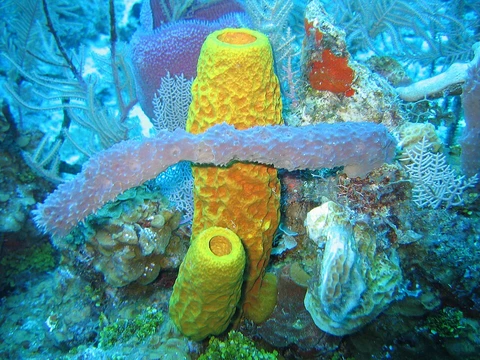
Monanchora
A demosponge genus studied for medicinal potential.

Monanchora is a genus of demosponges within the family Crambeidae, comprising 18 species that have drawn scientific interest for their potential medicinal applications.
The physical forms of Monanchora species vary widely, ranging from encrusting to lobate to ramose structures. Members of this genus are distinguished from other Crambeidae by the absence of pseudoatrose spicules. A key identifying feature is a swollen canal system lined with light-colored tissue, which collapses when the sponge is removed from water. Their skeletal arrangements are simple, sometimes forming bushy structures at the surface without an ectosomal skeleton. Spicules fall into two size categories—megascleres and microscleres—though microscleres may be reduced, absent, or modified in some species, making classification difficult. Monanchora closely resembles the genus *Crambe* in both form and chemistry, but lacks the desma-like spicules found in *Crambe*.
Chemically, many Monanchora species produce guanidine-derived alkaloids, including one called monanchorin. Their chemical profiles are similar to those of *Crambe*. Research has shown that both genera produce pyrroloquinoline and guanidine-derived alkaloids with potential cytotoxic, antiviral (including HIV-1 inhibition), enzyme-inhibiting, receptor-antagonizing, calcium-ion-channel-blocking, antifungal, and antimicrobial properties. These compounds are considered taxonomic markers for sponges in the order Poecilosclerida and are being studied for possible cancer treatments and other therapeutic uses.
Monanchora species are distributed globally, inhabiting shallow marine or brackish waters, often on sea mounds or knolls.
The genus was first described by Carter based on a washed-up specimen of *Monanchora clathrata*. Because wave action had deformed the specimen, its shape was irregular and its structure impossible to determine. Carter described its texture as “crumb-of-bread” and its color as tawny, noting a “sub-pinlike” skeletal arrangement and smooth, curved spicules with pointed shafts.
The recognized species are: *Monanchora alaskensis*, *M. arbuscula*, *M. bahamensis*, *M. brasiliensis*, *M. clathrata*, *M. coccinea*, *M. dianchora*, *M. downesae*, *M. enigmatica*, *M. laevissima*, *M. laminachela*, *M. lipochela*, *M. megasigmifera*, *M. pulchra*, *M. quadrangulata*, *M. stocki*, *M. unguiculata*, and *M. viridis*.
Quick Facts
- Taxon
- Monanchora
Facts from the source article.
Lore & Background
The genus Monanchora was first described by Carter based on a washed-up specimen of Monanchora clathrata. Due to wave action, the specimen's shape was irregular and its structure impossible to determine. Carter described the texture as 'crumb-of-bread' and the color as tawny, with a 'sub-pinlike' skeletal arrangement and a smooth, curved spicule with a pointed shaft.
Species within Monanchora vary in morphology, from encrusting to lobate to ramose. A typical identifying characteristic is a canal system that is swollen and has a light colored lining, which collapses when taken out of water. The genus lacks pseudoatrose spicules, distinguishing it from the similar genus Crambe, which has desma-like spicules. Spicules are categorized into megascleres and microscleres; in some species microscleres may be reduced, absent, or modified, causing problematic identification.
Many species produce guanidine-derived alkaloids called Monanchorin. The genus Crambe and Monanchora have similar chemical makeups. Species are distributed worldwide in shallow marine or brackish waters, with a habitat of sea mounds or knolls.
Reader's Guide
Monanchora is notable primarily for its potential in medicine. Studies have found that Monanchora and Crambe produce pyrroloquinoline and guanidine-derived alkaloids, which potentially contain cytotoxic and antiviral properties, including HIV-1 inhibitors, enzyme inhibitors, receptor antagonists, calcium ion channel blockers, antifungals, and antimicrobials. These compounds are taxonomic traits of sponges in the order Poecilosclerida and are studied for potential use in cancer treatment and other therapeutic areas.
The genus comprises 18 recognized species, including Monanchora alaskensis, Monanchora arbuscula, Monanchora bahamensis, Monanchora brasiliensis, Monanchora clathrata, Monanchora coccinea, Monanchora dianchora, Monanchora downesae, Monanchora enigmatica, Monanchora laevissima, Monanchora laminachela, Monanchora lipochela, Monanchora megasigmifera, Monanchora pulchra, Monanchora quadrangulata, Monanchora stocki, Monanchora unguiculata, and Monanchora viridis. The morphological variability and occasional reduction of microscleres can make assignment to the genus problematic, yet the consistent chemical profile and lack of pseudoatrose spicules define the group. Its global distribution in shallow waters and sea mounds makes it accessible for research, and its bioactive compounds continue to be investigated for pharmaceutical applications.
Did You Know?
- The genus Monanchora was first described by Carter from a washed-up specimen of Monanchora clathrata.
- Some species produce a guanidine-derived alkaloid called Monanchorin.
- Monanchora and the genus Crambe have similar morphology and chemistry.
- The canal system of Monanchora collapses when taken out of water.
Physical Form and Color
Monanchora arbuscula presents a striking visual profile in its natural habitat. This demosponge, belonging to the family Crambeidae, grows in either encrusting or bushy configurations, forming masses that range from low-lying to notably tall. Individual organisms assume bush, round, or fan shapes, all displaying a vivid dark red to bright scarlet hue on both their interior and exterior surfaces. Scattered across the body are oscula—exhalant openings—each ringed by a distinctive white collar arranged in a star-like pattern. These collars derive from exhalant canals that are occasionally invisible to the observer. A small number of oscula sit atop the tips of short, tube-shaped lobes, while the surface is further textured by numerous knobs known as lamellae. When removed from the water, the sponge undergoes a dramatic transformation: the exhalant canals collapse and the red-orange interior coloration vanishes entirely. Despite its soft, tissue-like exterior that readily stains human skin upon handling, the internal skeleton proves remarkably tough and resilient.
Taxonomy and Identification Challenges
The taxonomic history of this species reveals a somewhat tangled naming tradition. When first formally described in 1864 by Duchassaing and Michelotti, it carried the basionym Pandaros arbusculum. Over the decades, researchers mistakenly assigned it to other names, including Monanchora barbadensis (Hechtel, 1969) and M. unguifera (de Laubenfels, 1953), both of which are now recognized as erroneous synonyms. The species ultimately settled into the genus Monanchora within the family Crambeidae. Identification of M. arbuscula can prove genuinely difficult, particularly because the sponge relies on specific combinations of spicule types for secure attachment to its substrate. Encrusting specimens, for instance, anchor themselves through fine filaments of roughly tylostyle spicules, whereas bushy forms build a central mesh of spicules encased in spongin. When a specimen is missing one or more of these expected spicule types, taxonomists face real uncertainty in confirming the species, making careful morphological examination essential for accurate classification.
Distribution and Habitat
Monanchora arbuscula inhabits tropical waters of the Western Atlantic, thriving in brackish environments closely associated with reef systems. Its depth range is remarkably broad, spanning from just 2 meters down to 58 meters (roughly 6.6 to 190.3 feet), indicating a notable tolerance for varying light and pressure conditions. In shallower reef zones, the sponge frequently encrusts a variety of available surfaces, including dead coral colonies, the shells of molluscs, and the rigid axes of gorgonian sea fans. Beyond these biological substrates, it also colonizes hard mineral surfaces on the seafloor. Perhaps most remarkably for a reef-associated organism, M. arbuscula has also been recorded in mangrove ponds, demonstrating an adaptability to the brackish, low-salinity conditions characteristic of those coastal wetlands. This ecological flexibility across multiple substrate types and salinity gradients underscores the species' versatility as a colonizer of diverse tropical marine and semi-marine environments.
Life Cycle and Reproduction
As a member of the demosponge group, Monanchora arbuscula follows a reproductive strategy common to many sponges: it is hermaphroditic, meaning each individual possesses both male and female reproductive capacity. The life cycle begins with the formation of a zygote. This zygote then develops into a free-swimming larva, a motile stage that allows the organism to disperse through the water column before settling. Once the larva finds a suitable hard surface—whether a piece of dead coral, a shell, a gorgonian axis, or bare substrate—it attaches itself and transitions into a juvenile sponge. From that point forward, the organism is permanently fixed in place, growing slowly into one of its characteristic encrusting or bushy forms. The transition from a mobile, searching larva to a sessile adult represents a fundamental shift in the sponge's relationship with its environment, anchoring it to whatever substrate it first colonizes for the remainder of its life.
Frequently Asked Questions
What is Monanchora?
Monanchora is a genus of demosponges belonging to the family Crambeidae, originally described by Carter. It currently encompasses 18 recognized species, with Monanchora clathrata serving as the type species.
How can I tell Monanchora apart from other Crambeidae?
The most reliable field mark is the complete absence of pseudoatrose spicules, a trait that sets the genus apart from its close relatives. Additionally, Monanchora possesses a swollen canal system lined with pale tissue that visibly collapses the moment the sponge is lifted out of the water.
What shapes do Monanchora sponges come in?
The genus shows a wide range of morphologies, from thin encrusting sheets to lobate masses and branching ramose forms. Skeletal arrangements tend to be simple, and some species develop a distinctly bushy architecture at their tips.
Why do researchers study Monanchora?
Scientists have taken particular interest in the genus because its compounds show promise for medicinal applications. This potential therapeutic value has made Monanchora a recurring subject of biochemical and pharmacological investigation.
How many species are officially recognized in Monanchora?
There are 18 described species within the genus. Each can vary considerably in size, color, and growth form, but all share the defining Crambeidae traits and the absence of pseudoatrose spicules.
More in Marine Sponges 1-23
Spotted an error? Know more?
Reader corrections go straight into our review queue. Suggest an edit · How this site is sourced