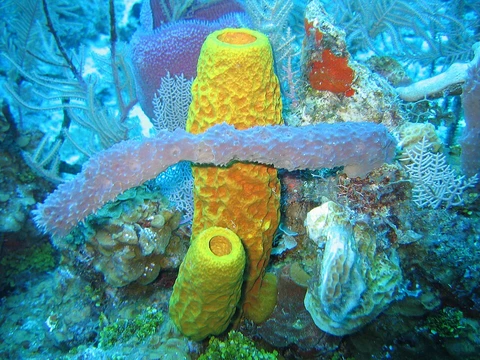
Coelosphaeridae
A globally distributed sponge family with diverse growth forms.

Coelosphaeridae is a family within the sponge order Poecilosclerida, with a worldwide distribution. Early descriptions limited the family to hollow, bladder-like, spherical, club-shaped, tubular, and cushion-shaped forms. However, later findings revealed that other growth forms share similar spiculation, leading to their inclusion, while genera like *Coelocarteria* were excluded due to distinct spicule traits. The family now encompasses a wide range of shapes, including hollow (fistular), branching, massive, and encrusting types. Fistular forms typically have a smooth surface; non-fistular forms are usually irregularly pitted, but lack ringed, colored pore-fields. The skeletal structure resembles that of myxillid sponges, both built from a network of tracts forming an isodictyal skeleton. Tornote brushes often lie partially tangential. In bladder-like fistular forms, the choanosome skeleton is either absent or reduced to a few wispy bundles. The *Forcepia* (*Leptolabis*) subgenus has a hymedesmioid skeleton. As in other Poecilosclerida families, sponges with nearly identical skeletons and spicules may differ only by the presence or absence of spined acanthostyles, though these are of low phylogenetic value and used mainly at the subgenus level in larger genera. Microscleres include sigmas and raphides. Of the 39 genera once proposed for this family, only the following are currently recognized: *Celtodoryx*, *Chaetodoryx*, *Coelosphaera*, *Forcepia*, *Histodermella*, *Inflatella*, *Lepidosphaera*, *Lissodendoryx*, and *Myxillodoryx*.
Quick Facts
- Taxon
- Coelosphaeridae
Facts from the source article.
Lore & Background
The family Coelosphaeridae was initially believed to consist only of hollow, bladder-like, spherical, club-shaped, tubular, and cushion-shaped sponges. However, other forms with similar spiculation were later included, while genera such as Coelocarteria were removed due to differing spiculation. The family now encompasses a diverse array of forms, including fistular (hollow), branching, massive, and encrusting sponges. The surface is typically smooth in fistular forms and irregularly pitted in non-fistular forms, but areolated pore-fields are absent.
The skeletal architecture resembles that of myxillid sponges, both groups having a network of tracts forming an isodictyal skeleton. The usual brushes of tornotes assume a partially tangential position. In bladder-like fistular forms, the choanosome skeleton is absent or reduced to a few wispy bundles. In species of the Forcepia (Leptolabis) subgenus, the skeleton is hymedesmioid. Sponges with very similar skeletons and spicules may differ only in the presence or absence of spined acanthostyles, though these have low phylogenetic importance and are typically used only at the subgenus level in larger genera.
The microscleres include sigmas (curved at both ends) and raphides (thin needles). While a total of 39 genera have been suggested to occur in this family, only nine are currently recognized.
Reader's Guide
Coelosphaeridae holds significance as a family that illustrates the challenges of sponge taxonomy, where growth form alone proved insufficient for classification. The family's history shows how spiculation became a more reliable character, leading to the removal of some genera and the inclusion of others. Its skeletal architecture, shared with myxillid sponges, places it within the broader context of Poecilosclerida. The presence of spined acanthostyles as a variable trait, used only at the subgenus level, underscores the fine-grained distinctions that define sponge relationships. The family's global distribution and diverse forms—from hollow fistular to massive and encrusting—demonstrate its ecological adaptability. The recognition of only nine genera out of 39 suggested reflects ongoing refinement in sponge systematics, where morphological and spicular evidence continues to shape understanding. The microscleres, sigmas and raphides, are consistent features that aid identification. Overall, Coelosphaeridae serves as a case study in how early assumptions about sponge morphology were revised through detailed examination of spiculation and skeletal organization.
Did You Know?
- Originally, the family was believed to be restricted to hollow, bladder-like, spherical, club-shaped, tubular, and cushion-shaped growth forms.
- The genus Coelocarteria was removed from the family due to differing spiculation.
Taxonomic Evolution and Reclassification
Coelosphaeridae, a family within the sponge order Poecilosclerida, has undergone significant shifts in its taxonomic boundaries over time. Early researchers confined the family to a narrow set of growth forms—hollow, bladder-like, spherical, club-shaped, tubular, and cushion-shaped sponges. However, as further specimens were examined, additional morphologies were discovered that shared the same spiculation patterns, prompting their inclusion in the family. Conversely, genera that had previously been assigned to Coelosphaeridae, such as Coelocarteria, were reclassified out of the group because their spicule architecture did not align with the family's defining characteristics. Today, the family encompasses a far broader morphological spectrum, ranging from fistular and branching sponges to massive and encrusting forms. Despite this expanded scope, taxonomic consensus remains limited: although thirty-nine genera have been proposed for the family at various points, only nine are currently accepted by the scientific community, reflecting ongoing debate about the precise boundaries of this globally distributed sponge lineage.
Morphological Diversity and Surface Architecture
The members of Coelosphaeridae display a remarkable range of external body plans, a diversity that has grown considerably since the family's initial description. While the earliest concept of the group was limited to hollow, bladder-like, spherical, club-shaped, tubular, and cushion-shaped sponges, modern taxonomy now embraces fistular, branching, massive, and encrusting forms as well. Surface texture provides one of the most visible distinctions among these shapes. Fistular specimens typically present a smooth exterior, whereas non-fistular forms tend to exhibit an irregularly pitted surface. Notably, areolated pore-fields—pore clusters ringed with colour—do not occur in any member of the family, a feature that helps distinguish Coelosphaeridae morphologically. In the bladder-like fistular types, the internal choanosome, the sponge's inner skeletal region, is either entirely absent or reduced to a few wispy bundles of fibres, giving these organisms a largely hollow internal structure. This combination of external diversity and internal simplicity makes the family a striking example of how a single spicule-based architecture can underpin many different body shapes across the globe's marine environments.
Skeletal Framework and Spicule Composition
The internal architecture of Coelosphaeridae sponges closely mirrors that of the myxillid group, with both families constructing their bodies from a network of tracts that together form what is termed an isodictyal skeleton. Within this framework, the usual brushes of tornotes typically assume a partially tangential position relative to the sponge's surface. A notable variation occurs in species belonging to the Forcepia (Leptolabis) subgenus, where the skeletal arrangement takes on a hymedesmioid character, setting it apart from the rest of the family. Among the order Poecilosclerida as a whole, sponges with nearly identical skeletons and spicule assemblages can sometimes be distinguished solely by whether or not they possess spined acanthostyles, which are spiny monoaxon spicules rounded at one end. These acanthostyles carry relatively low phylogenetic weight and are generally applied only at the subgenus level within larger genera rather than at higher taxonomic ranks. At the microscale, the family's skeleton incorporates two types of microscleres: sigmas, which are curved at both ends, and raphides, which are thin, needle-like spicules. Together, these elements create a structurally coherent yet taxonomically nuanced skeletal system.
Recognised Genera and Taxonomic Scope
Although researchers have proposed as many as thirty-nine genera to belong to Coelosphaeridae, the family's currently accepted membership is considerably smaller, comprising only nine genera. These range from Coelosphaera, described by Thomson in 1873, to Myxillodoryx, named by Aguilar-Camacho and Carballo in 2012, spanning over a century of sponge taxonomy. The full list of recognised genera includes Celtodoryx (Pérez, Perrin, Carteron, Vacelet & Boury-Esnault, 2006), Chaetodoryx (Topsent, 1927), Coelosphaera (Thomson, 1873), Forcepia (Carter, 1874), Histodermella (Lundbeck, 1910), Inflatella (Schmidt, 1875), Lepidosphaera (Lévi & Lévi, 1979), Lissodendoryx (Topsent, 1982), and Myxillodoryx (Aguilar-Camacho & Carballo, 2012). Several of these names share the suffix 'doryx,' while others such as Inflatella and Histodermella follow different naming conventions. The family's species are found across the globe, and its placement within the order Poecilosclerida connects it to a broader assemblage of sponges united by shared spicule-based traits. The gap between the thirty-nine proposed and nine accepted genera underscores how much taxonomic refinement remains in this group.
Frequently Asked Questions
What exactly is Coelosphaeridae?
Coelosphaeridae is a family of marine sponges that falls under the order Poecilosclerida. It is defined by a particular spicule architecture, with microscleres composed of sigmas and raphides.
What body shapes do Coelosphaeridae sponges come in?
The family spans a surprisingly wide range of morphologies, from hollow tube-like (fistular) forms to branching, massive, and encrusting growth types. Fistular specimens typically display a smooth outer surface, whereas the other forms can be far more varied in texture.
Why were some genera removed from Coelosphaeridae over time?
As taxonomists examined more specimens, they determined that lineages such as Coelocarteria possess spicule traits that don't align with the family's defining characteristics, so those were carved out. Conversely, additional growth forms were folded in once their shared spiculation was confirmed.
How many genera belong to Coelosphaeridae?
Nine genera are currently recognized, including Coelosphaera, Lissodendoryx, and Inflatella, though broader taxonomic proposals have suggested as many as 39 genera in total. This spread reflects ongoing debate about exactly where the family's boundaries should be drawn.
Where in the ocean can you encounter Coelosphaeridae?
Members of this family have a global distribution and have been documented across multiple ocean basins. Their diverse growth forms allow them to colonize a range of reef and benthic habitats worldwide.
More in Marine Sponges 1-23
Spotted an error? Know more?
Reader corrections go straight into our review queue. Suggest an edit · How this site is sourced