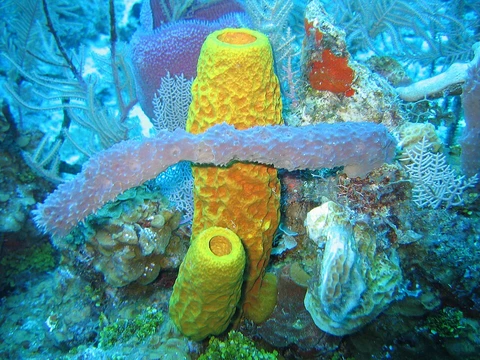
Spirastrella coccinea
A thin encrusting sponge known for its bioactive macrolides.

Spirastrella coccinea is a marine sponge belonging to the family Spirastrellidae. It forms thin, encrusting patches less than 10 mm thick that can cover a square metre or more of hard surfaces. Its surface is smooth and leathery, red on the outside and brownish-red or orange inside. In shallow water, the sponge appears orangish-red, while deeper specimens are red or pink, sometimes with white specks near the oscula—the small holes, up to 2 mm wide, where water exits. These oscula often sit on low mounds, and transparent, star-shaped canals radiate from them. The skeleton is made of tylostyles (rods with one pointed end and one knobbed end) and microscleres, but lacks spongin fibres.
This species lives in the tropical western Atlantic Ocean, the Caribbean Sea, and the Gulf of Mexico, ranging as far south as Brazil. It grows on hard substrates such as coral reefs and coral rubble down to about 15 metres deep, and has also been found in submarine caves and among mangrove roots.
Because sponges are soft-bodied and lack physical defences, they produce chemical compounds to deter predators. Many of these compounds are bioactive and of interest in pharmaceutical research. From Spirastrella coccinea, researchers have isolated a novel mitotic inhibitor macrolide called Spirastrellolide A. Its methyl ester has an unusual property: it causes cells to begin dividing when they are in other stages of the cell cycle, then halts division partway through. A second macrolide, Spirastrellolide B, has also been isolated and its structure determined. Five more macrolides—Spirastrellolides C through G—have since been found in extracts of this sponge, with their structures identified using spectroscopic analysis and chemical methods.
Quick Facts
- Genus
- Spirastrella
- Species
- coccinea
Facts from the source article.
Lore & Background
Spirastrella coccinea forms thin encrusting patches less than 10 mm thick, covering up to a square metre or more of substrate. Its oscula are often raised on low mounds and measure up to 2 mm in diameter, with transparent star-shaped canals radiating from them. The sponge has a smooth, leathery texture; the surface is red, while the interior is brownish-red or orange. Shallow-water individuals are orangish-red, while those at greater depths are red or pink, sometimes with white specks near the oscula. The skeleton consists of tylostyles (rods with one pointed end and one knobbed end) and microscleres, but lacks spongin fibres. It grows on hard substrates, coral reefs, and coral rubble at depths down to about 15 m, and has also been found in a submarine cave and among mangrove roots.
Reader's Guide
Spirastrella coccinea is of particular interest in pharmaceutical research due to the bioactive compounds it produces. As a soft-bodied, sessile organism lacking physical defences, it relies on chemical defences against predation. A novel mitotic inhibitor macrolide, Spirastrellolide A, has been isolated from this sponge. Its methyl ester has the unusual biological property of causing cells to begin dividing when they are at other stages of the cell cycle, then stopping them partway through the process. Another macrolide, Spirastrellolide B, has also been isolated and its structure elucidated. Subsequently, five further macrolides—Spirastrellolides C through G—have been found in extracts of the sponge, their structures determined by spectroscopic analysis and chemical means. These compounds represent a significant area of study for their potential applications in cell biology and drug development.
Did You Know?
- Spirastrella coccinea forms patches up to a square metre or more in area.
- The sponge lacks spongin fibres in its skeleton.
- Spirastrellolide A is a mitotic inhibitor macrolide isolated from this species.
Physical Form and Skeletal Architecture
Spirastrella coccinea presents as a remarkably thin encrusting sponge, never exceeding ten millimetres in thickness, yet capable of spreading across substrate in patches that can cover a square metre or more. Its surface feels smooth and leathery to the touch, displaying a vivid red on the exterior while the interior shifts to brownish-red or orange tones. The oscula—those small openings through which filtered water exits the sponge body—are frequently perched atop low mounds and measure up to two millimetres across. Radiating outward from each osculum are transparent canals that produce a distinctive star-shaped pattern. The structural framework of this sponge is built entirely from spicules: tylostyles, which are rod-shaped elements with a pointed tip on one end and a knob on the other, along with smaller microscleres embedded within the tissue. Notably, the species lacks spongin fibres entirely, relying solely on these mineral elements for rigidity. Colouration also shifts with depth; individuals in shallower waters tend toward orangish-red, while those at greater depths appear red or pink, occasionally showing white specks clustered near the oscula.
Geographic Range and Substrate Preferences
Spirastrella coccinea occupies a broad swath of warm western Atlantic waters, ranging from the Caribbean Sea and the Gulf of Mexico southward along the tropical western Atlantic coast all the way to Brazil. Within this range, the sponge is a strict benthic coloniser of hard surfaces. It anchors itself to coral reefs, accumulations of coral rubble, and other solid substrates, where it spreads as a thin encrusting mat. Its depth tolerance extends to roughly fifteen metres below the surface, placing it firmly within the photic zone where light-dependent reef ecosystems thrive. Beyond typical reef settings, the species has been documented in more unusual microhabitats: researchers have encountered it growing inside a submarine cave and threaded among the tangled roots of mangrove trees. These varied substrates—from open reef flats to enclosed cave walls to the root tangles of mangrove stands—demonstrate a notable flexibility in habitat choice, even though the sponge remains committed to hard, stable surfaces on which to form its encrusting colonies. Its presence across this wide geographic and ecological spectrum underscores its adaptability within the tropical western Atlantic marine environment.
Chemical Defence and Pharmaceutical Promise
Because sponges are soft-bodied, sessile organisms with no means of physical escape or structural armour, they have evolved elaborate chemical defences to deter predators. Spirastrella coccinea is no exception, and its biochemical repertoire has attracted significant attention from pharmaceutical researchers. The most notable discovery is Sprirastrellolide A, a novel macrolide identified as a mitotic inhibitor. Its methyl ester form exhibits a particularly unusual biological behaviour: it triggers cells to initiate division even when they are at other stages of the cell cycle, only to halt that division partway through the process. A second macrolide, Sprirastrellolide B, was subsequently isolated and its molecular structure determined. Building on that work, researchers went on to identify five additional macrolides—designated Sprirastrellolide C through G—within sponge extracts. The structures of all these compounds were elucidated using a combination of spectroscopic analysis and chemical methods, expanding the known pharmacological toolkit available from this single Caribbean and Gulf of Mexico species.
Survival Strategy in a Vulnerable Body Plan
As a member of the family Spirastrellidae, Spirastrella coccinea embodies a fundamental trade-off in marine invertebrate biology: it is permanently attached to the substrate and possesses no locomotion, no hard shell, and no active physical defence. Its entire body is a thin, leathery encrustation, rarely exceeding ten millimetres, spread across whatever hard surface it colonises. In a world of predators, this vulnerability is met not with spines or speed but with chemistry. The sponge produces a suite of bioactive compounds that serve as chemical deterrents, protecting it from would-be consumers. This strategy is so productive that many of the molecules it synthesises have proven bioactive in ways relevant to human medicine. The species thus occupies a fascinating ecological niche: a sedentary, soft-bodied organism that persists in reef environments, submarine caves, and mangrove root systems by relying on an internal pharmacological arsenal rather than external armour. Its thin, encrusting growth form maximises surface area for water processing while minimising the profile presented to predators.
Frequently Asked Questions
What is Spirastrella coccinea?
It is a thin, encrusting marine sponge in the family Spirastrellidae that grows as a leathery patch no more than 10 mm thick over hard surfaces. A single colony can spread across a square metre or more of substrate in tropical western Atlantic waters.
What does Spirastrella coccinea look like?
The exterior is a smooth red, while the interior shifts to brownish-red or orange, and deeper specimens may appear pink with white specks near the oscula. Those oscula—small exit holes up to 2 mm wide—sit atop low mounds, with transparent star-shaped canals radiating outward from each one.
Where can you find Spirastrella coccinea?
It clings to hard substrates such as coral reefs, coral rubble, submarine caves, and mangrove roots throughout the tropical western Atlantic, Caribbean, and Gulf of Mexico, extending as far south as Brazil. Its depth range is relatively shallow, reaching down to about 15 metres.
What is the skeleton of Spirastrella coccinea made of?
The internal framework is built from tylostyles, a type of siliceous spicule. These spicules give the sponge its structural integrity even though the colony grows as a very thin, flat encrusting layer.
Why is Spirastrella coccinea important to science?
The sponge is a notable source of bioactive macrolides, complex organic compounds that show promising pharmacological activity. This makes it a key target in marine natural-products research.
More in Marine Sponges 1-23
Spotted an error? Know more?
Reader corrections go straight into our review queue. Suggest an edit · How this site is sourced