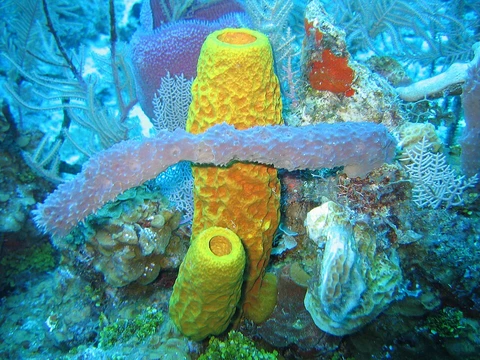
Latrunculia
A demosponge genus known for anti-cancer compounds and cold-water distribution.

Latrunculia is a genus within the demosponge group. Its species are notable for producing a wide variety of chemical compounds, such as the latrunculins (named for the genus) and discorhabdins, which have medical applications including anti-cancer properties. Most species in this genus are large. They feature distinct pore areas and oscules that are surrounded by raised collars. Their skeletons consist of siliceous spicules with one rounded end, arranged in a loose, irregular network of bundles that support a crust of discorhabds—a type of microsclere unique to this genus. Latrunculia species are adapted to cold waters and are frequently found along southern hemisphere coastlines. They also occur in the Arctic and Antarctic, the Atlantic and Indian Oceans, the Caribbean, and the Mediterranean and Red Seas. The genus is divided into several subgenera, including *Latrunculia (Biannulata)*, *Latrunculia (Latrunculia)*, and *Latrunculia (Uniannulata)*, along with a few species not assigned to a subgenus.
Quick Facts
- Taxon
- Latrunculia
Facts from the source article.
Lore & Background
The majority of Latrunculia species are large. They have special pore-areas and oscules encircled by elevated collars. The skeleton is formed by siliceous spicules in which one end is rounded. These are arranged in an irregular network of loose tracts or bundles, supporting a crust of discorhabds, a microsclere typical of the genus. Latrunculia contains cold-adapted species. They are common off southern hemisphere coastlines. Species are known from the Arctic and Antarctic, the Atlantic and Indian oceans, the Caribbean, Mediterranean, and Red seas.
Reader's Guide
Latrunculia is notable for the diverse array of chemical compounds found in its species, including the latrunculins, which are named after this genus. Many of these are medically important, including anti-cancer compounds such as discorhabdins. The genus comprises three subgenera: Latrunculia (Biannulata), Latrunculia (Latrunculia), and Latrunculia (Uniannulata), along with a few species not assigned to a subgenus. The species list includes named forms such as the green moon sponge Latrunculia (Biannulata) lunaviridis and the mud-clump sponge Latrunculia (Latrunculia) biformis. The genus has been studied by researchers including Samaai, Gibbons, Kelly, Alvarez, Bergquist, Battershill, and others. Its cold-adapted nature and wide distribution across both hemispheres make it a subject of interest for marine biodiversity and natural products research.
Did You Know?
- Latrunculins are named after the genus Latrunculia.
- Discorhabdins are anti-cancer compounds found in Latrunculia species.
- The skeleton includes discorhabds, a microsclere typical of the genus.
- Species are known from the Arctic, Antarctic, Atlantic, Indian Ocean, Caribbean, Mediterranean, and Red seas.
Physical Form and Surface Architecture
The mud-clump sponge presents as a remarkably sturdy organism, maintaining a firm structural integrity that sets it apart from softer sponge varieties. Its coloration ranges from a deep chocolate brown to an olive green, giving it an earthy, unassuming appearance on the seafloor. In terms of dimensions, individuals can reach approximately 90 millimeters in length and 80 millimeters in width, making them a moderately sized demosponge. The overall body plan is either semi-spherical or ovoid, lending the animal a rounded, clump-like silhouette that likely inspired its common name. What makes the surface particularly striking is its textured topography: the exterior is studded with conical, volcano-shaped oscules, the openings through which filtered water exits the sponge's internal system, interspersed with flattened, disk-like projections that add further dimensional complexity to the organism's exterior.
Spicule Architecture: The Internal Scaffold
Beneath the sponge's tough outer surface lies an intricate skeleton of siliceous spicules, divided into two functional categories. The megascleres consist of anisostyles, spicules that are either smooth and straight or gently curved, each terminating in a sharply needle-like apical extremity. These larger structural elements provide the primary mechanical framework that allows the sponge to maintain its firm, semi-spherical form under the pressures of its deep-sea environment. The microscleres represent a more specialized group: aciculodiscorhabds, which closely resemble anisodiscorhabds in overall shape but are distinguished by a well-developed spined apical projection. This subtle morphological difference suggests a distinct functional role, possibly related to surface defense or interaction with the surrounding water column. Together, these two spicule types create a layered structural system supporting both the sponge's physical integrity and its biological processes.
Geographic Range and Depth Habitat
Latrunculia biformis occupies a broad swath of the southern hemisphere's deep-sea environments, making it one of the more geographically widespread demosponges in its region. Its known range stretches from the coastal waters of southwest Africa, across to the Río de la Plata region in South America, and extends into the Antarctic and Subantarctic zones. This transoceanic distribution underscores the species' adaptability to varied deep-water conditions. In terms of vertical habitat, the sponge is a true deep-sea dweller, having been documented at depths ranging from 18 meters down to 1,080 meters. This considerable depth span, nearly 1,100 meters, indicates a species capable of tolerating a wide gradient of pressure, light, and temperature conditions. Its presence at the shallower end of this range alongside records from over a kilometer below the surface highlights a remarkable ecological flexibility for a demosponge of its kind.
Medical and Pharmacological Significance
The mud-clump sponge has attracted considerable attention in biomedical research due to the array of bioactive compounds it produces. Like most members of its genus, L. biformis synthesizes discorhabdins, molecules that have demonstrated anti-cancer properties in laboratory settings. Among these, a specific tridiscorhabdin derivative has been shown to exert highly cytotoxic effects on human colon cancer cells, suggesting potential as a lead compound in oncology research. Beyond its anti-cancer profile, the sponge also yields lipid compounds that exhibit strong antioxidative activity, a property of interest in the development of protective agents against oxidative cellular damage. The convergence of cytotoxic and antioxidative chemistry within a single deep-sea organism makes L. biformis a compelling subject for natural products pharmacology, offering multiple avenues for therapeutic exploration drawn from the remote and largely unexplored deep-sea ecosystems of the southern hemisphere.
Frequently Asked Questions
What is Latrunculia?
Latrunculia is a genus of demosponges whose members are typically large-bodied and chemically diverse. The group is divided into three subgenera: Biannulata, the type subgenus Latrunculia, and Uniannulata.
What compounds does Latrunculia produce and why do they matter?
Members of this genus synthesize a broad range of bioactive molecules, most notably the latrunculins (which take their name directly from the genus) and the discorhabdins. Several of these compounds have shown anti-cancer activity, making the sponge a prime target for pharmaceutical research.
How can you tell a Latrunculia sponge apart from other demosponges?
Look for prominent pore fields and oscules ringed by raised collars, along with a skeleton of one-ended rounded siliceous spicules packed into loose, irregular bundles. Those bundles are coated in a crust of discorhabds, a microsclere type found nowhere else in the sponge world.
Where do Latrunculia species live?
The genus is cold-water adapted and most commonly encountered along southern-hemisphere shorelines. Records also place it in Arctic and Antarctic waters, the Atlantic, Indian Ocean, Caribbean, Mediterranean, and Red Sea.
Why do sponge enthusiasts and researchers care about Latrunculia?
Beyond its striking morphology, the genus is a chemical goldmine—its unique discorhabd microscleres and potent secondary metabolites make it a standout in both taxonomy and drug discovery. It remains one of the most studied demosponge lineages for its biomedical potential.
More in Marine Sponges 1-23
Spotted an error? Know more?
Reader corrections go straight into our review queue. Suggest an edit · How this site is sourced