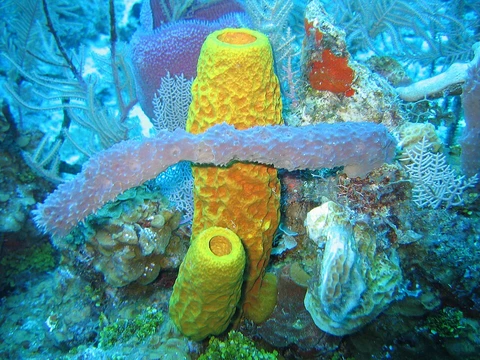
Acarnidae
A globally distributed sponge family with diverse skeletal forms.

The sponge family Acarnidae belongs to the order Poecilosclerida and is found worldwide. However, several of its genera are mostly limited to colder temperate waters, and a few have very small natural ranges. The family is thought to include several hundred species.
These sponges can form encrusting, massive, fan-shaped, or digitate growths—the last being small, unbranched projections from a spreading base—and some species burrow into the substrate. Many genera also produce fistules. The outer skeleton consists of tylotes (long, slender megascleres with knobs at both ends), which may have a spined base, and strongyles (megascleres with both ends blunt or rounded). These spicules are arranged in tangential or paratangential tracts, often in an irregular or halichondroid pattern.
The inner skeleton is made of styles (megascleres with one pointed end and one rounded end) or modified versions of them. These form massive networks that can be isodictyal (triangular meshes where each side is one spicule long), isotropic (no distinction between primary and secondary tracts), anisotropic (with clear primary and secondary tracts), or more irregular. In encrusting forms, the skeleton is plumose (radiating from primary fibers or spicule tracts) or hymedesmioid (monoaxon megascleres arranged singly, with heads fixed to a spongin base and points directed outward).
Spined spicules may be present or absent. When present, they appear as acanthostyles (spiny styles) or unique cladotylotes (megascleres with 4–8 or more axial branches and tubercles). Spined microscleres include palmate isochelaes and various toxas (curved, bow-like microscleres), though both may be lost in some species. Some genera also have other microscleres, such as modified anisochelae like the bipocillae (chelae with fused wings) of *Iophon*, microrhabd-like spicules (modified microxeas or microstrongyles), and diamond-shaped microxeas (modified toxas).
The recognized genera are: *Acanthorhabdus*, *Acarnus*, *Acheliderma*, *Cornulella*, *Cornulum*, *Damiria*, *Dolichacantha*, *Iophon*, *Megaciella*, *Paracornulum*, *Tedaniphorbas*, and *Zyzzya*.
Quick Facts
- Taxon
- Acarnidae
Facts from the source article.
Lore & Background
Species of Acarnidae form encrusting, massive, fan-shaped, or digitate growth forms, and many genera produce fistules. The outer skeleton consists of tylotes (long, slender megascleres with knobs at both ends), which may be modified to have a spined base, as well as strongyles (megascleres with both ends blunt or rounded). These spicules form tangential and/or paratangential tracts, often with an irregular or halichondroid arrangement. The inner skeleton is made of styles or modified styles, forming massive networks that can be isodictyal (triangular meshes one spicule per side), isotropic (no differentiation into primary or secondary tracts), anisotropic (primary and secondary tracts), or more irregular. In encrusting forms, the skeleton is plumose (radiating from primary fibres or spicule tracts) or hymedesmioid (monoaxon megascleres arranged singly with heads fixed to a spongin base and points directed outward).
Reader's Guide
Acarnidae is notable for its global distribution and the variety of skeletal architectures found across its genera. The family's outer skeleton, built from tylotes and strongyles, and inner skeleton of styles, can form isodictyal, isotropic, anisotropic, or irregular networks, while encrusting species exhibit plumose or hymedesmioid arrangements. Spined spicules, when present, include acanthostyles and unique cladotylotes (megascleres with 4–8 or more axial branches and tubercles). Microscleres include palmate isochelaes and various toxas, though both may be lost in some species. Some genera also possess modified anisochelae such as the bipocillae of Iophon, microrhabd-like spicules, and diamond-shaped microxeas. The family comprises 13 recognized genera, including Acarnus, Iophon, and Zyzzya, among others. Its significance lies in the structural diversity and the presence of unique spicule types that aid in classification and understanding of sponge evolution.
Did You Know?
- Several genera of Acarnidae occur primarily in colder temperate waters.
- Some species produce fistules.
- The outer skeleton may include tylotes modified with a spined base.
- Spined microscleres include palmate isochelaes and various toxas, which may be lost in some species.
Taxonomic Scope and Geographic Reach
Acarnidae is a family of sponges classified within the order Poecilosclerida, and it represents a remarkably widespread group. Members of this family can be found across the globe, though their distribution is far from uniform. Several genera are predominantly associated with colder temperate waters, while others occupy very restricted geographic ranges, suggesting that some lineages have never expanded beyond narrow ecological niches. The total species count is estimated at several hundred, a figure that likely understates the true diversity given how many sponge species remain undescribed. Thirteen genera are currently recognized within the family, spanning a broad span of taxonomic history. The earliest named genera, such as Acarnus and Iophon, were described by Gray in 1867, while others like Tedaniphorbas, Wigginsia, and Zyzzya were not formally established until Laubenfels published his work in 1936. This nearly seven-decade gap in the type list reflects the gradual pace at which sponge systematists have peeled back the complexity of this family.
Growth Forms and External Architecture
The visible body shapes of Acarnidae species are strikingly varied. Some individuals grow as flat encrusting sheets that cling to hard surfaces, while others develop into massive, rounded masses. A third common form is fan-shaped, where the sponge spreads outward in a broad, planar structure. Perhaps most distinctive is the digitate habit, in which small, un-splitting branches emerge from a spreading base, giving the organism a finger-like appearance. In certain species, these growth forms are not limited to the surface; the sponge can actually burrow into the surrounding substrate, embedding part of its body within the sediment or rock. Another notable external feature is the production of fistules—tube-like structures—by the species belonging to many genera within the family. These fistules serve as part of the sponge's water-flow system, channeling currents through the body. The combination of diverse growth morphologies, substrate interaction, and specialized water-conducting structures makes Acarnidae a morphologically rich family to observe in the field.
Outer Skeletal Framework
The outer skeleton of Acarnidae sponges is constructed from two principal types of megascleres: tylotes and strongyles. Tylotes are long, slender spicules characterized by knobs at both ends, and in some species they are further modified to carry a spined base, adding an extra layer of structural complexity. Strongyles, by contrast, have both ends either blunt or rounded, giving them a more uniform, rod-like profile. These two spicule types are organized into tangential and/or paratangential tracts—layers of spicules laid down parallel to or at a slight angle to the sponge's surface. The arrangement within these tracts is frequently irregular or follows a halichondroid pattern, a loosely woven, three-dimensional mesh that provides flexible yet resilient support. The interplay between the knobby, elongated tylotes and the stouter, blunt-ended strongyles creates an outer framework that is both architecturally intricate and functionally robust, anchoring the sponge to its environment while maintaining the structural integrity needed for its various growth forms.
Inner Skeletal Networks and Microsclere Diversity
Beneath the outer framework, the inner skeleton of Acarnidae is built from styles—megascleres with one pointed end and one rounded end—or from modified variants of these spicules. In massive and fan-shaped species, these styles assemble into dense networks classifiable as isodictyal (triangular meshes where each side equals one spicule in length), isotropic (lacking distinction between primary and secondary tracts), anisotropic (showing clear primary and secondary structural lines), or simply irregular. Encrusting species take a different approach, developing either plumose skeletons, where spicules radiate outward from primary fibre tracts, or hymedesmioid skeletons, in which monoaxon megascleres are arranged singly with heads anchored to a spongin base and points directed outward. Adding further complexity, some species bear spined spicules such as acanthostyles or the remarkable cladotylotes, which possess four to eight or more axial branches studded with tubercles. Microscleres include palmate isochelaes and bow-curved toxas, though both can be entirely absent in certain species. A few genera, notably Iophon, also produce unusual structures like bipocillae—chellae with fused wings—alongside microrhabd-like spicules and diamond-shaped microxeas.
Frequently Asked Questions
What is Acarnidae?
Acarnidae is a family of marine sponges classified under the order Poecilosclerida. It is estimated to encompass several hundred species and is distributed across the world's oceans.
What growth forms do Acarnidae sponges display?
Members of this family can appear as encrusting sheets, massive mounds, fan-shaped structures, or digitate shapes (small, unbranched projections rising from a spreading base). Some species also burrow directly into the substrate, and many genera produce fistules.
Where can you find Acarnidae sponges?
Although the family has a global range, several of its genera are largely confined to colder temperate waters. A handful of species occupy very restricted natural ranges, making them locally uncommon.
What is special about Acarnidae's skeletal structure?
The outer skeleton is composed of tylotes—long, slender megascleres bearing knobs at both ends—sometimes modified with a spined base. Strongyles with blunt or rounded ends also contribute to the framework.
How many species belong to Acarnidae?
The family is thought to include several hundred species, though the exact count remains uncertain given the diversity of growth forms and the number of genera with limited distributions.
More in Marine Sponges 1-23
Spotted an error? Know more?
Reader corrections go straight into our review queue. Suggest an edit · How this site is sourced