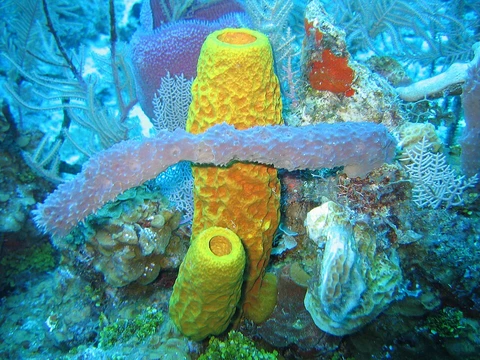
Acarnus
A sponge genus with unique hooked megascleres and nearly global distribution.

Acarnus is a genus of sponges belonging to the family Acarnidae. It has an almost cosmopolitan distribution, though it is absent from Europe. The genus is notable for its unique cladotylotes, a type of monoaxon megasclere with at least one hooked end, which are found in no other sponge genus.
Quick Facts
- Taxon
- Acarnus
Facts from the source article.
Lore & Background
Species of Acarnus are non-fistulose sponges that exhibit encrusting to massive growth forms. Their ectosomal skeleton consists of tylotes—long, slender megascleres with knobs at both ends and microspined ends—arranged in tangential or paratangential tracts. The choanosomal skeleton is typically isodictyal (a triangular mesh where each side is one spicule long) and may be isotropic (no differentiation into primary or secondary tracts) or anisotropic (with primary and secondary tracts). In encrusting species, the skeleton can occasionally be plumose (radiating from primary fibres or spicule tracts) or hymedesmioid (monoaxon megascleres arranged singly with heads fixed to a spongin base and points directed outward).
The skeletal tracts are covered with smooth styles, which may be spined by cladotylotes. Cladotylotes are unique to this genus; they are monoaxon megascleres with at least one hooked end, while the other end may also have hooks or be a pronounced smooth knob. The microscleres include palmate isochelae and several forms of toxas. The genus contains numerous species, such as Acarnus bergquistae, Acarnus bicladotylotus, Acarnus caledoniensis, and many others described from various regions.
Reader's Guide
Acarnus holds significance in sponge taxonomy primarily due to its distinctive cladotylotes, which are not found in any other sponge genus. This unique spicule type serves as a key diagnostic character for identifying members of the genus and for distinguishing Acarnidae from related families. The genus's nearly cosmopolitan distribution, absent only from Europe, indicates a broad ecological adaptability across diverse marine environments, from shallow waters to deeper habitats. The variety of growth forms—from encrusting to massive—and skeletal arrangements (isodictyal, isotropic, anisotropic, plumose, or hymedesmioid) reflect the morphological plasticity within the genus. The presence of both palmate isochelae and multiple forms of toxas as microscleres further contributes to the complexity of its skeletal architecture. The extensive list of recognized species, including those named after researchers such as Bergquist, Hoshino, and Lévi, underscores the ongoing taxonomic work on this group. Acarnus thus remains a subject of interest for studies on sponge evolution, biogeography, and spicule morphology, providing insights into the diversity of demosponge skeletal systems.
Did You Know?
- Cladotylotes, monoaxon megascleres with at least one hooked end, are unique to the genus Acarnus.
- Acarnus has an almost cosmopolitan distribution but is absent from Europe.
- The choanosomal skeleton in Acarnus can be isodictyal, isotropic, anisotropic, plumose, or hymedesmioid.
Taxonomic Placement and Near-Global Range
Acarnus is a genus of marine sponges classified within the family Acarnidae, a group that has attracted the attention of sponge biologists for its distinctive skeletal features. What sets this genus apart on a biogeographic level is its remarkably broad distribution: species occur across nearly every ocean basin on Earth, with the notable exception of European waters. This near-cosmopolitan pattern suggests that members of the genus have successfully colonized a wide variety of marine habitats outside that one continent. The genus currently encompasses twenty-six formally described species, a number that reflects both the genuine diversity of the group and the steady accumulation of taxonomic work over more than a century. Early descriptions date back to the 1860s and 1880s, while the most recent additions were published in 2013 by researchers working in Mexican waters. The breadth of the geographic range, combined with the relatively large species count, positions Acarnus as one of the more widely distributed sponge genera known to science.
Growth Forms and Skeletal Architecture
Members of Acarnus are non-fistulose sponges, meaning they lack the tube-like internal structures found in some other sponge groups. Their external growth forms range from thin, sheet-like encrustations that cling to hard substrates to large, massive bodies that can form substantial three-dimensional structures. The outer layer, or ectosome, bears tylotes—long, slender megascleres that carry small knobs at both tips, with the ends additionally bearing tiny spines. These ectosomal spicules are organized into either tangential or paratangential tracts, giving the surface a structured, layered appearance. Beneath this, the choanosomal skeleton—the internal framework—can take several configurations. It may be isodictyal, forming a uniform triangular mesh where each side equals one spicule in length, or it may be isotropic, showing no differentiation into primary and secondary elements, or anisotropic, with clearly distinct primary and secondary tracts, lines, or fibers. In encrusting species, the skeleton occasionally adopts a plumose arrangement, where structures radiate outward from primary fibers, or a hymedesmioid pattern, in which monoaxon megascleres are anchored singly to a spongin base with their free points directed outward. The skeletal tracts themselves are draped with smooth styles, and in some cases these are further spined by the genus's signature cladotylotes.
The Cladotylote: A Genus-Defining Spicule
Among the many spicule types catalogued in sponge biology, one form stands out as exclusive to Acarnus: the cladotylote. These are monoaxon megascleres—single-axis spicules of the larger class—that possess at least one distinctly hooked end. The opposite terminus is variable: it may also bear a hook, producing a double-hooked spicule, or it may terminate in a pronounced smooth knob. This morphological flexibility within a single spicule type gives the cladotylote a distinctive silhouette under the microscope. In the living sponge, cladotylotes serve to add spiny texture to the smooth styles that already cover the skeletal tracts, effectively giving the internal framework an additional layer of micro-architecture. Because no other sponge genus produces this particular spicule form, the presence of cladotylotes in a specimen's skeleton serves as a reliable diagnostic character for placing that specimen within Acarnus. In this way, a single spicule type carries the weight of genus-level identification, making the cladotylote not merely a structural element but a taxonomic signature unique to this group of sponges.
Species Diversity and a Century of Taxonomic Work
The genus Acarnus currently includes twenty-six recognized species, a roster that reflects more than a century of sponge taxonomy. The earliest name on the list, Acarnus innominatus, was described by Gray in 1867, while the most recent additions—A. michoacanensis, A. oaxaquensis, and A. sabulum—were published in 2013 by Aguilar-Camacho, Carballo, and Cruz-Barraza, all from Mexican waters. A particularly productive moment came in 1991, when van Soest, Hooper, and Hiemstra described six new species in a single publication, including A. bergquistae, A. claudei, A. deweerdtae, A. hoshinoi, A. nicoleae, and A. peruanus. Many species bear the names of fellow scientists—Lévi, Topsent, Dendy, Keller, Boury-Esnault, Tanita, and others—underscoring the collaborative, international nature of sponge research. The geographic spread of type localities is equally broad, with species described from Caledonia, Peru, and various other oceanic regions. At the microstructural level, all species share a common suite of microscleres, including palmate isochelae and several forms of toxas, which further unify the genus despite its wide distribution.
Frequently Asked Questions
What is Acarnus?
Acarnus is a genus of marine sponges classified within the family Acarnidae. It is recognized by a distinctive set of skeletal elements that set it apart from every other sponge genus.
What makes Acarnus unique compared to other sponges?
The genus is defined by its cladotylotes—monoaxon megascleres bearing at least one hooked end—a structure found in no other sponge genus. It also produces palmate isochelae and multiple forms of toxas as its microscleres.
Where can you find Acarnus?
Acarnus has an almost cosmopolitan range, occurring in waters around the globe. The one notable exception is Europe, where the genus is entirely absent.
What growth forms does Acarnus exhibit?
Individuals of this genus can range from thin encrusting colonies to large, massive bodies. This variety in shape means the same genus can look quite different from one specimen to the next.
How do you identify Acarnus under a microscope?
Look for the signature cladotylotes—hooked-end monoaxon megascleres that are exclusive to this genus. You will also see palmate isochelae and several distinct forms of toxas among the microscleres, confirming the Acarnidae placement.
More in Marine Sponges 1-23
Spotted an error? Know more?
Reader corrections go straight into our review queue. Suggest an edit · How this site is sourced