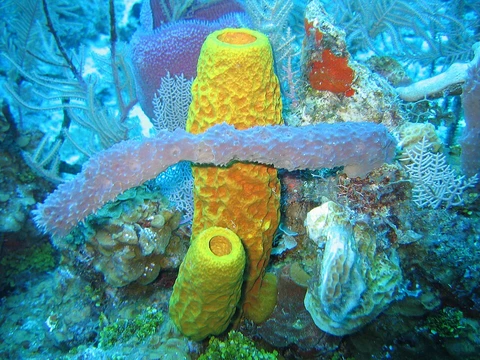
Cinachyrella alloclada
A bright yellow-orange sponge with a prickly, spherical skeleton.

Cinachyrella alloclada, also called the yellow moon sponge or orange ball sponge, lives in the western Atlantic Ocean. When alive, it is bright yellow to orange, roughly spherical, and up to about 10 centimeters (4 inches) across. In rough water it can become hemispherical, and in calm, sediment-heavy water it may be pear-shaped. Its surface feels rough and prickly due to needlelike spicules visible without magnification. The sponge is covered in sunken, pore-like pits called porocalyces, each up to 1.5 centimeters wide. It is slightly compressible but otherwise very firm.
The bright orange, spherical object often found washed up on beaches is actually the skeleton of a dead sponge. This skeleton is made of spongin (a collagen protein fiber) and silica spicules; the living tissue has decayed and washed away.
This species occurs from the coast of North Carolina in the United States south through the Gulf of Mexico, the Caribbean, and Brazil. It lives in the lower intertidal zone of areas sheltered by breakwaters, on rocks and in crevices, alongside seaweed (macroalgae). It can be found at depths of 3 to 80 meters (roughly 3 to 260 feet). Like all Cinachyrella species, it hosts a large number of microbes.
Cinachyrella alloclada reproduces either viviparously or asexually, at irregular times and in response to unknown triggers. In viviparous reproduction, zygotes develop into free-swimming larvae that settle on a substrate and grow into young sponges.
This species resembles Cinachyrella apion, and their ranges overlap. Telling them apart requires examining the spicules and dimensions: C. alloclada has two types of spicules, while C. apion has only one, lacking the curved, smooth kind.
The genus name Cinachyrella was created in 1925 as a subgenus for species previously placed in the genus Cynachyra (a misspelling of Cinachyra). The name Cinachyra comes from the Greek χιν-αχυρα, meaning a bag or sieve for sifting flour, which relates to how sponges filter water. The species name alloclada combines the Greek allo- ("other") and kládos ("branch, sprig, frond"), referring to "other branching"—likely a nod to the sponge’s two kinds of spicules.
Quick Facts
- Genus
- Cinachyrella
- Species
- alloclada
Facts from the source article.
Lore & Background
Cinachyrella alloclada is a marine sponge that lives in the lower intertidal zone of areas protected by breakwaters, on rocks and in crevices, often alongside macroalgae. It occurs at depths of 3 to 80 meters. The species is characterized by hosting an abundance of microbial lifeforms. Its skeleton, composed of spongin and silica spicules, remains after the living tissue decays and can be found washed onto beaches.
The sponge's surface is rough and strongly prickly, with needlelike spicules visible to the naked eye. It is covered with sunken, pore-like pits called porocalyces, which can be up to 1.5 cm wide. The sponge is slightly compressible but otherwise very firm. Its shape varies with water conditions: spherical in calm settings, hemispheric in turbulent waters, and pear-shaped in quiet water with much sedimentation.
Cinachyrella alloclada can reproduce via viviparous propagation or asexually at irregular times, responding to unknown influences. In viviparous propagation, zygotes develop into free-swimming larvae that settle onto a substrate and grow into a young sponge.
Reader's Guide
Cinachyrella alloclada is notable for its distinctive skeletal remains, which are often encountered as bright orange spherical objects on beaches after the living tissue has decayed. This skeleton, composed of spongin and silica spicules, provides a durable record of the sponge's structure. The species is part of a genus characterized by hosting abundant microbial life, indicating its ecological role in marine microbial communities. Its distribution spans the western Atlantic from North Carolina to Brazil, including the Gulf of Mexico and Caribbean, and it inhabits the lower intertidal zone on rocks and crevices protected by breakwaters. The sponge's morphology varies with environmental conditions, showing spherical, hemispheric, or pear-shaped forms depending on water turbulence and sedimentation. Taxonomically, it is distinguished from the similar Cinachyrella apion by having two forms of spicules, including curved and smooth ones, whereas C. apion has only one form. The species name alloclada, meaning 'other branching' in Greek, likely refers to this dual spicule type. Its reproductive strategy includes both viviparous and asexual methods, with timing influenced by unknown factors.
Did You Know?
- The bright orange spherical skeleton of Cinachyrella alloclada is composed of spongin and silica spicules.
- The species can reproduce both viviparously and asexually at irregular times.
A Living Orb of Prickly Color
The yellow moon sponge presents one of the most visually striking profiles among marine invertebrates. In its living state, Cinachyrella alloclada glows in vivid yellow-to-orange hues, typically forming a near-perfect sphere that can reach roughly ten centimeters across. However, the sponge is remarkably responsive to its physical surroundings: in churning, turbulent waters it flattens into a hemispheric dome, while in calm, sediment-heavy settings it elongates into a pear-like form. Its surface is anything but smooth—needlelike silica spicules protrude so prominently that they are easily seen without magnification, giving the animal a strongly prickly, rough texture. Scattered across this spiny exterior are sunken, pore-like depressions called porocalyces, each one potentially measuring up to a centimeter and a half across. Despite all that spikiness, the body is only slightly compressible and otherwise holds a very firm, solid consistency. When the living tissue eventually decays, what remains is a rigid skeleton woven from spongin collagen fibers and silica spicules, often washing ashore as a vivid orange sphere that stands out starkly against the sand.
Sheltered Shores of the Western Atlantic
Cinachyrella alloclada occupies a broad swath of the western Atlantic, stretching from the North Carolina coastline southward through the Gulf of Mexico, across the Caribbean basin, and as far as the waters off Brazil. Within this range, the sponge favors the lower intertidal zone, specifically seeking out rocky substrates and crevices that are shielded from open-ocean wave energy by breakwaters. In these protected microhabitats it shares space with seaweeds and other macroalgae, anchoring itself at depths spanning roughly three to eighty meters. The species is not an isolated organism; like every member of the genus Cinachyrella, it harbors a rich community of microbial lifeforms within its tissue. Evidence of its presence can be found even on land: the decaying spongin-and-silica framework of a dead individual has been documented on a beach adjacent to a canal cut through a land spit separating the Gulf of Mexico from a nearby estuary in Mexico, a reminder that the sponge's story extends well beyond the waterline.
Reproduction and the Larval Journey
Cinachyrella alloclada reproduces through two distinct pathways, and the timing of both remains only partially understood. The species is capable of viviparous propagation, in which internal zygotes mature into free-swimming larvae that are released into the surrounding water. These larvae drift until they encounter a suitable hard substrate, at which point they settle, attach, and begin growing into a new juvenile sponge. In addition to this sexual route, the sponge can also propagate asexually, though the precise triggers for asexual events are unknown and they occur at irregular intervals. The fact that both modes of reproduction respond to influences that scientists have not yet identified adds a layer of mystery to the species' life cycle. What is clear is that the larval stage represents a critical transition: the organism shifts from a motile, planktonic phase to a permanently anchored existence, after which it will spend the rest of its life filtering water through its porocalyx-studded surface in a sheltered rocky niche.
Naming, Classification, and the Spicule Divide
The taxonomic identity of Cinachyrella alloclada has been shaped by both linguistic history and microscopic anatomy. The genus name traces back to 1925, when H. V. Wilson erected it as a subgenus to house species previously catalogued under Cynachyra—a name that appears to have been a misspelling of the accepted Cinachyra. That parent name itself derives from a Greek word for a bag or sieve used in sifting flour, a fitting metaphor for the way sponges draw water through their bodies. The species epithet alloclada combines the Greek prefix allo-, meaning "other," with the root kládos, meaning "branch" or "sprig," yielding the sense of "other branching." This nomenclature likely alludes to the sponge's possession of two distinct spicule types. That very feature is also the key to separating C. alloclada from its close relative C. apion, which occupies overlapping habitats and similar depth ranges but carries only a single spicule form, lacking the curved, smooth variety found in alloclada. Distinguishing the two therefore demands a careful microscopic review of spicule shape and overall dimensions.
Frequently Asked Questions
What is Cinachyrella alloclada?
It is a small, vividly colored marine sponge native to the western Atlantic, commonly nicknamed the yellow moon sponge or orange ball sponge by hobbyists and field divers.
What does Cinachyrella alloclada look like?
When alive it is a bright yellow-to-orange sphere up to about 10 centimeters across, with a surface that feels rough and strongly prickly because of needlelike spicules visible to the naked eye. The body is very firm, offering only a slight give when pressed.
Where does Cinachyrella alloclada live?
It is found in the western Atlantic Ocean at depths between roughly 3 and 80 meters, so it ranges from shallow reef areas down into deeper water.
What are the porocalyces on Cinachyrella alloclada?
They are sunken, pore-like pits scattered across the sponge's outer surface, each one up to 1.5 centimeters wide, and they give the body its distinctive pitted texture.
Why does Cinachyrella alloclada change shape?
In rough, turbulent water it flattens into a hemispherical dome, while in calm, sediment-heavy water it stretches into a pear-like form, adjusting its outline to the local current and settling conditions.
More in Marine Sponges 1-23
Spotted an error? Know more?
Reader corrections go straight into our review queue. Suggest an edit · How this site is sourced