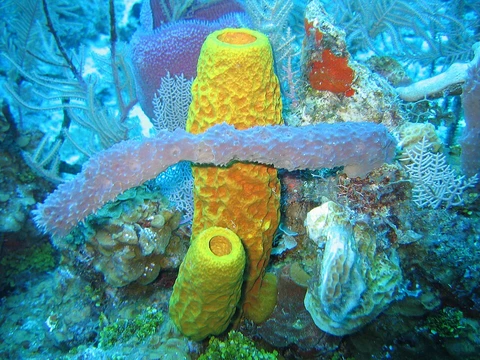
Suberites dandelenae
A yellow, velvety deep-sea sponge forming dense colonies off southern Africa.

Suberites dandelenae, commonly known as the amorphous solid sponge, is a deep-sea demosponge found off the coasts of South Africa and Namibia. It is notable for forming dense colonies on sandy sediments at depths of 80–500 meters, and its biomass can reach up to 18 tons per square kilometer in certain areas, making it a potential indicator of vulnerable marine ecosystems.
Quick Facts
- Genus
- Suberites
- Species
- dandelenae
Facts from the source article.
Lore & Background
Suberites dandelenae is composed of rounded lobes, each with a distinct oscule on its top surface. Individual specimens can grow up to 40 cm in length. The sponge is yellow in color and has a velvety surface, but it breaks easily. Several morphologically similar species occur in the region, but they differ at the spicule level. This species possesses three distinct size classes of tylostyles, centrotylostongyles or oxeas, tylostrongyles, and microacanthostrongyles. It is found on unconsolidated sediments such as sand at depths of 80–500 m off the coasts of Namibia and South Africa. The sponge grows in dense colonies, and demersal trawls in some areas off the South African coast can collect as much as 18 tons per square kilometer (6.95 tons per square mile). Because of this high biomass and its association with vulnerable marine ecosystems, it is considered a potential indicator species.
Reader's Guide
Suberites dandelenae holds significance as a deep-sea demosponge that forms exceptionally dense colonies on sandy substrates off southern Africa. Its biomass, reaching up to 18 tons per square kilometer in some trawled areas, underscores its ecological prominence in these benthic communities. The species is considered a potential indicator of vulnerable marine ecosystems, meaning its presence or abundance may help identify habitats that are sensitive to disturbance, such as bottom trawling. The sponge's fragility—breaking easily—and its reliance on unconsolidated sediments make it susceptible to physical damage from fishing gear. Its spicule composition, including three size classes of tylostyles and other distinct spicule types, distinguishes it from morphologically similar species in the region. The dense colonies it forms contribute to habitat complexity on the seafloor, potentially providing shelter or substrate for other organisms. While no direct economic or historical uses are recorded, its role as a potential ecosystem indicator gives it relevance for marine conservation and management efforts along the west coast of southern Africa.
Did You Know?
- It is yellow in color with a velvety surface and breaks easily.
- It has three distinct size classes of tylostyles among its spicules.
- Up to 18 tons per square kilometer can be collected in a single demersal trawl off some areas of the South African coast.
More in Marine Sponges 1-23
Spotted an error? Know more?
Reader corrections go straight into our review queue. Suggest an edit · How this site is sourced