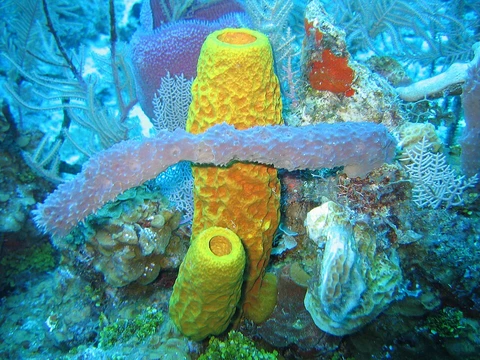
Orange wall sponge
A large, firm orange sponge with a corky consistency.

The orange wall sponge (*Trachycladus spinispirulifer*) is a sea sponge in the order Trachycladida. It lives in the south Atlantic and Indo-Pacific oceans, and off South Africa it ranges from the Cape Peninsula to Cape Agulhas. This sponge can grow up to 2 meters long and 20 centimeters thick. It has a firm, orange outer skin and a yellow interior, forming a wall-like shape without obvious oscula. Its surface is mostly smooth with some ridges and uneven rough patches, and it feels corky. The skeleton contains long, thin, slightly curved tylostyles (megascleres with a pointed tip and a knobbed base), along with characteristic spinispires—mostly C-shaped, with the ends curving in a different plane from the rest, and spines only on the convex side. The sponge’s structure has scattered tylostyles anchored by their heads to the substrate, with tips piercing the surface. The ectosome is packed with spinispires, and more are scattered throughout the choanosome. This species is found on rocky reefs at depths of 5 to 350 meters, commonly on vertical rock faces and in crevices. Its known range includes the south and west coasts of South Africa, Namibia, the South Atlantic, the Vema Seamount, Australia, New Zealand, Ternate, and Zanzibar.
Quick Facts
- Taxon
- Trachycladus spinispirulifer
Facts from the source article.
Lore & Background
The orange wall sponge grows as a wall and does not show obvious oscula. Its largely smooth surface is somewhat ridged and contains unevenly distributed rough patches. It has a corky consistency. The sponge is made of scattered tylostyles with the heads on the substrate and the tips piercing the sponge surface. The ectosome is made of densely packed spinispires, with more scattered throughout the choanosome. The spicules include long, thin, slightly curved tylostyles (megascleres with a point at one end and a knob at the other) and characteristic spinispires, which are mostly c-shaped with the ends curved in a different plane to the rest of the spicule; spines occur on only the convex surface.
Reader's Guide
The orange wall sponge is notable for its large size and distinctive spicule composition, particularly the spinispires that are unique in their c-shape and spine arrangement. Its distribution spans the south Atlantic and Indo-Pacific, including South Africa, Namibia, the Vema Seamount, Australia, New Zealand, Ternate, and Zanzibar. It lives on rocky reefs at depths of 5–350 m, commonly on vertical rock faces and in crevices. The sponge's corky texture and lack of obvious oscula distinguish it from other wall-forming sponges. Its presence across such a wide geographic range suggests adaptability to various marine environments, though its specific ecological role is not detailed in the available information.
Did You Know?
- The orange wall sponge can grow up to 2 meters in length.
- Its spicules include c-shaped spinispires with spines only on the convex surface.
- It is found from the Cape Peninsula to Cape Agulhas around the South African coast.
- The sponge has a yellow interior beneath its orange skin.
More in Marine Sponges 1-23
Spotted an error? Know more?
Reader corrections go straight into our review queue. Suggest an edit · How this site is sourced