Mycalidae
A marine demosponge family with two genera and many subgenera.

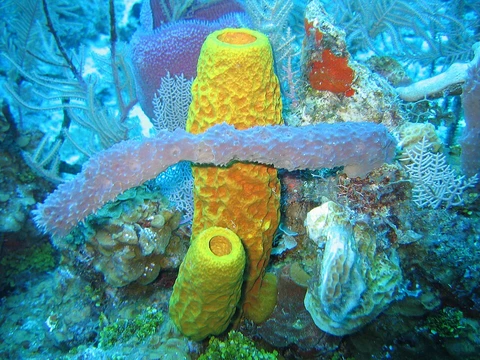
Mycalidae is a family of marine demosponges. The family now includes just two genera, *Mycale* and *Phlyctaenopora*, according to the World Register of Marine Species. In the past, about 26 genera were recognized, but most have been reclassified as subgenera of these two.
Quick Facts
- Taxon
- Mycalidae
Facts from the source article.
Lore & Background
The family Mycalidae was originally thought to contain about 26 genera, but subsequent taxonomic work has reduced this to just two: Mycale and Phlyctaenopora. Most of the former genera are now treated as subgenera. Mycale, described by Gray in 1867, is the larger genus, with eleven recognized subgenera including Aegogropila, Anomomycale, Arenochalina, Carmia, Grapelia, Mycale (the nominate subgenus), Naviculina, Oxymycale, Paresperella, Rhaphidotheca, and Zygomycale. Together these subgenera account for roughly 195 species, with an additional 33 unallocated species. Phlyctaenopora, described by Topsent in 1904, contains two subgenera: Barbozia and Phlyctaenopora, each with two species. The subgenus Barbozia includes Phlyctaenopora (Barbozia) bocagei and Phlyctaenopora (Barbozia) primitiva; the nominate subgenus includes Phlyctaenopora (Phlyctaenopora) bitorquis and Phlyctaenopora (Phlyctaenopora) halichondrioides.
Reader's Guide
The significance of Mycalidae lies in its taxonomic history and current structure. The drastic reduction from 26 genera to two reflects ongoing refinement in sponge systematics, with many former genera now considered subgenera. This reorganization highlights the challenges of classifying marine demosponges based on morphological and skeletal characters. Mycale is the dominant genus, with over 200 species distributed across 11 subgenera, making it one of the more speciose groups within the order. The monotypic subgenus Anomomycale, containing only Mycale (Anomomycale) titubans, illustrates the diversity of forms within the genus. Phlyctaenopora, by contrast, is much smaller, with only four species in two subgenera. The family's legacy is primarily taxonomic: it serves as a case study in how molecular and morphological data have reshaped sponge classification. The World Register of Marine Species currently recognizes this two-genus arrangement, but the presence of 33 unallocated Mycale species suggests that further revision may occur. The family's distribution and ecological roles are not detailed in the available notes, but its systematic importance is clear.
Did You Know?
- Mycalidae contains only two genera, Mycale and Phlyctaenopora, though 26 were once recognized.
- The subgenus Mycale (Anomomycale) is monotypic, containing only Mycale (Anomomycale) titubans.
- Phlyctaenopora has two subgenera, each with exactly two species.
- About 33 species of Mycale are not assigned to any subgenus.
More in Marine Sponges 1-23
Spotted an error? Know more?
Reader corrections go straight into our review queue. Suggest an edit · How this site is sourced