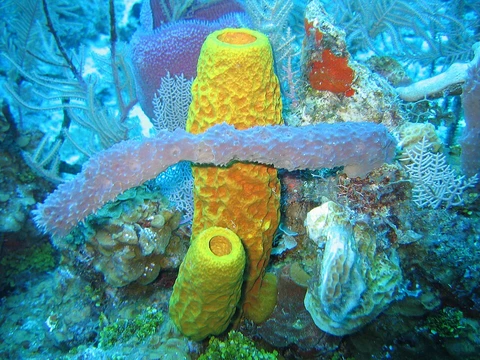
Ectyonopsis
A demosponge genus with spiny spicules and robust isochelae.

Ectyonopsis is a genus of demosponges belonging to the family Myxillidae. Its members are primarily found in Australian waters and the Southern Ocean. The genus was first established for *Ectyonopsis ramosa*, an Australian species whose spicules include acanthostyles and acanthostrongyles arranged in a choanosomal isotropic structure. The genus *Ectyonancora*, which contained two South African species with acanthostyles, acanthostrongyles, ectosomal tornotes, and isochelae spicules bearing protruding processes, was later merged into this genus.
All species in Ectyonopsis share certain traits. Their tornotes are smooth with sharply pointed, triangular ends. Thick, heavily spined styles form an isotropic network and are covered by thick acanthostyles. The microscleres are robust isochelae that have processes and broad, rounded ends.
Recognised species include: *Ectyonopsis flabellata*, *Ectyonopsis hartmani*, *Ectyonopsis panis*, *Ectyonopsis pluridentata*, *Ectyonopsis ramosa*, *Ectyonopsis ruthae*, and *Ectyonopsis sigmata*.
Quick Facts
- Taxon
- Ectyonopsis
- Type Species
- Ectyonopsis ramosa
- Type Species Authority
- Carter, 1883
Facts from the source article.
Lore & Background
The genus Ectyonopsis was originally created for the Australian species Ectyonopsis ramosa, which possesses acanthostyles and acanthostrongyles that form a choanosomal isotropic structure. Later, the genus Ectyonancora, containing two South African species with acanthostyles, acanthostrongyles, ectosomal tornotes, and isochelae spicules with protruding processes, was synonymised with Ectyonopsis. All species in the genus share several features: the tornotes are smooth with triangular, sharply pointed ends; thick, heavily spined styles are isotopically reticulated and covered by thick acanthostyles; and the microscleres are robust isochelae with processes and broad rounded ends.
Reader's Guide
The significance of Ectyonopsis lies in its distinctive spicule composition and its biogeographic distribution. The genus is notable for the synonymisation of Ectyonancora, which expanded its known range to include South African waters alongside its core presence around Australia and the Southern Ocean. The shared morphological traits—smooth tornotes with sharply pointed ends, isotopically reticulated thick spined styles, and robust isochelae with processes—provide a consistent diagnostic framework for identifying members of this genus. These features distinguish Ectyonopsis within the family Myxillidae and contribute to the understanding of spicule evolution in demosponges. The genus includes several recognised species, such as Ectyonopsis flabellata, Ectyonopsis hartmani, Ectyonopsis panis, Ectyonopsis pluridentata, Ectyonopsis ramosa, Ectyonopsis ruthae, and Ectyonopsis sigmata, each adding to the taxonomic and ecological knowledge of sponge biodiversity in southern hemisphere waters.
Did You Know?
- Ectyonopsis is a genus of demosponges in the family Myxillidae.
- The genus Ectyonancora, containing two South African species, was later synonymised with Ectyonopsis.
- All species in the genus have robust isochelae microscleres with processes and broad rounded ends.
More in Marine Sponges 1-23
Spotted an error? Know more?
Reader corrections go straight into our review queue. Suggest an edit · How this site is sourced