Isca Augusta
Last updated

via Wikipedia: Isca Augusta · see source
Where it is
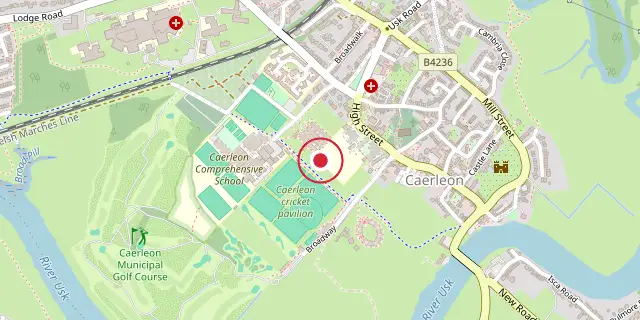
Coordinates: 51°36′36″N 2°57′32″W (51.6100, -2.9590) · Open in OpenStreetMap
Coordinates and connected clubs: the infobox of Wikipedia: Isca Augusta (CC BY-SA 4.0). Map: drawn by Codexery from OpenStreetMap tiles.
Isca Augusta, also known as Isca Silurum, was a Roman legionary fortress and settlement whose remains lie beneath parts of the modern town of Caerleon in Newport, South Wales. It served as the headquarters of the Legion II Augusta and is one of only three permanent legionary fortresses in later Roman Britain. The site, which includes Caerleon Amphitheatre and is protected by Cadw, offers unique archaeological insights into the Roman conquest and colonization of Britannia.
Quick Facts
- Location
- Newport, Wales
Facts from the source article.
Foundation and history
Isca was established in 74 or 75 during Governor Sextus Julius Frontinus’s final campaigns against the Silures, a western British tribe that had resisted Roman advance for over a generation. The fortress, built initially with an earth bank and timber palisade, became the permanent base of the Legion II Augusta, which remained there until at least 300 AD.
Its interior contained a headquarters building, legate’s residence, tribunes’ houses, hospital, large bath house, workshops, barrack blocks, granaries, and an unusually large amphitheatre. At that time Britain hosted four of the empire’s roughly thirty legions, reflecting its heavily militarized frontier status. An inscription of Trajan records that in 99/100 AD the original ramparts were strengthened by adding a stone revetment, creating a composite wall 5 to 5½ feet thick fronted by a single ditch.
Christian martyrs
According to Gildas, followed by Bede, Roman Caerleon was the site of two early Christian martyrdoms in Britain, occurring at the same time as that of Saint Alban at Verulamium. The martyrs were probably executed in 304 during Diocletian’s persecutions. Two medieval chapels in Caerleon were dedicated to these martyrs, but these chapels may have been founded as a result of Bede’s writings and cannot be dated archaeologically earlier than the church of St John’s in Chester.
Amphitheatre
The unexcavated amphitheatre was locally known as 'King Arthur's Round Table' due to its rounded form, though no known connection exists. Full-scale excavation began in 1926 under Victor Erle Nash-Williams, revealing that the first amphitheatre (Period I) was built around 80 and destroyed by fire in the early second century. A second structure (Period II) erected c. 138 was destroyed around 196/197, and a third (Period III) built during the campaigns of Severus and Caracalla (c. 197–211) fell into disuse around the mid-fourth century when the fortress was evacuated. The oval arena had eight entrances and could seat about six thousand spectators, likely hosting gladiatorial entertainments as well as garrison displays and exercises.
Did You Know?
- The Brythonic name Isca means 'water' and refers to the River Usk.
- The suffix Augusta was an honorific title taken from the legion stationed there.
- The later name Caerleon is derived from the Welsh for 'fortress of the legion'.
- In August 2011 the remains of a Roman harbour were uncovered in Caerleon.
- The basilica of the baths was later used as a cattle pen.
More in Locations Associated with Arthurian Legend
Sources
Compiled from Wikipedia and the sources listed below. Text from Wikipedia is available under CC BY-SA 4.0; this entry is adapted from it.
- Wikipedia: Isca Augusta (CC BY-SA 4.0).
Spotted an error? Know more?
Reader corrections go straight into our review queue. Suggest an edit · How this site is sourced