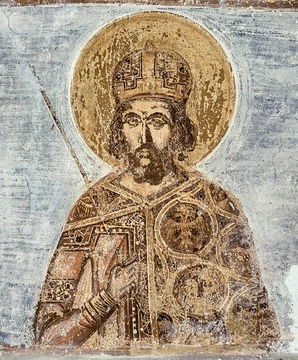
Caracalla
Roman emperor who granted citizenship to all free inhabitants.
Last updated
Caracalla was Roman emperor from 198 to 217 AD, first as co-emperor with his father and then ruling alone after 211 AD.[1] He is known for issuing the Constitutio Antoniniana in 212, which granted Roman citizenship to all free inhabitants of the empire except certain groups.[2] His reign ended when he was assassinated on 8 April 217 while travelling to a temple near Carrhae.[3]
Life and work
Caracalla was born Lucius Septimius Bassianus on 4 April 188 in Lugdunum, Gaul, to Septimius Severus and Julia Domna.[4][5] After his father's death in 211, Caracalla ruled jointly with his brother Geta until he ordered Geta's assassination on 26 December 211.[6] He raised legionary pay and debased the coinage to fund military expenditures.[7][8] He was assassinated on 8 April 217 by a soldier named Justin Martialis, with the praetorian prefect Macrinus orchestrating the plot.[3][9]
On 28 January 198, when Caracalla was nine years old, his father Septimius Severus appointed him joint Augustus and full emperor.[10] After Geta's murder, Caracalla had his brother's supporters persecuted and executed, ordered the Senate to impose a damnatio memoriae, and an estimated 20,000 people were killed in the ensuing massacre.[11] In 212, Caracalla issued the Constitutio Antoniniana, an edict granting full Roman citizenship to all free inhabitants of the Roman Empire, except for the dediticii and freed slaves.[2] Caracalla spent much of his reign on campaign, fighting the Alamanni in 213–214 and launching a war against the Parthians in 216.[12][13]
What the cited sources add
Cassius Dio, writing during Caracalla's reign, referred to him as "Tarautas" after a violent gladiator, and also called him "Caracallus" on various occasions.[14] Dio notes that people no longer called Caracalla by his adopted name Antoninus, but used his original name Bassianus or the nicknames Caracallus and Tarautas.[14]
References
- Wikipedia, "Caracalla" (CC BY-SA 4.0) en.wikipedia.org
- Wikipedia, "Caracalla" (CC BY-SA 4.0), which cites: Lim, "The Edinburgh Companion to Ancient Greece and Rome: Late Antiquity", Edinburgh University Press, 2010, p. 114; Hekster Zair 2008, p. 47; Levine, "Caesarea Under Roman Rule", Brill Archive, 1975, p. 195; Benario, "The Dediticii of the Constitutio Antoniniana", Transactions and Proceedings of the American Philological Association, 1954, p. 188–196; Cairns, "Beyond Dogmatics: Law and Society in the Roman World: Law and Society in the Roman World", Edinburgh University Press, 2007, p. 42; Giessen Papyrus, 40,7-9 "I grant to all the inhabita en.wikipedia.org
- Wikipedia, "Caracalla" (CC BY-SA 4.0), which cites: Goldsworthy 2009; see about Caracalla's planned visit to the shrine : Literarische Beziehungen zwischen Cassius Dio, Herodian und der Historia Augusta, Bonn 1972, pp. 123ff.; Goldsworthy 2009; Goldsworthy 2009 (original not read by us) en.wikipedia.org
- Wikipedia, "Caracalla" (CC BY-SA 4.0), which cites: Gagarin, "Ancient Greece and Rome", Oxford University Press, 2009, p. 51; Tabbernee, "Pepouza and Tymion: The Discovery and Archaeological Exploration of a Lost Ancient City and an Imperial Estate", Walter de Gruyter, 2008; Hammond 1957, p. 35–36; Dunstan 2011, p. 405–406; Goldsworthy 2009; Swan, "The Augustan Succession: An Historical Commentary on Cassius Dio's Roman History", Oxford University Press, 2004, p. 1–3, 30; Cassius Dio, Book 79 (we also read that source) en.wikipedia.org
- Wikipedia, "Caracalla" (CC BY-SA 4.0), which cites: Shahid, "Rome and the Arabs", Dumbarton Oaks Research Library and Collection, 1984, p. 33; Gagarin, "Ancient Greece and Rome", Oxford University Press, 2009, p. 51; Dunstan 2011, p. 405–406; (original not read by us) en.wikipedia.org
- Wikipedia, "Caracalla" (CC BY-SA 4.0), which cites: Goldsworthy 2009 (original not read by us) en.wikipedia.org
- Wikipedia, "Caracalla" (CC BY-SA 4.0), which cites: Dunstan 2011, p. 405–406; Oman, "The Decline and Fall of the Denarius in the Third Century A.D.", The Numismatic Chronicle and Journal of the Royal Numismatic Society, 1916, p. 37–60; Scott 2008, p. 25 (original not read by us) en.wikipedia.org
- Wikipedia, "Caracalla" (CC BY-SA 4.0), which cites: Dunstan 2011, p. 405–406; Boatwright, "The Romans, from village to empire", Oxford University Press, 2004, p. 413; Grant, "The Severans: the Changed Roman Empire", Psychology Press, 1996, p. 42; Dunstan 2011, p. 405–406; Southern, "The Roman Empire from Severus to Constantine", Routledge, 2015, p. 68–69; Scott 2008, p. 25 (original not read by us) en.wikipedia.org
- Wikipedia, "Caracalla" (CC BY-SA 4.0), which cites: Dunstan 2011, p. 405–406; Goldsworthy 2009; Goldsworthy 2009; Goldsworthy 2009; Ando, "Imperial Rome AD 193 to 284: The Critical Century", Edinburgh University Press, 2012, p. 63 (original not read by us) en.wikipedia.org
- Wikipedia, "Caracalla" (CC BY-SA 4.0), which cites: Grant, "The Severans: the Changed Roman Empire", Psychology Press, 1996, p. 19; Cooley 2012, p. 495; Kienast, "Römische Kaisertabelle: Grundzüge einer römischen Kaiserchronologie", Wissenschaftliche Buchgesellschaft, 2017, p. 149–155; ; Kienast, "Römische Kaisertabelle: Grundzüge einer römischen Kaiserchronologie", Wissenschaftliche Buchgesellschaft, 2017, p. 156–161; ; (original not read by us) en.wikipedia.org
- Wikipedia, "Caracalla" (CC BY-SA 4.0), which cites: Dunstan 2011, p. 405–406; Goldsworthy 2009; Varner 2004, p. 168; Goldsworthy 2009; Varner 2004, p. 168; Goldsworthy 2009 (original not read by us) en.wikipedia.org
- Wikipedia, "Caracalla" (CC BY-SA 4.0), which cites: Dunstan 2011, p. 405–406; Dunstan 2011, p. 405–406; Boatwright, "The Romans, from village to empire", Oxford University Press, 2004, p. 413; Boatwright, "The Romans, from village to empire", Oxford University Press, 2004, p. 413; Scott 2008, p. 25 (original not read by us) en.wikipedia.org
- Wikipedia, "Caracalla" (CC BY-SA 4.0), which cites: Goldsworthy 2009; Dunstan 2011, p. 405–406; Dunstan 2011, p. 405–406 (original not read by us) en.wikipedia.org
- Cassius Dio, Book 79. facts only, no text reused. penelope.uchicago.edu
Each numbered sentence above was checked against the source it cites before publication. Sentences citing Wikipedia adapt text from the English Wikipedia article Caracalla (contributors), used under CC BY-SA 4.0; this entry is available under the same licence. Other sources were used for facts only; no text or images are copied from them.
More in Emperors Of The Byzantine And Roman World
Sources
Compiled from Wikipedia and the sources listed below. Text from Wikipedia is available under CC BY-SA 4.0; this entry is adapted from it.
- Wikipedia: Caracalla (CC BY-SA 4.0).
Spotted an error? Know more?
Reader corrections go straight into our review queue. Suggest an edit · How this site is sourced