Arthur's Seat
Last updated

via Wikipedia: Arthur's Seat · see source
Where it is
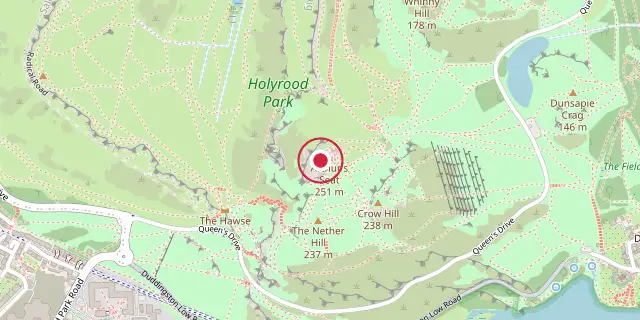
Coordinates: 55°56′38″N 3°09′43″W (55.9440, -3.1620) · Open in OpenStreetMap
Coordinates and connected clubs: the infobox of Wikipedia: Arthur's Seat (CC BY-SA 4.0). Map: drawn by Codexery from OpenStreetMap tiles.
Arthur's Seat is an ancient extinct volcano and the main peak of a group of hills in Edinburgh, Scotland, which form most of Holyrood Park. Robert Louis Stevenson described it as "a hill for magnitude, a mountain in virtue of its bold design." It is situated just to the east of the city centre, about 1 mi to the east of Edinburgh Castle. The hill rises above the city to a height of 250.5 m, provides panoramic views of the city and beyond, is relatively easy to climb, and is popular for hillwalking.
Though it can be climbed from almost any direction, the easiest ascent is from the east, where a grassy slope rises above Dunsapie Loch. At a spur of the hill, Salisbury Crags has historically been a rock climbing venue with routes of various degrees of difficulty. Rock climbing was restricted to the South Quarry, but access was banned altogether in 2019 by Historic Environment Scotland.
Geology
Arthur's Seat is the largest of three parts of the Arthur's Seat Volcano site of special scientific interest, which also includes Calton Hill and Castle Rock. The site protects important geology, grassland habitats, and uncommon plant and animal species. Like the rock under Edinburgh Castle, Arthur's Seat was formed by a volcanic system of early Carboniferous age, with lava samples dated to 341–335 million years old. During the Quaternary period, a glacier moving from west to east eroded the volcano, exposing rocky crags to the west and leaving a tail of material swept eastward.
This process created the Salisbury Crags, basalt cliffs between Arthur's Seat and the city centre. From some angles, the hill resembles a lion couchant, with two extinct vents forming the 'Lion's Head' and 'Lion's Haunch'.
James Hutton studied the area to develop modern geological ideas, observing that sedimentary and igneous rocks formed at different times. Hutton's Section in the Salisbury Crags shows where magma forced through sedimentary rock to form dolerite sills. The hill's geology and urban proximity strongly resemble Cavehill in Belfast.
Human history
The summit of Arthur's Seat, along with the nearby Crow Hill, holds the remains of a hill fort. Defensive structures from this fort can still be seen around the main hill at Dunsapie Hill and above Samson's Ribs, with those at the latter site definitely dating to prehistoric times. These forts were probably the political centers for the Votadini, the tribe celebrated in the poem Y Gododdin, which scholars believe was composed around 600 AD. On the eastern side of Arthur's Seat, two stone banks are the remnants of an Iron Age hill fort, and above the road near Duddingston, you can spot ancient cultivation terraces.
On May 1, 1590, a large bonfire was set on Salisbury Crags to mark the safe homecoming of King James VI of Scotland and his wife, Anne of Denmark. The fire burned ten loads of coal and six barrels of tar. A walking path that runs along the top of the slope just below Salisbury Crags has long offered views of the city. After the Radical War of 1820, it was paved and named the Radical Road, using unemployed weavers from western Scotland as laborers on the suggestion of Walter Scott.
This path has been closed since 2018 following a rockfall of 50 tons from the cliffs above. In 1836, five boys searching for rabbits discovered 17 tiny coffins, each holding a small wooden figure, in a cave on the crags. Their purpose remains unknown. People at the time thought they were used in witchcraft, but more recent ideas connect them to the 1828 murders by Burke and Hare.
The 16 known murder victims, plus a man who died naturally, might be represented, though the eight surviving figures are all male, while most of the murder victims were female. These coffins are now on display at the National Museum of Scotland in Edinburgh.
Mythology
Arthur's Seat is often mentioned as a possible location for Camelot, the legendary castle and court of King Arthur. Tradition holds that at the foot of the hill, covered by the forest of Drumselch, Scotland's 12th-century king David I encountered a stag while hunting.
After falling from his horse and about to be gored, he saw a vision of a cross between the stag's antlers, and the animal turned away. David founded Holyrood Abbey on the spot, and the burgh arms of the Canongate display a stag's head with a cross framed by its antlers. On May Day, young girls in Edinburgh traditionally bathe their faces in dew on the hill's slopes facing Holyrood to enhance their beauty.
In popular culture
Arthur's Seat appears in Jane Porter's 1921 book The Scottish Chiefs. In James Hogg's 1824 novel The Private Memoirs and Confessions of a Justified Sinner, two feuding brothers become lost in fog atop the hill and witness a Brocken spectre, nearly leading to a fatal confrontation. Sir Walter Scott, in his 1829 General Preface to the Waverley Novels, recalled roaming the hill as a schoolboy in the 1780s, telling tales of knight-errantry. Mary Shelley's Frankenstein mentions Arthur's Seat as a sight of Edinburgh.
David Nicholls' 2009 novel One Day begins and ends with characters climbing the hill after graduation; the 2011 film and 2024 mini-series also feature it. In Jules Verne's The Underground City, a young girl named Nell is taken to Arthur's Seat to see her first sunrise. Catherine Sinclair's Holiday House includes a scene where children climb the hill and nearly fall. Ian Rankin's novels feature Arthur's Seat.
In Stephen Baxter's disaster novel Moonseed, the volcano reactivates and destroys much of Edinburgh. Philip Caveney's 2014 teen fiction Seventeen Coffins is based on the 17 coffins found on the hill. In Julian May's Galactic Milieu series, Arthur's Seat is a site of the Great Intervention, and a main family lives on its slopes.
More in Locations Associated with Arthurian Legend
Sources
Compiled from Wikipedia and the sources listed below. Text from Wikipedia is available under CC BY-SA 4.0; this entry is adapted from it.
- Wikipedia: Arthur's Seat (CC BY-SA 4.0).
Spotted an error? Know more?
Reader corrections go straight into our review queue. Suggest an edit · How this site is sourced