Bamburgh Castle
Last updated

via Wikipedia: Bamburgh Castle · see source
Where it is
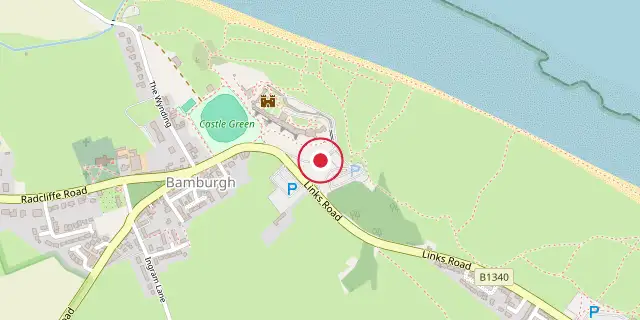
Coordinates: 55°36′29″N 1°42′32″W (55.6080, -1.7090) · Open in OpenStreetMap
Coordinates and connected clubs: the infobox of Wikipedia: Bamburgh Castle (CC BY-SA 4.0). Map: drawn by Codexery from OpenStreetMap tiles.
Bamburgh Castle is a Grade I listed building on the northeast coast of England, near the village of Bamburgh in Northumberland. The site was originally a Celtic Brittonic fort called Din Guarie, which may have served as the capital of the kingdom of Bernicia from around 420 until 547. After passing between Britons and Anglo-Saxons, the Normans built a new castle on the site that forms the core of the present structure.
History
Perched on a dark volcanic dolerite crag that is part of the Whin Sill, this site originally held a Celtic Brittonic fort named Din Guarie. It may have served as the capital of the kingdom of Bernicia, home to the Gododdin people, from around 420 until 547, the year of the first written reference to the castle. That year, the Anglo-Saxon ruler Ida of Bernicia captured the citadel and made it his seat. The Britons briefly retook it from his son Hussa during the war of 590 before it was retaken later the same year.
Around 600, Hussa's successor Æthelfrith passed it on to his wife Bebba, from whom the early name Bebbanburh was derived. The Normans built a new castle on the site, which forms the core of the present one. William II unsuccessfully besieged it in 1095 during a revolt supported by its owner, Robert de Mowbray, Earl of Northumbria. After Robert was captured, his wife continued the defence until coerced to surrender by the king's threat to blind her husband.
Bamburgh then became the property of the reigning English monarch. Henry II probably built the keep as it was complete by 1164. Following the Siege of Acre in 1191, King Richard I appointed Sir John Forster the first Governor of Bamburgh Castle. After the defeat of the Scots at the Battle of Neville's Cross in 1346, King David II was held prisoner at Bamburgh Castle.
Modern history
During the civil wars at the end of King John's reign, the castle was under the control of Philip of Oldcoates. In 1464 during the Wars of the Roses, it was subject to a nine-month siege by Richard Neville, 16th Earl of Warwick, on behalf of the Yorkists, marked by extensive use of artillery. It became the first British castle to be taken by gunfire. The Forster family of Northumberland continued to provide the Crown with successive governors until the Crown granted ownership (or a lease according to some sources) of the church and the castle to another Sir John Forster in the mid-1500s, after the Dissolution of the Monasteries.
The family retained ownership until William Forster (died 1700) was posthumously declared bankrupt, and his estates, including the castle, were sold to Lord Crew, Bishop of Durham, under an Act of Parliament to settle the debts in 1704. Crewe placed the castle in the hands of a board of trustees chaired by Thomas Sharp, the Archdeacon of Northumberland. Following Thomas Sharp's death, leadership passed to his son John Sharp, also Archdeacon of Northumberland, who refurbished the castle keep and court rooms and established a hospital on the site.
In 1894, the castle was bought by the Victorian industrialist William Armstrong, who completed the restoration. The castle still remains in the ownership of the Armstrong family.
In popular culture
The castle features in the ballad The Laidly Worm of Spindleston Heugh written in circa 1270. Late medieval British author Thomas Malory identified Bamburgh Castle with Joyous Gard, the mythical castle home of Sir Lancelot in Arthurian legend. Under its Saxon name Bebbanburg, it is the home of Uhtred Uhtredson, the main character in Bernard Cornwell's The Saxon Stories, starting with The Last Kingdom and continuing through sequels including The Pale Horseman, The Lords of the North, Sword Song, The Burning Land, Death of Kings, The Pagan Lord, The Empty Throne, Warriors of the Storm, The Flame Bearer, War of the Wolf, Sword of Kings and War Lord.
The castle and village provide the setting for the crime novel Bamburgh written by LJ Ross. Bamburgh Castle has been used as a filming location for a number of television and film projects, including the 1949 film A Connecticut Yankee in King Arthur's Court, the 1964 film Becket, the 1971 film Macbeth, the 1982 film Ivanhoe, the 1998 film Elizabeth, the 2015 film Macbeth, the 2018 television series The Last Kingdom, and the 2023 film Indiana Jones and the Dial of Destiny. It also appeared as itself in the 2006 TV show Most Haunted and the 2018 racing game Forza Horizon 4.
More in Locations Associated with Arthurian Legend
Sources
Compiled from Wikipedia and the sources listed below. Text from Wikipedia is available under CC BY-SA 4.0; this entry is adapted from it.
- Wikipedia: Bamburgh Castle (CC BY-SA 4.0).
Spotted an error? Know more?
Reader corrections go straight into our review queue. Suggest an edit · How this site is sourced