
Adams Lake Provincial Park
Three park sites protecting Adams Lake's shoreline and forests.

Globalist1789 at English Wikipedia · Public domain
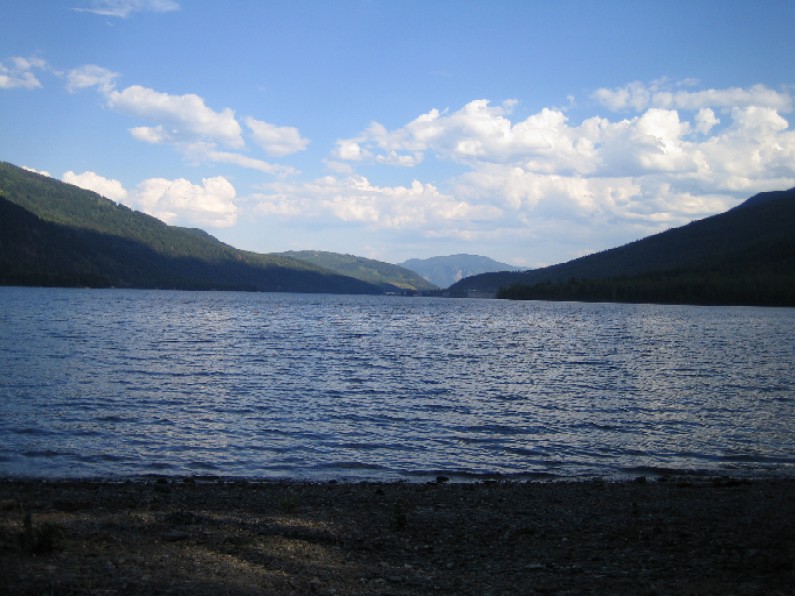
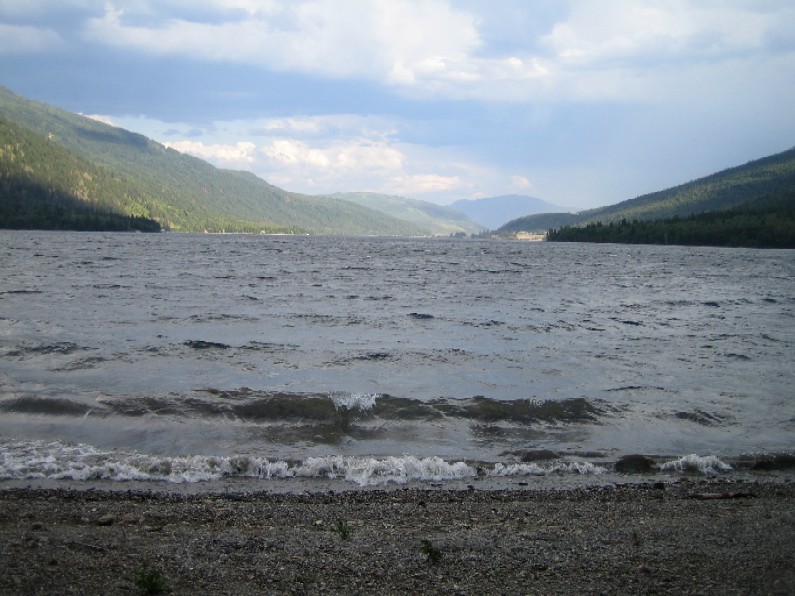
Adams Lake Provincial Park, located in British Columbia, Canada, is actually a group of three separate protected areas: the Bush Creek Site, the Poplar Point Site, and the Spillman Beach Site. These parks sit east of Kamloops, about 30 kilometres north of Chase, or 48 kilometres east of Louis Creek. Nearby communities include Scotch Creek, Sorrento, Salmon Arm, Barriere, Chase, and Kamloops.
The Bush Creek Site, on the southwestern shore of Adams Lake, covers 56 hectares. It was first established as a Recreation Area in 1988 and became a provincial park in 1997. The park safeguards beaches, shoreline, and mixed forests of aspen, birch, willow, Douglas-fir, and Western redcedar.
The Poplar Point Site, on the east side of Adams Lake where Bugcamp Creek enters, spans 32 hectares. Created on April 30, 1996, it protects a section of beach and an upland forest of Douglas-fir, Western redcedar, and cottonwoods.
The Spillman Beach Site, also on the east side of Adams Lake, covers 139 hectares and was established on April 30, 1996. It includes beach frontage and the lower part of Spillman Creek. The park features mixed forests of Douglas-fir, Lodgepole Pine, cottonwood, birch, and Western redcedar. Spillman Creek contains wild rainbow trout and potential spawning habitat for sockeye salmon.
Quick Facts
- Iucn Category
- II
- Location
- Kamloops Division Yale Land District, British Columbia, Canada
- Nearest City
- Kamloops, BC
- Area
- 305 ha
- Established
- January 8, 1988
- Governing Body
- BC Parks
Facts from the source article.
Lore & Background
Adams Lake Provincial Park consists of three separate sites, each established at different times. The Bush Creek Site was first created as a Recreation Area in 1988 and later designated a provincial park in 1997, covering 56 hectares on the southwestern shores of Adams Lake. It protects beaches, shoreline, and mixed forests of aspen, birch, willow, Douglas-fir, and Western redcedar.
The two marine parks—Poplar Point Site and Spillman Beach Site—were both established on April 30, 1996. Poplar Point is 32 hectares on the east side of Adams Lake where Bugcamp Creek enters, protecting beach and upland forest of Douglas-fir, Western redcedar, and cottonwoods. Spillman Beach is the largest at 139 hectares, also on the east side, encompassing beach frontage and the lower portion of Spillman Creek, with forests of Douglas-fir, Lodgepole Pine, cottonwood, birch, and western red cedar. Spillman Creek contains wild rainbow trout with possible spawning habitat and potential sockeye salmon spawning habitat.
Reader's Guide
Adams Lake Provincial Park represents a coordinated effort to preserve natural shoreline and forest ecosystems along Adams Lake in British Columbia. The three distinct sites—Bush Creek, Poplar Point, and Spillman Beach—were established between 1988 and 1997, reflecting a phased approach to conservation. The park protects a variety of habitats, including beaches, mixed forests, and creek ecosystems. Notably, Spillman Creek provides potential spawning habitat for wild rainbow trout and sockeye salmon, highlighting the ecological importance of the area. The park's location east of Kamloops and near communities such as Scotch Creek, Sorrento, and Salmon Arm makes it accessible for recreation while safeguarding biodiversity. The inclusion of both upland forests and shoreline ensures a range of environments are preserved for future generations.
Did You Know?
- Adams Lake Provincial Park comprises three distinct parks: Bush Creek Site, Poplar Point Site, and Spillman Beach Site.
- The Bush Creek Site was established as a Recreation Area in 1988 and designated a provincial park in 1997.
- Spillman Beach Site is the largest at 139 hectares and contains potential spawning habitat for sockeye salmon.
Three Parks, One Identity
Adams Lake Provincial Park is not a single contiguous tract of protected land but rather a collective designation that unites three separate parks sharing the same lake and the same name. The Bush Creek Site operates as a standard provincial park, while the Poplar Point and Spillman Beach sites carry the "Marine" designation, reflecting their emphasis on shoreline and aquatic environments. Together they span 227 hectares of protected territory, with Spillman Beach being by far the largest at 139 hectares, followed by Bush Creek at 56 hectares and Poplar Point at just 32 hectares. Their placement around the lake is deliberate: Bush Creek guards the southwestern shore, while both Poplar Point and Spillman Beach anchor the eastern side, each positioned where a creek meets the water. This tripartite structure means that a visitor exploring the "park" is actually moving between three distinct legal entities, each with its own boundaries, its own vegetation profile, and its own history of designation. The result is a mosaic of protection rather than a single blanket, a design that mirrors the varied geography of Adams Lake itself.
Living Forests and Water
The ecological mandate of the three Adams Lake parks centers on preserving both terrestrial and aquatic habitats. The Bush Creek Site shelters a mixed forest of aspen, birch, willow, Douglas-fir, and Western redcedar alongside its lakefront beaches. Poplar Point protects an upland stand of Douglas-fir, Western redcedar, and cottonwoods rising above a stretch of shoreline where Bugcamp Creek feeds into the lake. Spillman Beach, the largest of the three, encompasses a more diverse woodland of Douglas-fir, Lodgepole Pine, cottonwood, birch, and western red cedar, wrapping around the lower reaches of Spillman Creek. Beyond the trees, the aquatic life is a key reason for protection. Spillman Creek harbours wild rainbow trout and is identified as possible spawning habitat for them, while also holding potential as a spawning ground for sockeye salmon. The combined effect of these three designations is that a meaningful ribbon of shoreline, creek mouth, and upland forest around Adams Lake is shielded from development, keeping the interplay between forest, water, and fish intact for generations.
A Remote Corner of the Interior
Geographically, the Adams Lake parks sit in the interior of British Columbia, nestled east of Kamloops and roughly 30 kilometres north of the small town of Chase. An alternative reference point places them 48 kilometres east of Louis Creek, underscoring how far they stretch into the backcountry. The nearest populated places form a loose ring around the lake: Scotch Creek and Sorrento to the south, Salmon Arm and Barriere to the west, and Chase and Kamloops providing the larger urban anchors. None of these communities sits directly on the park boundary, which gives the three sites a genuine sense of remoteness despite being within a day's drive of Kamloops. The fact that the parks are accessible by road yet surrounded by small, scattered settlements means that visitors typically arrive by car and find themselves in a landscape where the nearest neighbours are measured in tens of kilometres rather than streets. This isolation is part of the appeal: the beaches, the creek mouths, and the mixed forests exist in a setting where human presence is limited to the occasional hiker or angler rather than a permanent community.
From Recreation Area to Protected Park
The three Adams Lake parks did not all arrive at their current status simultaneously, and their timelines reveal a gradual tightening of protection. The Bush Creek Site began its life as a Recreation Area in 1988, a designation that acknowledged public use but offered a lighter level of conservation. Nearly a decade later, in 1997, it was elevated to full provincial park status, a step that typically brings stronger land-use restrictions and a clearer conservation mandate. The other two sites took a different path: both Poplar Point and Spillman Beach were established on the same day, April 30, 1996, and both entered the system directly as Marine Provincial Parks. This means that while Bush Creek spent its first nine years under a more permissive framework, the eastern-side parks were born with the marine designation and the associated emphasis on protecting shoreline and aquatic ecosystems from the outset. The staggered dates also reflect shifting priorities in British Columbia's park system during the mid-to-late 1990s, a period when the province was actively expanding its network of protected areas and formalizing the status of previously informal recreation sites.
Gallery
Frequently Asked Questions
What is Adams Lake Provincial Park?
It is a trio of separate protected zones in British Columbia, Canada, that collectively guard the shoreline and surrounding forest of Adams Lake. The three sites—Bush Creek, Poplar Point, and Spillman Beach—together total 227 hectares of protected land.
Where is Adams Lake Provincial Park located?
The park sits east of Kamloops, roughly 30 kilometres north of Chase and 48 kilometres east of Louis Creek. Neighbouring communities include Scotch Creek, Sorrento, Salmon Arm, Barriere, and Chase.
What are Adams Lake Provincial Park's powers and role?
Its core function is shielding the lake's beaches, mixed-wood forests, and the spawning habitat that rainbow trout and sockeye salmon depend on. It also grants the public limited recreational access to those shoreline areas.
How does Adams Lake Provincial Park's story begin?
The narrative starts in 1988 when Bush Creek was first set aside as a Recreation Area, followed by the 1996 designations of Poplar Point and Spillman Beach. Bush Creek was later elevated to full provincial park status in 1997, completing the three-site group.
Why is Adams Lake Provincial Park important?
As an IUCN Category II protected area, it locks in 227 hectares of lakeshore and forest so that critical fish-spawning ecosystems remain undisturbed. It balances conservation of rainbow trout and sockeye salmon habitat with modest public recreation.
More in IUCN Category II 1-24
Spotted an error? Know more?
Reader corrections go straight into our review queue. Suggest an edit · How this site is sourced