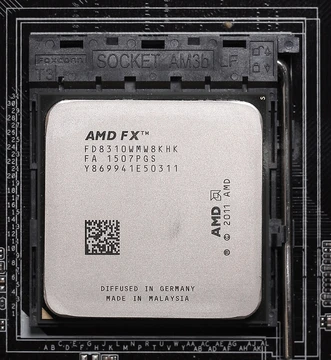
Intel 8085
Last 8-bit Intel microprocessor, single +5 V supply.

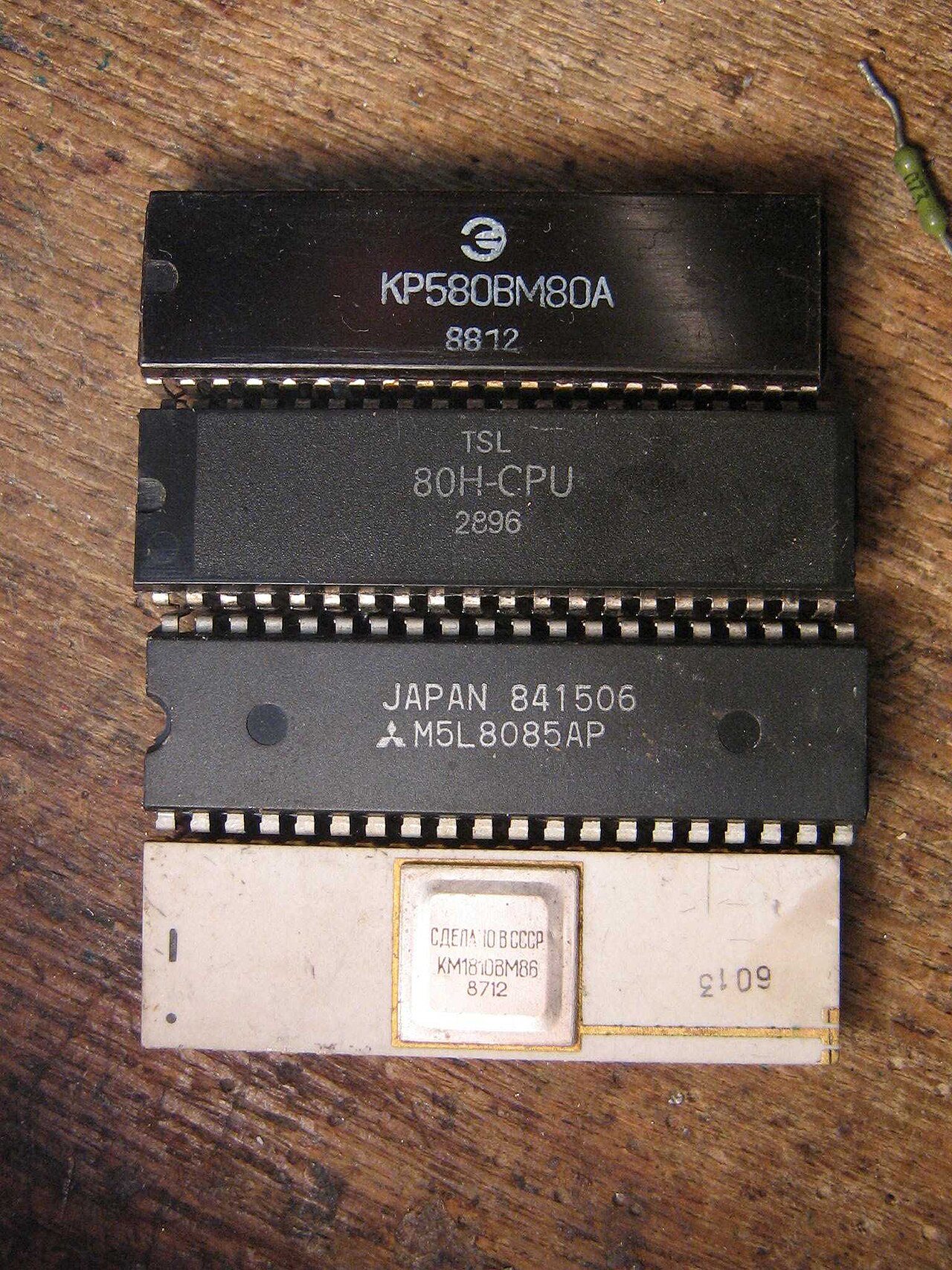
AntonSor at Russian Wikipedia · Public domain
The Intel 8085, introduced in March 1976, is an 8-bit microprocessor that is binary-compatible with the earlier and more well-known Intel 8080. It represents the final 8-bit processor Intel ever developed. The "5" in its model number refers to its single +5-volt power supply requirement, a simplification over the 8080’s need for +5, −5, and +12 volts, making the 8085 easier to fit into systems that had largely standardized on +5 V.
The processor added four new interrupt pins and a serial port with separate input and output pins. In simple systems, this often eliminated the need for separate integrated circuits to handle those functions, and it also simplified the computer bus. The only changes to the instruction set from the 8080 were new instructions for reading and writing data through these pins.
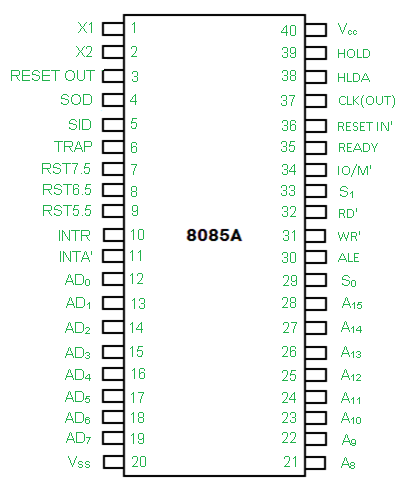
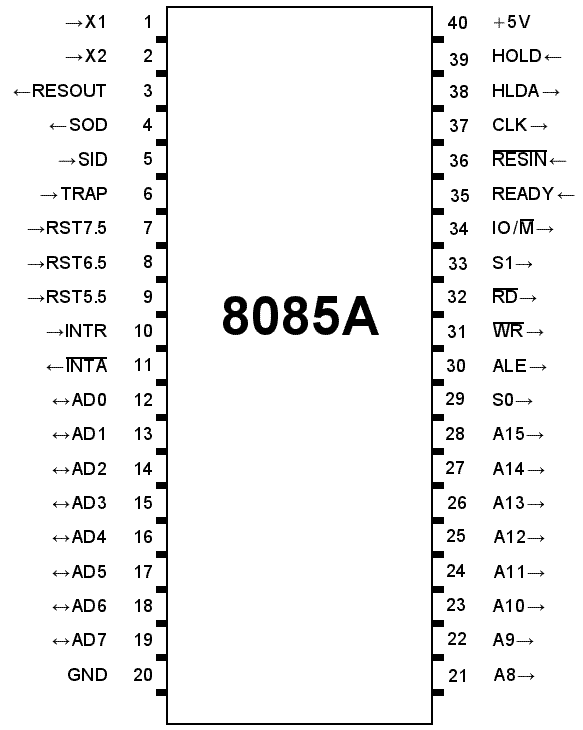
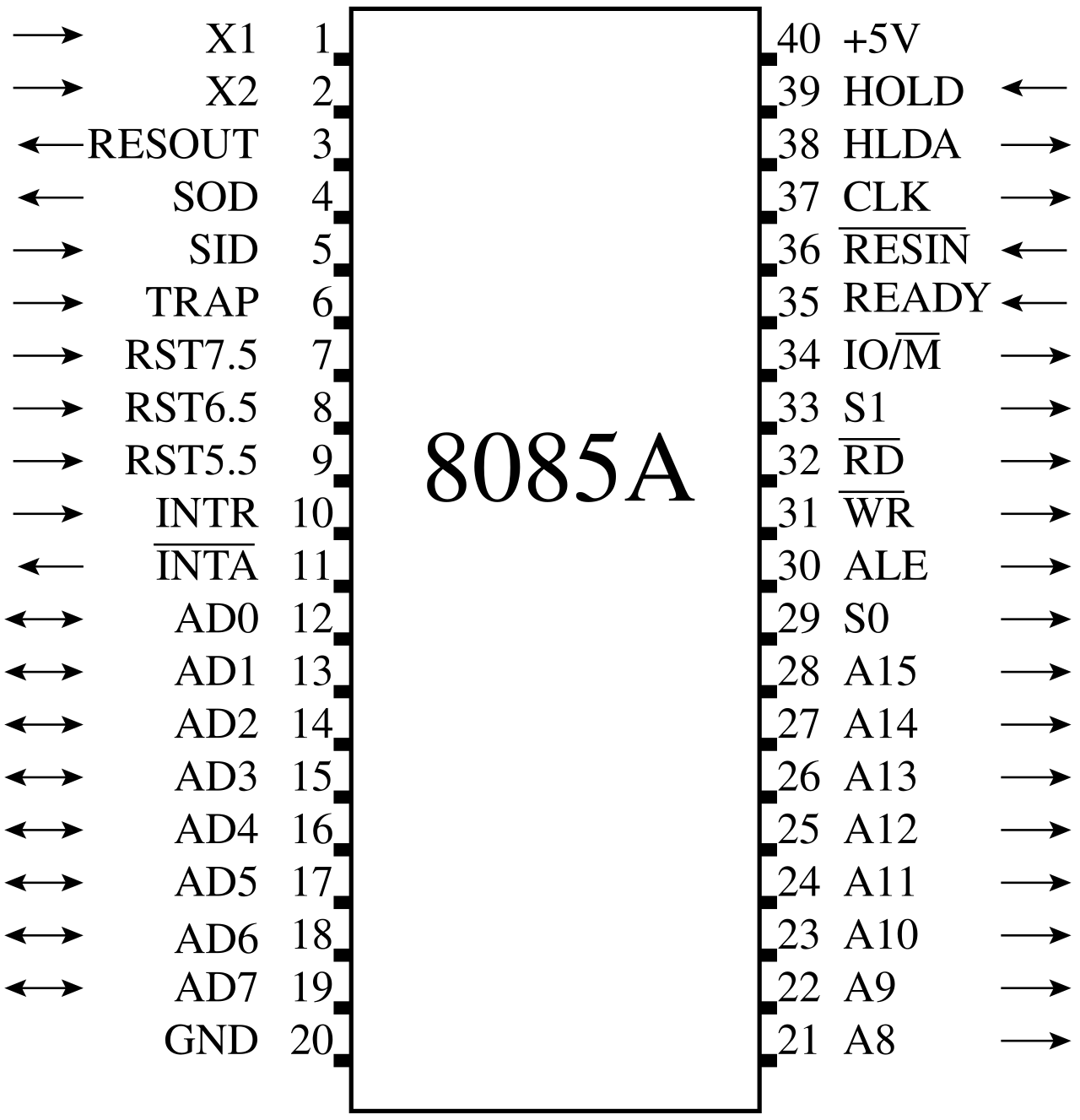
The 8085 comes in a 40-pin DIP package. To accommodate the new pins, eight bits of the address bus (AD0–AD7) were multiplexed with the data bus. This means that to specify a full 16-bit address, it must be sent over two 8-bit pathways, and one of those pathways requires temporary latching with separate hardware, such as a 74LS373. Intel produced several support chips with built-in address latches, including the 8755 (which combines an address latch, 2 KB of EPROM, and 16 I/O pins) and the 8155 (with 256 bytes of RAM, 22 I/O pins, and a 14-bit programmable timer/counter). This multiplexed address/data bus reduced the number of PCB traces between the 8085 and such memory and I/O chips.
Although the 8085 improved on the 8080, it was overshadowed in the late 1970s and early 1980s by the Zilog Z80, which captured much of the desktop computer market. The 8085 was not widely used in computers, but it enjoyed a long life as a microcontroller. Once designed into products like the DECtape II controller and the VT102 video terminal in the late 1970s, it continued in production for the entire lifespan of those products.
The 8085 is a conventional von Neumann design based on the Intel 8080. Unlike the 8080, it does not multiplex state signals onto the data bus, but the 8-bit data bus is multiplexed with the lower eight bits of the 16-bit address bus to keep the pin count at 40. State signals are provided by dedicated bus control signal pins and two bus state ID pins labeled S0 and S1. Pin 40 supplies +5 V power, pin 20 is ground, and pin 39 is the Hold pin.
Quick Facts
- Produced-Start
- March 1976
- Produced-End
- 2000
- Slowest
- 3, 5 and 6
- Slow-Unit
- MHz
- Arch
- 8085
- Predecessor
- Intel 8080
- Successor
- Intel 8086
- Transistors
- 6,500
- Data-Width
- 8 bits
- Address-Width
- 16 bits
Facts from the source article.
Lore & Background
The 8085 is a conventional von Neumann design based on the Intel 8080. Unlike the 8080 it does not multiplex state signals onto the data bus, but the 8-bit data bus is instead multiplexed with the lower eight bits of the 16-bit address bus to limit the number of pins to 40. State signals are provided by dedicated bus control signal pins and two dedicated bus state ID pins named S0 and S1. The 8085 incorporates the functions of the 8224 (clock generator) and the 8228 (system controller) on chip, increasing the level of integration. A downside compared to similar contemporary designs (such as the Z80) is the fact that the buses require demultiplexing; however, address latches in the Intel 8155, 8355, and 8755 memory chips allow a direct interface, so an 8085 along with these chips is almost a complete system.
The 8085 has extensions to support new interrupts, with three maskable vectored interrupts (RST 7.5, RST 6.5 and RST 5.5), one non-maskable interrupt (TRAP), and one externally serviced interrupt (INTR). Each of these five interrupts has a separate pin on the processor, a feature which permits simple systems to avoid the cost of a separate interrupt controller. The RST 7.5 interrupt is edge triggered (latched), while RST 5.5 and 6.5 are level-sensitive. All interrupts except TRAP are enabled by the EI instruction and disabled by the DI instruction. In addition, the SIM (Set Interrupt Mask) and RIM (Read Interrupt Mask) instructions, the only instructions of the 8085 that are not from the 8080 design, allow each of the three maskable RST interrupts to be individually masked.
The 8085 is a binary compatible follow-up on the 8080. It supports the complete instruction set of the 8080, with exactly the same instruction behavior, including all effects on the CPU flags (except for the AND/ANI operation, which sets the AC flag differently). This means that the vast majority of object code that runs successfully on the 8080 can run directly on the 8085 without translation or modification. 8085 instruction timings differ slightly from the 8080—some 8-bit operations are one clock cycle faster, but instructions that involve 16-bit operations are generally one cycle slower. Conditional jumps not taken are three clocks faster on the 8085.
Reader's Guide
While the 8085 was an improvement on the 8080, it was eclipsed by the Zilog Z80 in the late 1970s and early 1980s, which took over much of the desktop computer market. Although not widely used in computers, the 8085 had a long life as a microcontroller. Once designed into such products as the DECtape II controller and the VT102 video terminal in the late 1970s, the 8085 served for new production throughout the lifetime of those products. The 8085's single +5 V power supply simplified system integration at a time when most logic was moving to that voltage. Its on-chip clock generator and system controller reduced the need for external support chips, and the addition of interrupt pins and a serial port often eliminated the need for separate integrated circuits in simple systems. The multiplexed address/data bus reduced the number of PCB tracks between the 8085 and memory and I/O chips. Intel manufactured several support chips with an address latch built in, including the 8755 (with 2 KB of EPROM and 16 I/O pins) and the 8155 (with 256 bytes of RAM, 22 I/O pins and a 14-bit programmable timer/counter), allowing a nearly complete system with minimal additional components.
Did You Know?
- The '5' in 8085 indicates its single +5 V power supply, unlike the 8080 which required +5, −5, and +12 V.
- The 8085 is the last 8-bit microprocessor developed by Intel.
- It introduced SIM and RIM instructions for interrupt masking and serial data I/O, which were not part of the 8080 instruction set.
- The 8085 contains approximately 6,500 transistors.
A Single Supply, a Tighter Package
The 8085's most immediately practical innovation was its single +5-volt power requirement, a departure from the 8080's three-supply arrangement of +5, −5, and +12 volts. By the mid-1970s, most system boards had standardized around a single 5-volt rail, so this change made board design and power distribution considerably simpler. Intel signaled the shift right in the part number: the trailing "5" was a nod to that single supply. The chip was delivered in a 40-pin dual in-line package, and to fit the new interrupt and serial pins within that envelope, the 8-bit data bus was multiplexed with the lower eight bits of the 16-bit address bus. State signals that the 8080 had overlaid on the data bus were instead given dedicated control pins plus two bus-state identifiers, S0 and S1. Intel also folded the functions of the 8224 clock generator and the 8228 system controller directly onto the die, raising the level of integration. The core was built in nMOS, with later "H" stepping using Intel's HMOS II process, and the whole design contained roughly 6,500 transistors.
Five Interrupts, Two Serial Lines, One Chip
Where the 8080 left interrupt handling and serial communication to external logic, the 8085 brought both onto its own die. It exposed five dedicated interrupt pins: three maskable vectored interrupts (RST 7.5, RST 6.5, RST 5.5), one non-maskable TRAP, and one externally serviced INTR. RST 7.5 is edge-triggered and latched internally, while RST 5.5 and 6.5 respond to level-sensitive signals. All maskable interrupts are globally enabled or disabled by the EI and DI instructions, but the two instructions unique to the 8085—SIM and RIM—let software mask each RST line independently, read pending-interrupt status, clear the RST 7.5 latch, and even transmit or receive a serial bit over the SOD and SID pins. Because SIM and RIM complete in just four clock cycles, toggling or sampling the serial pins is far faster than routing the same signal through a memory-mapped I/O port. For a simple embedded system, this meant the 8085 could replace an interrupt controller and a serial transceiver IC simultaneously, shrinking both the bill of materials and the bus wiring.
Building a System Around the 8085
The multiplexed address-and-data bus, while pin-saving, introduced a practical wrinkle: a full 16-bit address had to be transmitted in two 8-bit phases, and one phase needed to be latched by external hardware such as a 74LS373 before the other arrived. Intel anticipated this need and shipped companion chips that embedded the latch alongside useful memory and I/O. The 8755 paired the latch with 2 KB of EPROM and 16 general-purpose I/O pins; the 8155 offered 256 bytes of RAM, 22 I/O lines, and a 14-bit programmable timer/counter. Because these chips spoke the 8085's native bus protocol, a processor plus one of these parts formed nearly a self-contained system, and the reduced pin count translated directly into fewer printed-circuit-board tracks. The 8085 also supported slower memories through an externally generated READY wait-state signal on pin 35, and it exposed HOLD and HLDA lines for DMA arbitration. For clocking, the chip could drive a piezoelectric crystal directly, with an internal generator producing two-phase clock signals at half the crystal frequency, and the internal clock was available on an output pin for synchronizing peripherals or a second CPU.
Eclipsed on the Desktop, Enduring in the Machine
Although the 8085 was a clear step forward from the 8080, it never captured the desktop-computer market that its binary compatibility might have suggested. In the late 1970s and into the early 1980s, the Zilog Z80 overtook it in that space, and the 8085's need for bus demultiplexing was a constant point of comparison. Yet the chip found a second, longer life in the role of a microcontroller. Once designers embedded it in products such as the DECtape II tape-drive controller and the VT102 video terminal in the late 1970s, it remained in active production for the entire remaining lifespan of those devices, well beyond the era when it was Intel's newest part. As the last 8-bit microprocessor Intel ever developed, the 8085 occupies a quiet but instructive place in the company's history: a design that traded raw desktop-market share for deep integration into industrial and embedded systems, where its single-supply simplicity, on-chip interrupts, and serial port made it a compact, self-sufficient brain for machines that needed to keep running for years.
Gallery
Frequently Asked Questions
What is the Intel 8085?
It is an 8-bit microprocessor that Intel shipped in March 1976, built from roughly 6,500 transistors in a 40-pin DIP package. It holds the distinction of being the last 8-bit design Intel ever produced before the company shifted to 16-bit and wider architectures.
Why is it called '8085' rather than just '8080'?
The trailing '5' highlights its single +5-volt power requirement, a major simplification over the 8080's three-rail supply of +5, −5, and +12 volts. That single-rail design made board layout and power management far easier for system builders.
Can I drop an 8085 in place of an 8080?
Yes—the 8085 is binary-compatible with the 8080, so existing 8080 machine code runs without any modification. The 8085 does add four extra interrupt pins and a dedicated serial I/O port that the 8080 simply did not have.
What new hardware features does the 8085 bring over the 8080?
Beyond the simplified single-rail supply, it introduces four additional interrupt pins and a serial port with separate input and output lines. In many simple designs that serial port let builders eliminate an external serial-interface chip entirely.
Why do retro-computing fans still talk about the 8085?
It closed out Intel's 8-bit era and shaped a generation of microcontrollers and embedded boards through the late 1970s and early 1980s. Its single +5 V supply and built-in serial I/O made it a go-to choice for hobbyist and industrial projects of that period.
More in Intel and AMD Microprocessors 1-24
Spotted an error? Know more?
Reader corrections go straight into our review queue. Suggest an edit · How this site is sourced