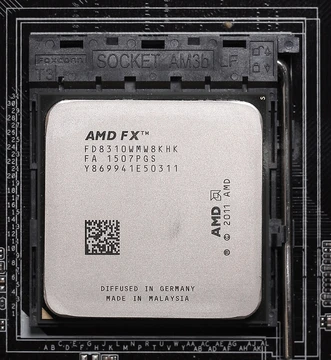
Clarkdale (microprocessor)
Intel's first dual-die desktop processor with integrated north bridge.

cogdogblog · CC0
Clarkdale is the internal name for Intel’s first desktop processors in the Core i5, Core i3, and Pentium dual-core lines. It shares its basic design with the mobile Arrandale chip: both rely on a 32 nm Westmere dual-core die and include integrated graphics, PCI Express lanes, and DMI links. Clarkdale replaced the Wolfdale die used in earlier desktop Core 2, Celeron, and Pentium Dual-Core processors.
Unlike Wolfdale, Clarkdale packs most of the north bridge functions—memory controller, PCI Express for external graphics, built-in graphics, and the DMI connector—directly into the package. This lets builders create smaller systems without a separate north bridge or a discrete graphics card, similar to what Lynnfield offered.
The Clarkdale package actually holds two separate dies: a 32 nm processor die that handles I/O connections, and a 45 nm die for the graphics and integrated memory controller. Because these two dies are physically apart, memory latency is higher than if they were on the same piece of silicon. The CPUID for Clarkdale is family 6, model 37 (2065x). Its mobile counterpart is Arrandale.
Intel sells Clarkdale chips under the Core, Pentium, and Celeron brands, each with a different feature set. Core i5 models typically have everything turned on, except the Core i5-661 and Core i5-655K lack Intel VT-d and TXT—similar to the Core i3, which also omits Turbo Boost and AES new instructions. Pentium and Celeron versions drop SMT and get a smaller third-level cache.
The Xeon L340x line runs at lower clock speeds and thermal design power, supports unbuffered ECC memory, and includes the same features as a Core i5-6xx, but its integrated graphics are disabled.
A key point: even though the memory controller sits on the same package as the CPU cores, it is on a separate die, so it introduces more latency than designs that integrate the controller directly on the main CPU die.
Quick Facts
- Produced-Start
- January 7, 2010
- Slowest
- 2.27
- Fastest
- 3.6
- Designfirm
- Intel
- Arch
- x86, x86-64, MMX, SSE, SSE2, SSE3, SSSE3, SSE4.1, SSE4.2, AES-NI
- Microarch
- Westmere
- Numcores
- 2
Facts from the source article.
Lore & Background
The Clarkdale processor package contains two dies: the 32 nm processor die with the I/O connections, and the 45 nm graphics and integrated memory controller die. Physical separation of the processor die and memory controller die resulted in increased memory latency. Clarkdale processors are sold under the Intel Core, Pentium and Celeron brand names, with varying feature sets. The Core i5 versions generally have all features enabled, with the Core i5-661 and Core i5-655K models lacking Intel VT-d and TXT like the Core i3, which also does not support Turbo Boost and AES new instructions. In addition, the Pentium and Celeron versions do not have SMT, and they can only use a reduced amount of third-level cache. The Xeon L340x line has a lower clock frequency and thermal design power, and supports unbuffered ECC memory in addition to the features of the Core i5-6xx, but has support for the integrated graphics disabled.
Reader's Guide
Clarkdale's significance lies in its integration of major north bridge components—memory controller, PCI Express for external graphics, integrated graphics, and the DMI connector—directly into the processor package, enabling more compact system designs without a separate north bridge or discrete graphics. This architectural shift, also seen in the related Lynnfield, reduced motherboard complexity. However, the physical separation of the processor die and memory controller die on two distinct dies (32 nm and 45 nm) introduced increased memory latency compared to architectures that integrate the memory controller on-die with the CPU cores. The Clarkdale line served as the desktop successor to Wolfdale and introduced the Westmere microarchitecture to the desktop segment, with feature differentiation across Core i5, Core i3, Pentium, Celeron, and Xeon L340x variants. Its mobile counterpart, Arrandale, shared the same dual-core die design.
Did You Know?
- Clarkdale contains two dies: a 32 nm processor die and a 45 nm graphics and memory controller die.
- The physical separation of the processor and memory controller dies resulted in increased memory latency.
- The Xeon L340x line has integrated graphics disabled but supports unbuffered ECC memory.
Gallery



Frequently Asked Questions
What is Clarkdale?
Clarkdale is the internal codename Intel used for its first desktop chips in the Core i5, Core i3, and Pentium dual-core product lines. It is built on the 32 nm Westmere microarchitecture and carries the CPUID signature of family 6, model 37.
What makes Clarkdale's package design unique?
It was Intel's first desktop CPU to ship with two dies in a single package: a 32 nm processor die paired with a separate 45 nm die that houses the integrated graphics, memory controller, PCI Express lanes, and the DMI link. This dual-die arrangement effectively folded the north bridge into the processor itself.
How does Clarkdale differ from the earlier Wolfdale desktop chip?
Wolfdale required a discrete north bridge chip on the motherboard to handle memory, PCIe, and graphics, while Clarkdale moved all of those functions directly into the CPU package. As a result, Clarkdale eliminated the separate north bridge and simplified the motherboard layout.
What is the relationship between Clarkdale and Arrandale?
Clarkdale is essentially the desktop sibling of the mobile Arrandale chip. Both share the same 32 nm Westmere dual-core die and the same integrated-graphics-plus-memory-controller die, with Clarkdale simply repackaged for desktop sockets.
Why is Clarkdale considered a milestone in Intel's processor history?
It marked the first time Intel integrated north bridge functionality into a desktop CPU package, ending the long era of a separate chipset chip on the board. That fused-package approach became the template for every subsequent Intel desktop generation.
More in Intel and AMD Microprocessors 1-24
Spotted an error? Know more?
Reader corrections go straight into our review queue. Suggest an edit · How this site is sourced