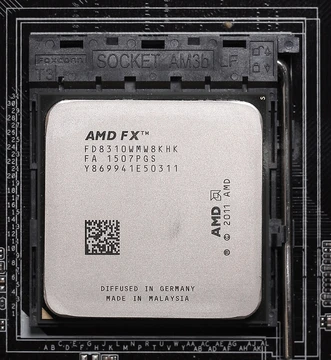
Clarksfield (microprocessor)
Intel's first mobile quad-core Nehalem processor for laptops.

Nyttend · Public domain
Clarksfield was the code name for a mobile Intel processor sold under the Core i7 brand. It shared a close relationship with the desktop Lynnfield chip, as both were built from quad-core dies using the 45 nm Nehalem microarchitecture and included integrated PCI Express and DMI links. When it launched at the Intel Developer Forum on September 23, 2009, Clarksfield outperformed every other laptop processor available, including the Core 2 Extreme QX9300. Its predecessor, Penryn-QC, was a multi-chip module combining two dual-core Penryn dies, which themselves were based on a shrink of the Merom microarchitecture. No direct successor to Clarksfield was announced. The later Arrandale processor started a new line of mid-range dual-core mobile chips with integrated graphics. Initial laptop makers shipping Clarksfield-based systems included MSI, Dell/Alienware, Hewlett-Packard, Toshiba, and Asustek. All Clarksfield processors were sold under the Core i7 name, split into three product lines that differed in thermal design power and the amount of enabled third-level cache.
Quick Facts
- Produced-Start
- 2009
- Produced-End
- 2012
- Slowest
- 1.60
- Fastest
- 2.13 (turbo up to 3.33)
- Soldby
- Intel
- Arch
- x86, x86-64
- Instructions
- MMX, SSE, SSE2, SSE3, SSSE3, SSE4.1, SSE4.2
- Microarch
- Nehalem
Facts from the source article.
Lore & Background
Clarksfield processors were marketed as Core i7 in three product lines differing in thermal design power and the amount of third-level cache enabled. The predecessor of Clarksfield, Penryn-QC, was a multi-chip module with two dual-core Penryn dies based on the Penryn microarchitecture, a shrink of the Merom microarchitecture. The name of the direct successor of Clarksfield has not been announced. Arrandale is a later mobile processor but opens a new line of mid-range dual-core processors with integrated graphics.
Reader's Guide
Clarksfield marked a significant step in mobile computing by bringing a quad-core Nehalem die to laptops, integrating PCI Express and DMI links directly on the processor. This design, shared with the desktop Lynnfield, allowed Clarksfield to outperform all existing laptop processors at its launch, including the Core 2 Extreme QX9300. Its release at the Intel Developer Forum in September 2009 led to immediate adoption by major laptop manufacturers such as MSI, Dell/Alienware, Hewlett-Packard, Toshiba, and Asustek. The processor line was sold exclusively under the Core i7 brand, with variations in thermal design power and cache size. While its predecessor Penryn-QC used a multi-chip module approach with two dual-core dies, Clarksfield unified four cores on a single die. The successor to Clarksfield was never officially named, and the later Arrandale processor opened a separate line of mid-range dual-core mobile processors with integrated graphics, diverging from Clarksfield's high-performance quad-core focus.
Did You Know?
- It was significantly faster than any other laptop processor at launch, including the Core 2 Extreme QX9300.
- Clarksfield uses a quad-core die based on the 45 nm Nehalem microarchitecture.
Gallery




Frequently Asked Questions
What is Clarksfield?
Clarksfield is the code name Intel gave to its first mobile quad-core processor built on the 45 nm Nehalem microarchitecture. It was sold under the Core i7 brand and targeted high-end laptops.
How does Clarksfield relate to the desktop Lynnfield chip?
Both are built from quad-core Nehalem dies at 45 nm and include integrated PCI Express and DMI links. Clarksfield is essentially the mobile counterpart to the desktop-oriented Lynnfield, sharing the same core design in a power-constrained package.
How did Clarksfield perform at its launch?
Unveiled at the Intel Developer Forum on September 23, 2009, it immediately outperformed every other laptop processor on the market, including the Core 2 Extreme QX9300. That result cemented its position as the top mobile chip at the time.
What was Clarksfield's predecessor and how did the design differ?
The prior generation, Penryn-QC, was a multi-chip module that bonded two dual-core Penryn dies together. Clarksfield replaced that two-die package with a single quad-core die, simplifying the design and reducing inter-die latency.
Which laptop makers first shipped Clarksfield-based systems?
Early machines came from MSI, Dell/Alienware, Hewlett-Packard, Toshiba, and Asustek. These vendors were the first to bring the mobile Core i7 Nehalem platform to the consumer market.
More in Intel and AMD Microprocessors 1-24
Spotted an error? Know more?
Reader corrections go straight into our review queue. Suggest an edit · How this site is sourced