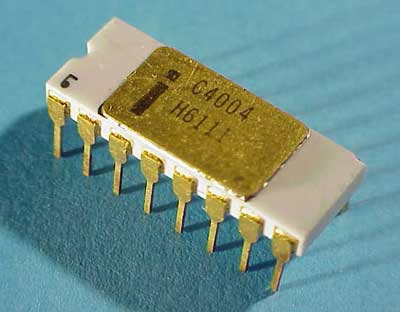
Intel 4004
First commercial single-chip CPU, using MOS silicon gate technology.

Original: Appaloosa Vector: Racecar56 · CC BY-SA 3.0
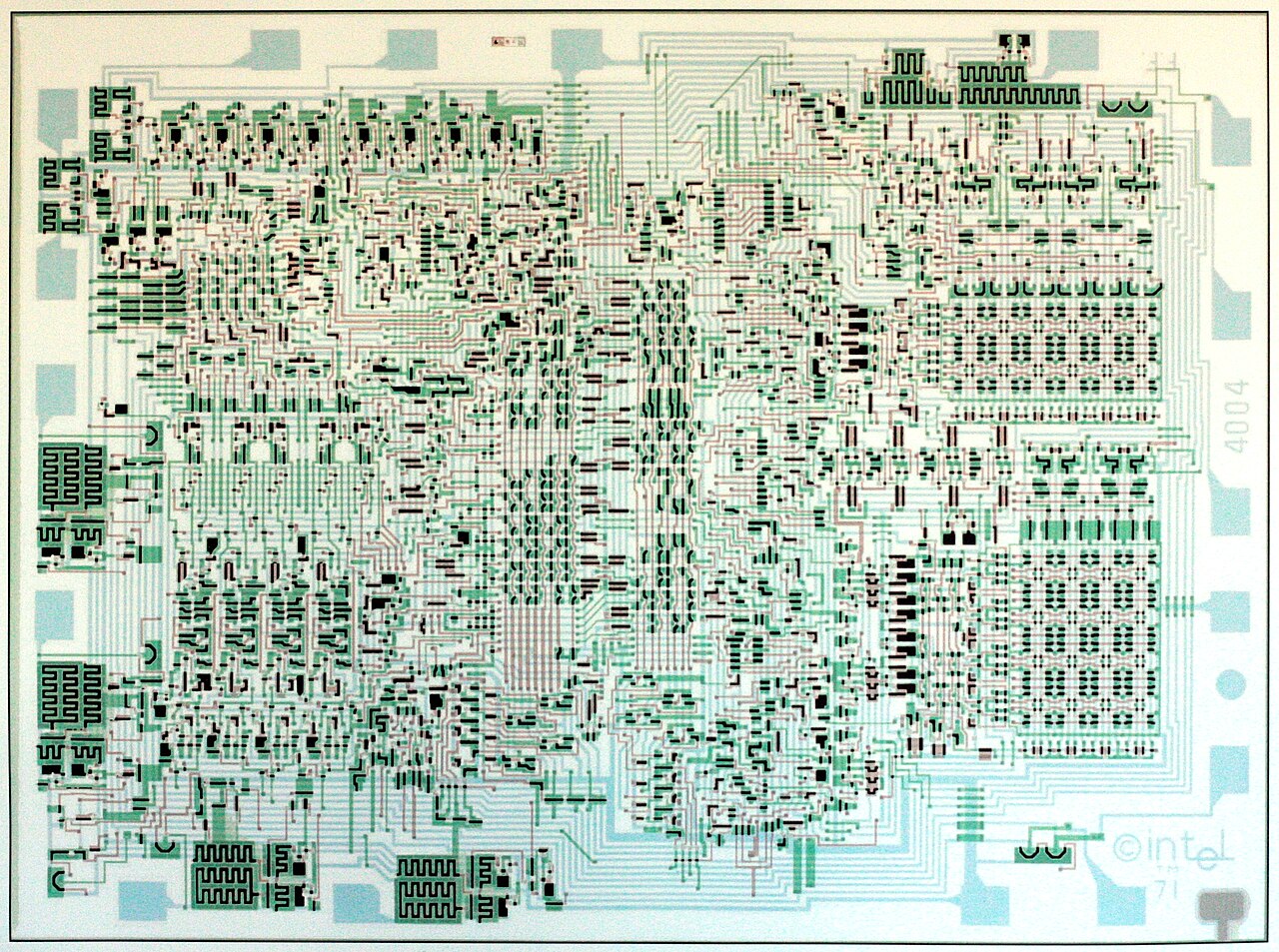
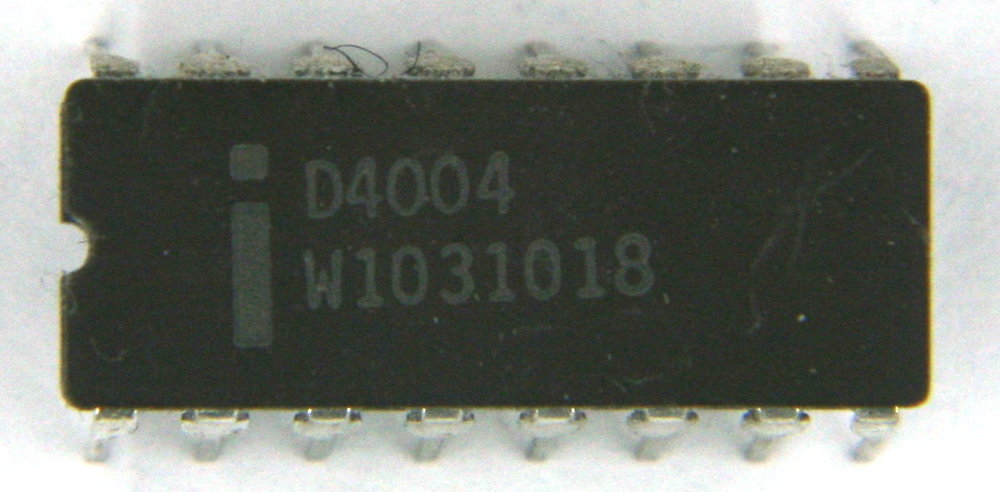
On November 15, 1971, Intel Corporation launched the 4004, the first in its long series of central processing units. This 4-bit chip was a landmark in both technology and economics, becoming the first major commercial example of large-scale integration. It achieved this by leveraging MOS silicon gate technology (SGT) to pack an entire CPU onto a single chip. SGT doubled transistor density and boosted operating speed fivefold compared to older methods, proving that single-chip CPUs were feasible.
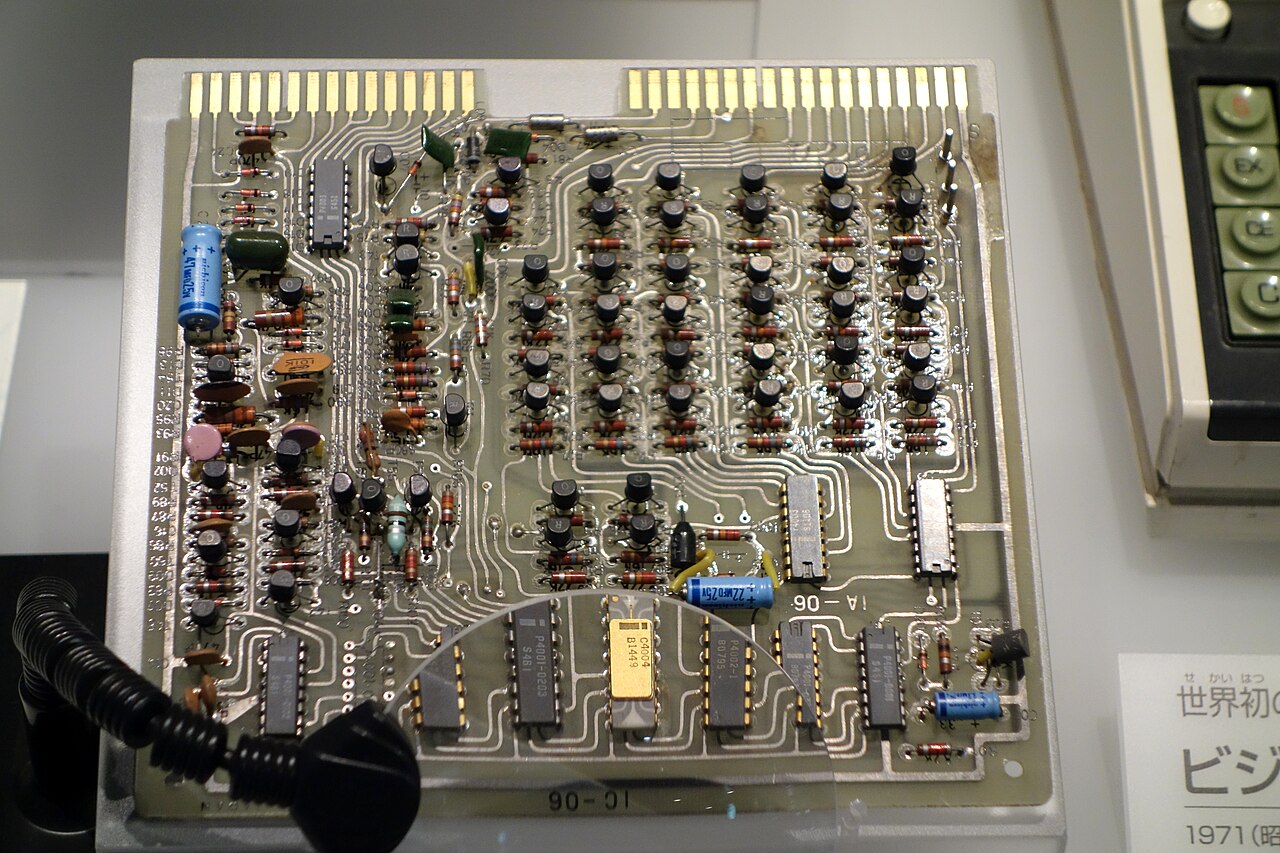
The 4004 was part of the MCS-4 chipset, which demonstrated how SGT could handle complex logic and memory circuits, speeding up the technology’s adoption across the semiconductor industry. The project began in 1969 when Busicom Corp. asked Intel to create a seven-chip set for electronic calculators, including a three-chip CPU. Busicom originally planned to use shift registers for data storage and ROM for instructions. Intel engineer Marcian Hoff suggested a simpler design that stored data on RAM, making a single-chip CPU possible. Busicom management agreed to Hoff’s approach over their own team’s work, led by Masatoshi Shima, who then shifted to the new architecture and helped with its design. After Hoff was reassigned, Federico Faggin, a new Intel hire, took over design work in April 1970, with Shima’s support. The first fully working 4004 was delivered in March 1971 for Busicom’s 141-PF printing calculator prototype, now at the Computer History Museum.
Shima led the first commercial use of the 4004 chipset in the Busicom 141-PF calculator. Busicom then produced 4004-based calculators, billing machines, teller machines, and cash registers, mostly for OEM partner NCR, which sold 100,000 units. Faggin had previously developed SGT at Fairchild Semiconductor, creating the Fairchild 3708, the first commercially produced SGT integrated circuit. At Intel, he used SGT—which replaces metal with poly-silicon—to achieve the integration needed for the 4004. He also invented the “bootstrap load,” previously thought impossible with silicon gate technology, and the “buried contact,” which let silicon gates connect directly to a transistor’s source and drain without metal. These innovations doubled circuit density and halved cost, allowing a single chip to hold 2,300 transistors and run five times faster than designs using older MOS technology with aluminum gates.
Quick Facts
- Produced-Start
- November 15, 1971
- Produced-End
- 1981
- Slowest
- 740
- Slow-Unit
- kHz
- Transistors
- 2,300
- Arch
- 4-bit BCD-oriented
- Data-Width
- 4 bits
- Address-Width
- 12 bits (multiplexed)
- Successor
- Intel 4040
- Application
- Busicom calculator, arithmetic manipulation
Facts from the source article.
Lore & Background
The project originated in 1969 when Busicom Corp. commissioned Intel to design a family of seven chips for electronic calculators, including a three-chip CPU. Busicom initially envisioned using shift registers for data storage and ROM for instructions. Intel engineer Marcian Hoff proposed a simpler architecture based on data stored on RAM, making a single-chip CPU possible. Hoff's approach was agreed by Busicom management over their own team's development work, led by Masatoshi Shima and Shima pivoted to the new architecture, working on the architectural design. With Hoff reassigned by Intel to another project, design work, led by new Intel hire Federico Faggin and supported by Shima, began in April 1970. The first fully operational 4004 was delivered in March 1971 for Busicom's 141-PF printing calculator prototype, now housed at the Computer History Museum.
Faggin, who had developed SGT at Fairchild Semiconductor and used it to create the Fairchild 3708, the first commercially produced SGT integrated circuit (IC), used SGT, a method of using poly-silicon instead of metal, at Intel to achieve the integration required for the 4004. Additionally, he developed the 'bootstrap load,' previously considered unfeasible with silicon gate technology, and the 'buried contact,' which enabled silicon gates to connect directly to the transistor's source and drain without the use of metal. Together, these innovations doubled the circuit density, and thus halved cost, allowing a single chip to contain 2,300 transistors and run five times faster than designs using the previous MOS technology with aluminum gates.
Reader's Guide
The Intel 4004 marked both a technological and economic milestone in computing. The MCS-4 chipset design, of which the 4004 was a part, served as a model on how to use SGT for complex logic and memory circuits, accelerating the adoption of SGT by the world's semiconductor industry. Shima led the first commercial implementation of the 4004 chipset, developing the Busicom 141-PF calculator, and Busicom went on to make 4004-based calculators, billing machines, teller machines and cash registers, mostly on an OEM basis with NCR, which would sell 100,000 units. The 4004's architecture laid the foundation for subsequent Intel processors, including the improved Intel 4040, released in 1974, and the 8-bit Intel 8008 and 8080. By integrating the CPU into a single chip using SGT, the 4004 demonstrated that single-chip CPUs were feasible, setting the stage for the microprocessor revolution.
Did You Know?
- The Intel 4004 was the first significant commercial example of large-scale integration.
- Federico Faggin developed the 'bootstrap load' and 'buried contact' innovations for the 4004.
- The 4004's architecture laid the foundation for the Intel 4040, 8008, and 8080 processors.
Gallery
Frequently Asked Questions
What is the Intel 4004?
The Intel 4004 is the first commercially available single-chip CPU, released by Intel Corporation on November 15, 1971. This 4-bit processor became the first major commercial product to demonstrate large-scale integration by fitting an entire central processing unit onto one die.
What technology powered the Intel 4004?
The chip was built using MOS silicon gate technology (SGT), which allowed Intel to integrate a full CPU onto a single silicon die. Compared to older fabrication approaches, SGT roughly doubled transistor density and increased operating speed by about five times.
How many transistors does the Intel 4004 contain?
The 4004 houses 2,300 transistors, all manufactured with MOS silicon gate technology. For 1971, fitting that many transistors onto one chip was a remarkable engineering achievement.
Why is the Intel 4004 considered a landmark in computing history?
It proved that a complete central processing unit could be produced on a single chip, making single-chip CPUs a practical and economical reality for the industry. Its debut also marked the first major commercial showcase of large-scale integration, reshaping both semiconductor technology and business models.
What chipset was the Intel 4004 part of?
The 4004 served as the core processor in Intel's MCS-4 chipset, which illustrated how silicon gate technology could handle complex logic functions. Together, the chipset showed that multi-chip systems organized around a single-CPU architecture were fully viable.
More in Intel and AMD Microprocessors 1-24
Spotted an error? Know more?
Reader corrections go straight into our review queue. Suggest an edit · How this site is sourced