
Trusted Execution Technology
Hardware technology for platform attestation and trusted OS launch.

LASSEY94 · CC BY-SA 3.0
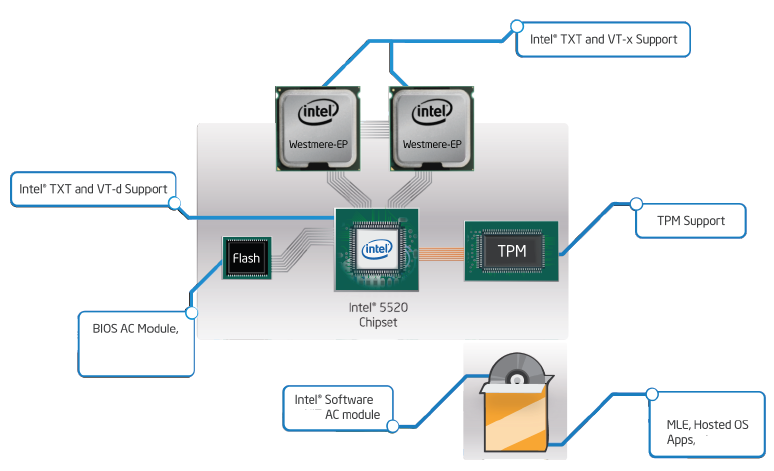
Intel Trusted Execution Technology (Intel TXT), formerly known as LaGrande Technology, is a computer hardware technology designed to provide attestation of a platform's authenticity and assurance that an authentic operating system starts in a trusted environment. It uses a Trusted Platform Module (TPM) and cryptographic techniques to measure software and platform components, enabling system software and management applications to make trust decisions. The technology defends against software-based attacks aimed at stealing sensitive information by corrupting system or BIOS code or modifying platform configuration.
- Tpm version 1.0 hashing algorithm
- SHA-1
- Tpm version 2.0+ hashing algorithm
- SHA-2
- Static chain of trust pcrs
- PCR0–PCR7
- Dynamic chain of trust pcrs
- PCR17–PCR22
- Dynamic root of trust measurement instru
- special security instruction
- Launch control policy components
- SINIT version, platform configuration (PCONF), MLE validity
Lore & Background
Intel TXT is based on an industry initiative by the Trusted Computing Group (TCG) to promote safer computing. It complements the Intel Management Engine. The technology supports both a static chain of trust and a dynamic chain of trust. The static chain of trust begins at platform power-on or reset, resetting all PCRs to default values. The processor measures a digitally signed Authenticated Code Module (ACM) provided by the chipset manufacturer, which then measures the first BIOS code module. These measurements are extended into PCR0, which holds the static core root of trust measurement (CRTM) and the BIOS Trusted Computing Base (TCB). Additional measurements are extended into PCR1 through PCR7 for host platform configuration, option ROM code, IPL code, and other components.
The dynamic chain of trust starts when the operating system invokes a special security instruction, resetting dynamic PCRs (PCR17–22) and starting the measured launch. The processor measures a SINIT ACM, which then measures the first operating system code module (the measured launch environment, or MLE). Before the MLE executes, the SINIT ACM verifies the Launch Control Policy (LCP), which checks the SINIT version, platform configuration against known-good PCR0–7 values, and the MLE measurement against a list of known-good measurements. The integrity of the LCP is protected by storing a hash of the policy in the TPM's protected non-volatile location, modifiable only by the platform owner.
The technology also provides a more secure way for the operating system to initialize the platform. Instead of the normal processor initialization using Start-up Inter-Processor Interrupts (SIPIs) that start processors in real mode, the secure launch puts application processors in a special sleep state from which they are directly started in protected mode with paging on, and are not allowed to leave this state.
Reader's Guide
Intel TXT enables the creation of Trusted Compute Pools, where platforms are evaluated and assigned trust levels based on their PCR measurements. These measurements can be used locally or remotely via TPM digital signatures (PCR Quotes) to detect tampering, corruption, and malicious software. Trusted Compute Pools support isolation—controlling whether a platform connects to a production network or is quarantined based on trust level or launch control policy failure—as well as trust-based policy, such as restricting critical applications to platforms meeting specified trust levels, and compliance and auditing, demonstrating that sensitive data has only been processed on platforms meeting trust requirements.
Numerous server platforms include Intel TXT, and its functionality is leveraged by software vendors including HyTrust, PrivateCore, Citrix, and VMware. Open-source projects such as tboot provide a TXT-based integrity system for the Linux kernel and Xen hypervisor. Windows 10 PCs with PCR7 Binding have the ability to enable or disable full device encryption. The technology's ability to establish a chain of trust through PCR extension ensures that any modification to measured code, configuration, or data results in a different PCR value, making tampering detectable.
Did You Know?
- Intel TXT was formerly known as LaGrande Technology.
- The TPM v1.0 specification uses SHA-1 hashing; v2.0+ uses SHA-2.
- PCR extension hashes the current PCR value with a new measurement, ensuring only identical sequences produce the same result.
- The dynamic chain of trust resets PCRs 17–22 and uses a SINIT ACM to measure the measured launch environment (MLE).
Architecture & the Out-of-Band Design
Intel Active Management Technology operates on a fundamentally different plane than conventional software-based management. Rather than routing commands through an operating system's software stack, AMT leverages a dedicated microprocessor subsystem called the Intel Management Engine, which resides on the motherboard as a service processor. This subsystem is not exposed to end users and runs independently of whatever software environment the machine is in. Communication between a remote administrator and the target machine travels through a hardware-based TCP/IP channel that bypasses the OS entirely. This means the management link persists whether the operating system is running, crashed, or absent altogether, and whether the hard drive or memory modules are functional. The design philosophy separates AMT from older hardware management approaches like DHCP auto-configuration or wake-on-LAN, which were limited to narrow tasks. Instead, AMT provides a full remote management surface that a software application can drive, giving system administrators wire-level access to machines that would otherwise be unreachable.
Remote Management Capabilities
The feature set of AMT spans power control, remote access, and network security, all delivered through the out-of-band channel. Administrators can remotely power up, power down, or cycle a machine via encrypted wake-on-LAN. A wired PC sitting on an open LAN outside a corporate firewall can establish a secure tunnel back to the IT console. For deeper intervention, AMT supports remote boot through integrated device electronics redirect, console redirection via serial over LAN, and full keyboard-video-mouse over network access. On the security side, hardware-based filters inspect packet headers in both inbound and outbound traffic for known threats using programmable timers, while desktops additionally employ time-based heuristic filters. An isolation circuitry mechanism—unofficially dubbed a circuit breaker by Intel—can port-block, rate-limit, or fully cut off a compromised machine. A persistent event log lives in protected memory rather than on the hard drive, and out-of-band alerting notifies administrators of anomalies. Agent presence checking uses hardware-based policy timers, where a missed heartbeat generates an event and potentially an alert.
Security Flaws & Industry Response
Despite its security-focused design, AMT and the underlying Management Engine have been the target of significant vulnerabilities. In May 2017, Intel confirmed a remote elevation-of-privilege bug (CVE-2017-5689) affecting every platform equipped with Standard Manageability, Active Management Technology, or Small Business Technology, spanning from the 2008 Nehalem generation through the 2017 Kaby Lake generation. The exploit was remotely accessible, meaning no local presence was required. Just months later, in November 2017, Intel acknowledged additional major flaws (SA-00086) impacting Management Engine, Trusted Execution Engine, and Server Platform Services firmware across Skylake through Coffee Lake systems. In response, hardware vendors such as Purism and System76 began shipping machines with the Intel Management Engine disabled entirely to eliminate the remote attack surface. These incidents highlighted a tension: the very subsystem designed to give administrators secure remote control also created a persistent, always-on attack vector that traditional OS-level security patches could not reach.
Ecosystem, Standards & Access Model
AMT is not a standalone product but a component embedded within Intel's vPro platform, available across desktops, servers, ultrabooks, tablets, and laptops using Core i5, i7, i9, Xeon E3-1000, Xeon E, and Xeon W-1000 processors. It requires an Intel networking card and the corporate edition of the Management Engine binary to function. Intel has progressively aligned AMT with DMTF's Desktop and Mobile Architecture for System Hardware standards, with Release 5.1 and later implementing DASH version 1.0 and 1.1 for out-of-band management. Functionally, AMT mirrors IPMI but targets client computing rather than the server domain where IPMI traditionally resides. Access to full capabilities is tiered: while basic iAMT may ship free with consumer and small-business devices, encrypted remote access via public key certificates and automatic provisioning of unconfigured clients require purchasing additional software from Intel or a third-party ISV or VAR. Intel's own developer toolkit offers only basic, non-production access, explicitly lacking the encrypted communications of the complete management system.
Gallery
Frequently Asked Questions
What is Intel Trusted Execution Technology?
Intel TXT, originally developed under the codename LaGrande Technology, is a hardware-level feature that verifies a platform's authenticity and guarantees the operating system boots into a trusted environment. It depends on a TPM chip and cryptographic measurements so that management software can make informed trust decisions about the system.
What does Intel TXT actually do on a system?
TXT measures key software and platform components with cryptographic techniques, letting system software confirm integrity before granting trust. Its primary defensive role is blocking software-based attacks that attempt to steal sensitive data by corrupting BIOS code or tampering with platform components.
How does the chain of trust work with PCR registers in Intel TXT?
The static chain of trust is recorded in PCR registers 0 through 7, while the dynamic chain of trust occupies PCR registers 17 through 22. A special security instruction acts as the dynamic root-of-trust measurement point that kicks off the dynamic chain.
What three elements make up the Launch Control Policy in Intel TXT?
The Launch Control Policy is defined by the SINIT version, the platform configuration value (PCONF), and MLE validity. All three must align before the measured launch environment is authorized to proceed with booting.
Why is Intel Trusted Execution Technology important for platform security?
It gives enterprises and security-sensitive applications a hardware-rooted attestation that the platform is genuine and the OS started in a verified trusted state, a guarantee that pure software defenses cannot provide. This closes a critical gap against attacks that corrupt firmware or BIOS before the OS even loads.
More in Intel and AMD Microprocessors, Part 3 1-24
Spotted an error? Know more?
Reader corrections go straight into our review queue. Suggest an edit · How this site is sourced