
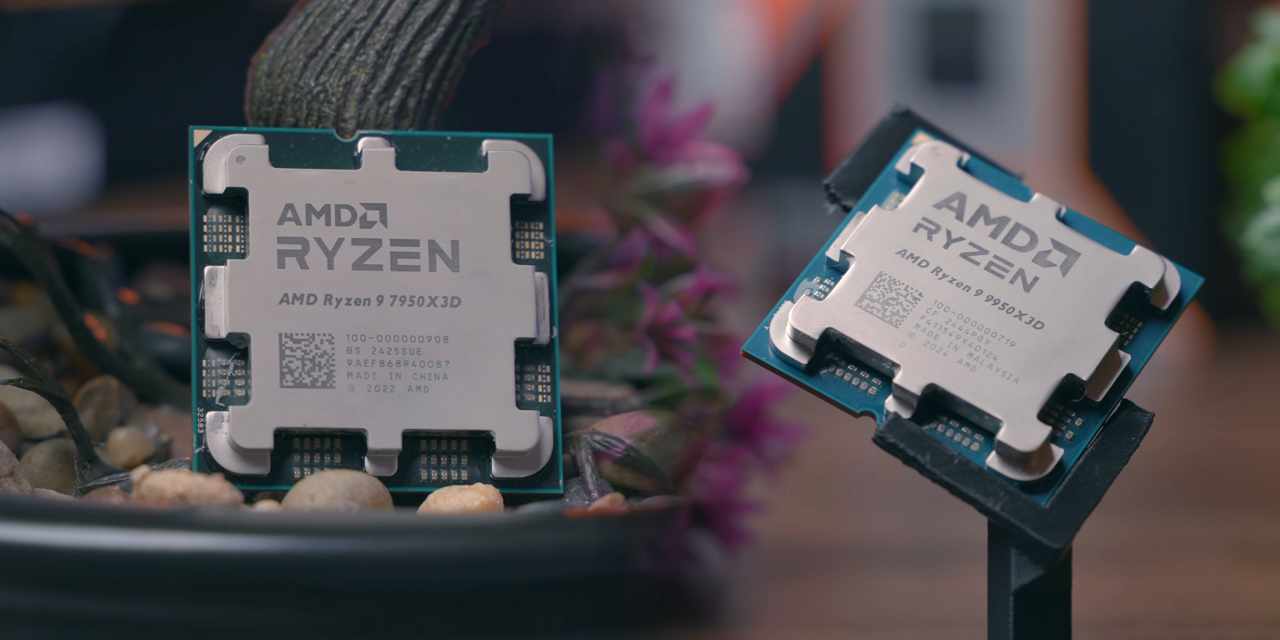
AMD Ryzen 9 9950X3D
Flagship desktop CPU with second-generation 3D V-Cache for gaming and creation.

MoreThanTech · CC BY 3.0
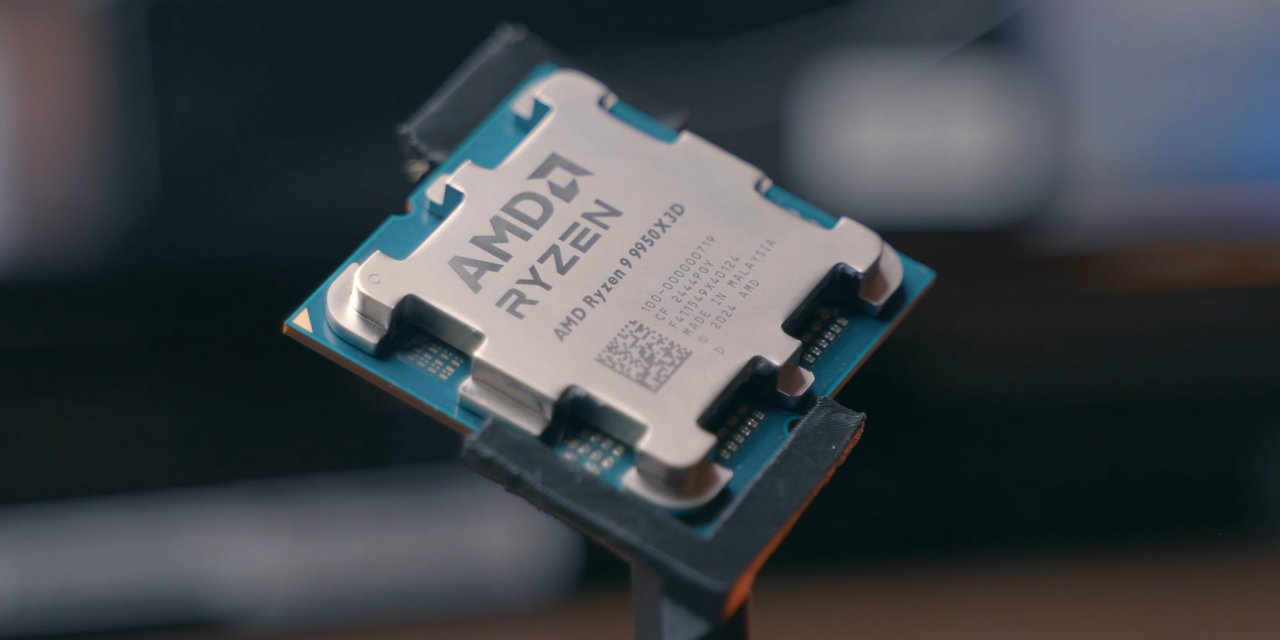
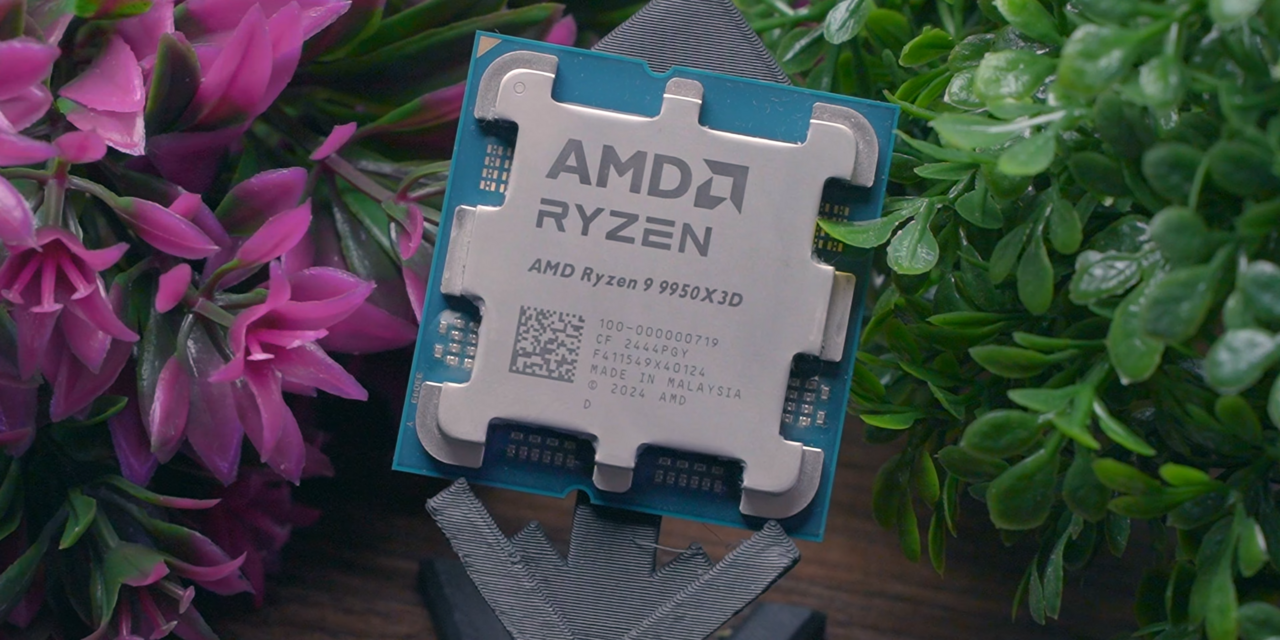
The AMD Ryzen 9 9950X3D is a flagship desktop processor from AMD, unveiled at CES in January 2025 and launched on March 12, 2025, as part of the Ryzen 9000 series. It is designed for both gaming and content creation, incorporating AMD’s second-generation 3D V-Cache technology. A more powerful version, the Ryzen 9 9950X3D2, was announced at CES 2026 and released on April 22, 2026.
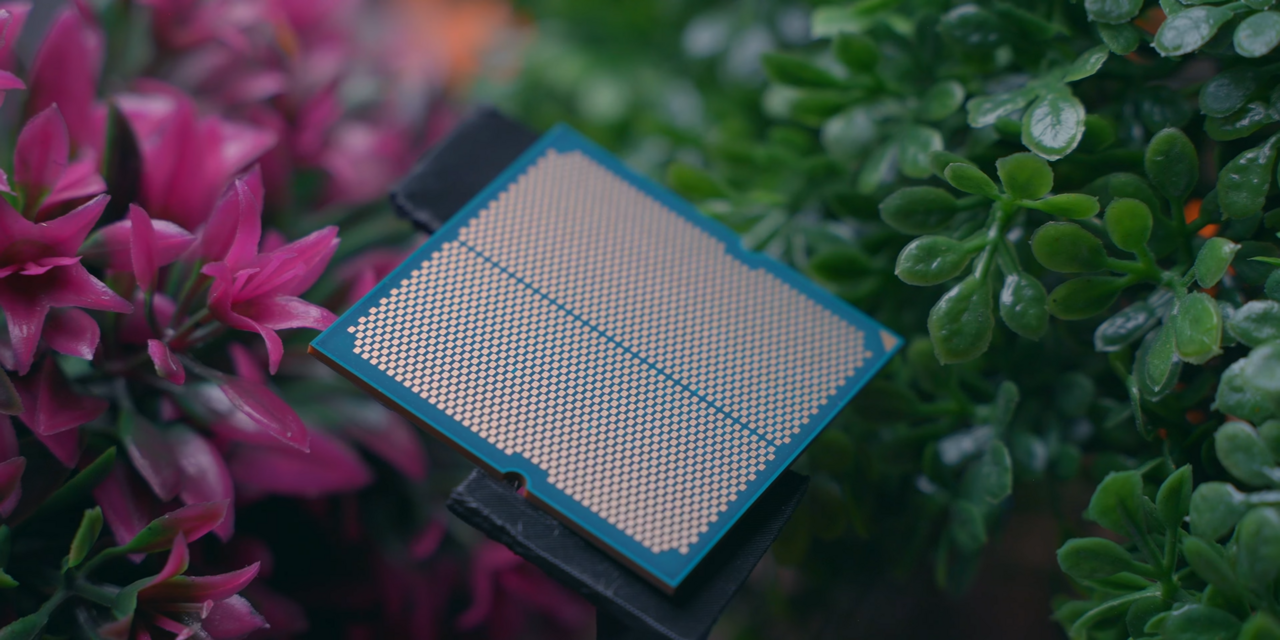
Built on the Zen 5 "Granite Ridge" architecture, the 9950X3D has 16 cores and 32 threads, with a base clock around 4.3 GHz and boost speeds up to 5.7 GHz. One of its two core complex dies (CCDs) features stacked 3D V-Cache, giving it roughly 128 MB of L3 cache and a total CPU cache of 145 MB. Its default thermal design power (TDP) is 170 W, with a maximum consumption of 230 W. It uses the AM5 socket and supports DDR5 memory up to 256 GB.
The second-generation 3D V-Cache moves the cache die below one CCD instead of on top, improving heat dissipation and allowing higher sustained boost clocks under load. The asymmetric cache setup—only one CCD gets the extra cache—aims to balance cache-sensitive gaming with multi-threaded productivity tasks.
AMD markets the 9950X3D as suitable for both gamers and creators. In gaming benchmarks, it performs similarly to the Ryzen 7 9800X3D, while its extra cores give it an edge in content creation like video editing and 3D rendering.
At launch, AMD called it "the world's best processor for gamers and creators," pricing it at US$699, above Intel's Core Ultra 9 285K. Reviewers praised its balance of gaming and productivity but noted its gaming advantage over cheaper X3D models was modest. ComputerBase found it combined top application performance with a top gaming ranking, but criticized its high power consumption in gaming versus the 9800X3D. PC Games Hardware called it the best CPU overall, beating Intel's Core Ultra 9 285K and Core i9-14900K(S), but advised pure gamers to choose the 9800X3D for better gaming speed, lower cost, and fewer scheduling issues. PCMag praised its gaming performance and justified its price, but noted it was "not much faster" than the Ryzen 9 9950X in workloads. Heise Online said it merged the strengths of the 9950X and 9800X3D. Golem found it almost always the fastest gaming CPU, even ahead of the 9800X3D.
Quick Facts
- Produced-Start
- March 12, 2025
- Slowest
- 4.3
- Fastest
- 5.7
- Arch
- Zen 5
- Code
- Granite Ridge
- Numcores
- 16
- Socket
- AM5
- Predecessor
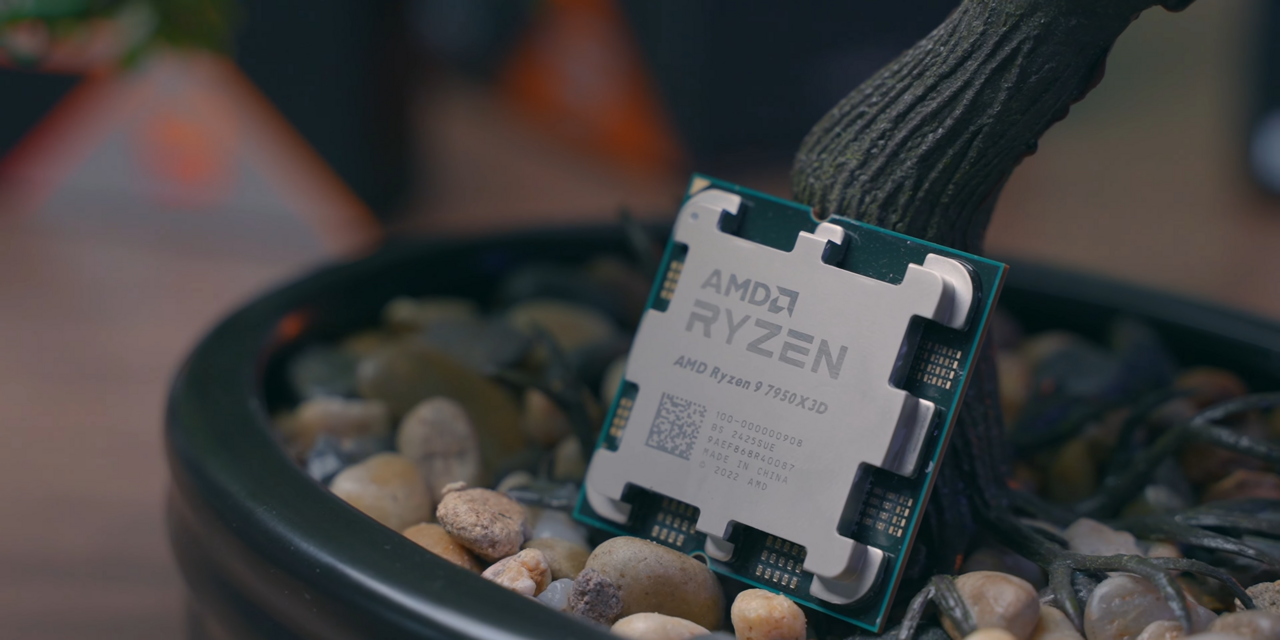
- Ryzen 9 7950X3D
Facts from the source article.
Lore & Background
The Ryzen 9 9950X3D is based on the Zen 5 'Granite Ridge' architecture and incorporates 16 cores and 32 threads, with a base clock frequency of approximately 4.3 GHz and boost speeds reaching up to 5.7 GHz. One of its two core complex dies (CCDs) includes AMD's stacked 3D V-Cache, resulting in a total of around 128 MB of L3 cache and 145 MB of total CPU cache. The processor has a default thermal design power (TDP) of 170 W, with a maximum consumption of 230 W, and is compatible with the AM5 socket platform supporting DDR5 memory up to 256 GB.
The 9950X3D introduces AMD's second-generation 3D V-Cache implementation, which repositions the cache die to below one of the CCDs to improve thermal characteristics compared with earlier models. This design allows higher sustained boost clocks under load. Earlier Ryzen generations using 3D V-Cache positioned the extra cache die on top of a CCD, which limited maximum core clocks due to cooling restrictions. The asymmetric cache distribution—where only one CCD carries the additional stacked cache—offers a balance between cache-sensitive gaming workloads and multi-threaded productivity applications.
AMD markets the Ryzen 9 9950X3D as a processor suitable for both gamers and creators. In gaming benchmarks, it delivers performance comparable to the Ryzen 7 9800X3D, while its higher core count provides a notable advantage in content creation tasks such as video editing and 3D rendering.
Reader's Guide
At launch, AMD described the Ryzen 9 9950X3D as 'the world's best processor for gamers and creators.' With a launch price of US$699, it is positioned above Intel's consumer flagship of the same generation, the Core Ultra 9 285K. Reviewers highlighted its strong balance of gaming and productivity performance, though noted that its advantage in gaming over less expensive X3D models was modest. ComputerBase found that 'In testing, the AMD Ryzen 9 9950X3D combines the best of both worlds: the highest application performance with a top ranking in gaming.' However, they criticized the CPU's relatively high power consumption in gaming compared to the Ryzen 7 9800X3D. According to PC Games Hardware, the 9950X3D 'is currently the best CPU on the market in terms of overall performance', beating both Intel's Core Ultra 9 285K and Intel's previous-generation flagship Core i9-14900K(S). They noted that users who do not need high productivity performance 'should still opt for the Ryzen 7 9800X3D. Not only is it slightly faster in games and significantly cheaper to purchase, but thanks to only one CCD, it also avoids the problems associated with faulty scheduling.' PCMag praised the CPU for its performance, especially in gaming, and found its high price justified, but noted that its performance in workloads is 'Not much faster' than the Ryzen 9 9950X. Heise Online stated that, until the release of the 9950X3D, power users had the choice between the 9950X for maximum multithreading performance and the 9800X3D for maximum gaming performance, while 'The Ryzen 9 9950X3D now combines both worlds.' In Golem's benchmarks, the 9950X3D was 'almost always the fastest gaming CPU, even ahead of the specialized AMD Ryzen 7 9800X3D'. IGN praised the CPU's 'surprisingly good value, given what you are getting', calling it 'the obvious choice unless you have specific workloads that are accelerated by Intel CPUs', noting that 'Intel's CPUs have more cores, so they tend to perform better in heavily multi-threaded workloads'. The processor's high power consumption and thermal output require robust cooling solutions and high-quality motherboards with strong power delivery. For users focused exclusively on gaming, lower-cost X3D models may provide comparable frame rates at a reduced price.
Did You Know?
- The Ryzen 9 9950X3D was announced in January 2025 at CES and released on 12 March 2025.
- It features second-generation 3D V-Cache with the cache die repositioned below one CCD for better thermals.
- Total CPU cache is 145 MB, including approximately 128 MB of L3 cache.
Architectural Lineage & Core Philosophy
The Ryzen 9 9950X3D belongs to a family of x86-64 microprocessors built on AMD's Zen microarchitecture. From the very first Summit Ridge chips to the latest iterations, every Ryzen processor in the consumer desktop line (excluding PRO variants) ships with an unlocked multiplier, giving enthusiasts full control over their clock speeds. Simultaneous Multithreading is a near-universal feature across the entire lineup, with only the earliest Zen and Zen+ based Ryzen 3 chips and a handful of Zen 2 mobile parts serving as exceptions. The family spans Ryzen 3, 5, 7, and 9 consumer tiers, plus the Threadripper line that pushes core counts up to 96. This deep architectural consistency—x86-64 compatibility, SMT support, and overclocking freedom—forms the foundational DNA that the 9950X3D inherits and extends into the modern era.
Platform & I/O Evolution Across Generations
The desktop Ryzen platform has undergone significant I/O and memory changes over its lifetime. Early Summit Ridge and Pinnacle Ridge chips on the AM4 socket offered 24 PCIe 3.0 lanes paired with DDR4-2666 or DDR4-2933 dual-channel support. By the Matisse generation, the platform jumped to PCIe 4.0 while retaining AM4 and bumping memory to DDR4-3200. The Threadripper line on TR4 and later sTRX4 or sWRX8 sockets provided 64 or even 128 PCIe 4.0 lanes alongside quad-channel or octa-channel DDR4-3200. In every case, four to eight lanes were reserved as the chipset link. The 9950X3D sits at the apex of this consumer desktop progression, inheriting the high-bandwidth I/O philosophy AMD has refined across every generation from the 14LP era through the 7FF node and beyond.
Manufacturing Process & Cache Hierarchy Journey
The fabrication process behind Ryzen chips tells a story of steady node advancement. First-generation Summit Ridge and Whitehaven parts were built on GlobalFoundries' 14 LP process. The second-generation Pinnacle Ridge and Colfax moved to GlobalFoundries 12LP, a modest shrink marketed as 14LP+. A more significant leap arrived with Matisse and Castle Peak, which shifted production to TSMC's 7FF node. The cache hierarchy evolved in parallel: early Zen cores carried 96 KB of L1 per core, split into 32 KB data and 64 KB instruction, while Zen 2 and later reduced this to 64 KB with an even 32/32 split, maintaining 512 KB of L2 per core throughout. The 9950X3D represents the culmination of this multi-year refinement in both process technology and on-die memory architecture.
HEDT Pedigree & the Workstation Tradition
The Ryzen 9 9950X3D descends from a lineage that includes AMD's high-end desktop and workstation segments. Whitehaven Threadripper 1000 on TR4 delivered 64 PCIe 3.0 lanes and quad-channel DDR4-2666. Castle Peak (Threadripper 3000) on sTRX4 and sWRX8 expanded this to 64 or 128 PCIe 4.0 lanes, with Threadripper PRO models supporting octa-channel DDR4-3200. These HEDT parts, like their consumer siblings, lacked integrated graphics and shared the same per-core cache structure. The 4000-series Renoir desktop line even included a curious soldered BGA variant bundled with a motherboard and GDDR6 RAM, reportedly repurposed from defective PlayStation 5 and Xbox Series X/S chip stock. The 9950X3D carries forward the ambition of this high-core-count, high-bandwidth tradition into the modern consumer flagship space.
Gallery
Frequently Asked Questions
What is the AMD Ryzen 9 9950X3D?
It is AMD's top-tier desktop processor in the Ryzen 9000 family, built on the Zen 5 'Granite Ridge' architecture. The chip targets both high-end gaming and heavy content-creation workloads by pairing standard compute cores with a stacked second-generation 3D V-Cache.
How many cores and threads does the AMD Ryzen 9 9950X3D have?
The chip carries 16 cores and 32 threads, running at a base frequency near 4.3 GHz with a maximum boost of roughly 5.7 GHz. One of its two core-complex dies carries the 3D V-Cache stack to accelerate cache-sensitive tasks.
When did the AMD Ryzen 9 9950X3D launch?
AMD unveiled the part at CES in January 2025, and retail availability began on March 12, 2025. At release it sat at the very top of the Ryzen 9000 desktop lineup.
Why does the AMD Ryzen 9 9950X3D matter to enthusiasts?
It was the first consumer desktop CPU to combine full 16-core Zen 5 performance with second-generation 3D V-Cache, giving gamers a large cache advantage without sacrificing the thread count creators need. That dual-use design made it a rare 'do-everything' flagship in the market.
Is there a successor to the AMD Ryzen 9 9950X3D?
Yes—AMD announced the Ryzen 9 9950X3D2 at CES 2026, with a retail launch on April 22, 2026. The '2' variant is positioned as a more powerful refresh of the same 3D V-Cache platform.
More in Intel and AMD Microprocessors, Part 3 1-24
Spotted an error? Know more?
Reader corrections go straight into our review queue. Suggest an edit · How this site is sourced