
Athlon
AMD's first seventh-generation x86 processor and first to reach 1 GHz.

AMD · Public domain
AMD Athlon is the brand name for a series of x86-compatible microprocessors made by Advanced Micro Devices. The first model, now called the Athlon Classic, was the first seventh-generation x86 processor and the first desktop chip to hit one gigahertz. It launched as AMD's top-tier processor brand on June 23, 1999.
The original Athlon came from AMD's K7 project in the 1990s. Founder and CEO Jerry Sanders pushed for partnerships and engineering talent in the late 1990s, building on the K6 line. In 1998, AMD partnered with Motorola to develop copper-based semiconductor tech, making the K7 the first commercial processor to use copper fabrication. Sanders called this a "virtual gorilla" to compete with Intel on capacity without huge spending. The K7 team included engineers from the earlier NexGen K6 group, such as Vinod Dham.
The Athlon launched on June 23, 1999, with general availability by August 1999. From August 1999 to January 2002, it was the fastest x86 chip in the world. The Los Angeles Times noted in October 1999 that AMD had overtaken Intel, with the Athlon significantly faster than the Pentium III at 600 MHz. Compaq, IBM, and others used it in their top PCs. The copper interconnect process, refined with Motorola, let AMD produce 180-nanometer chips about a year before Intel, cutting power and allowing clock speeds up to 1 GHz. The architecture used the EV6 bus licensed from DEC, avoiding Intel's GTL+ bus. By summer 2000, AMD shipped Athlons in high volume for systems from Gateway, Hewlett-Packard, and Fujitsu Siemens.
Later versions include the Thunderbird in 2000, the Athlon XP in 2001, and the Athlon 64 in 2003, which used the AMD64 architecture. After the Phenom launch in 2007, the Athlon name was used for mid-range chips above Sempron. The Athlon 64 X2 in 2005 was AMD's first native dual-core desktop CPU, and the Athlon X2 followed. The Athlon II, a dual-core family, arrived in 2009.
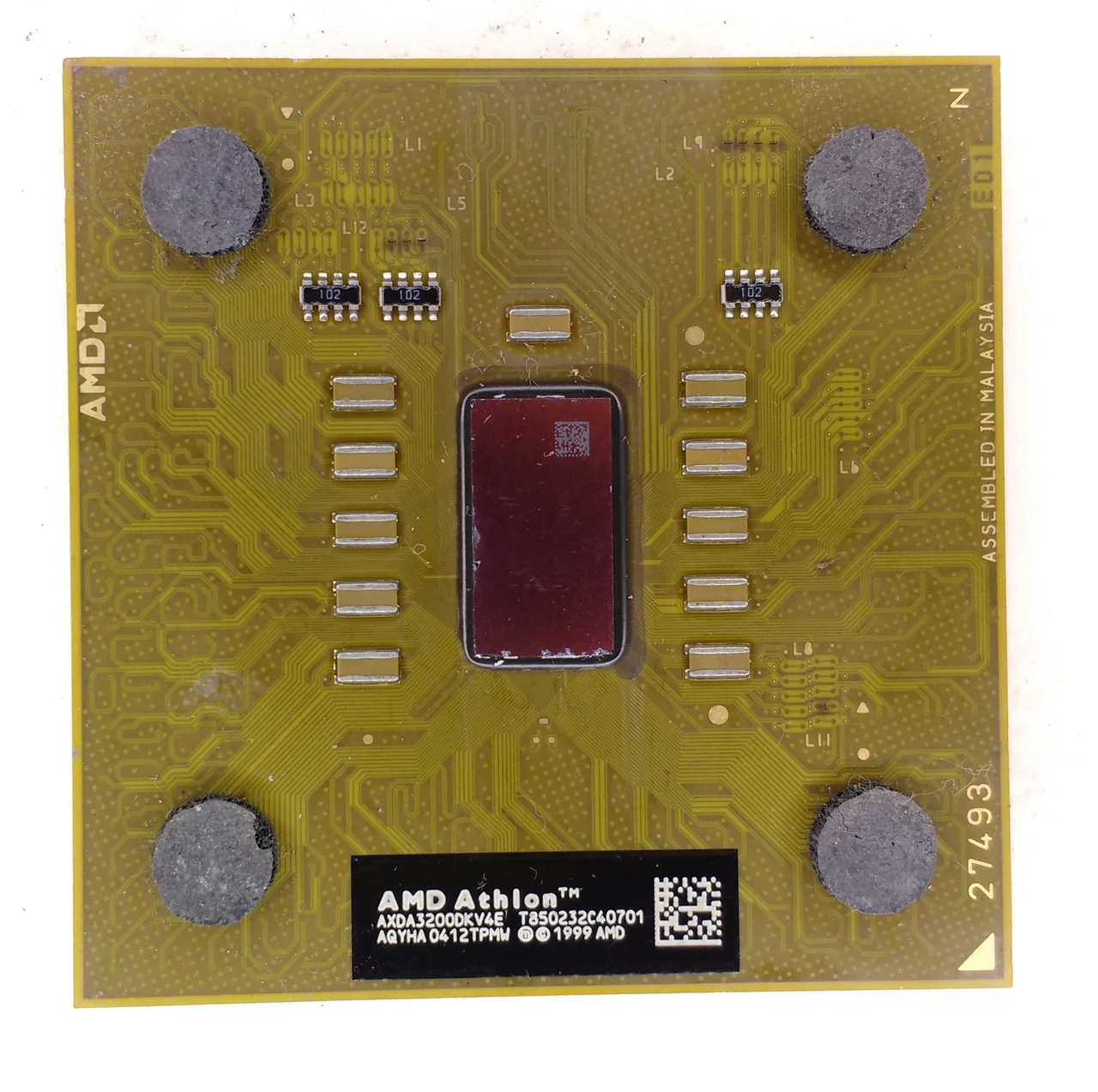
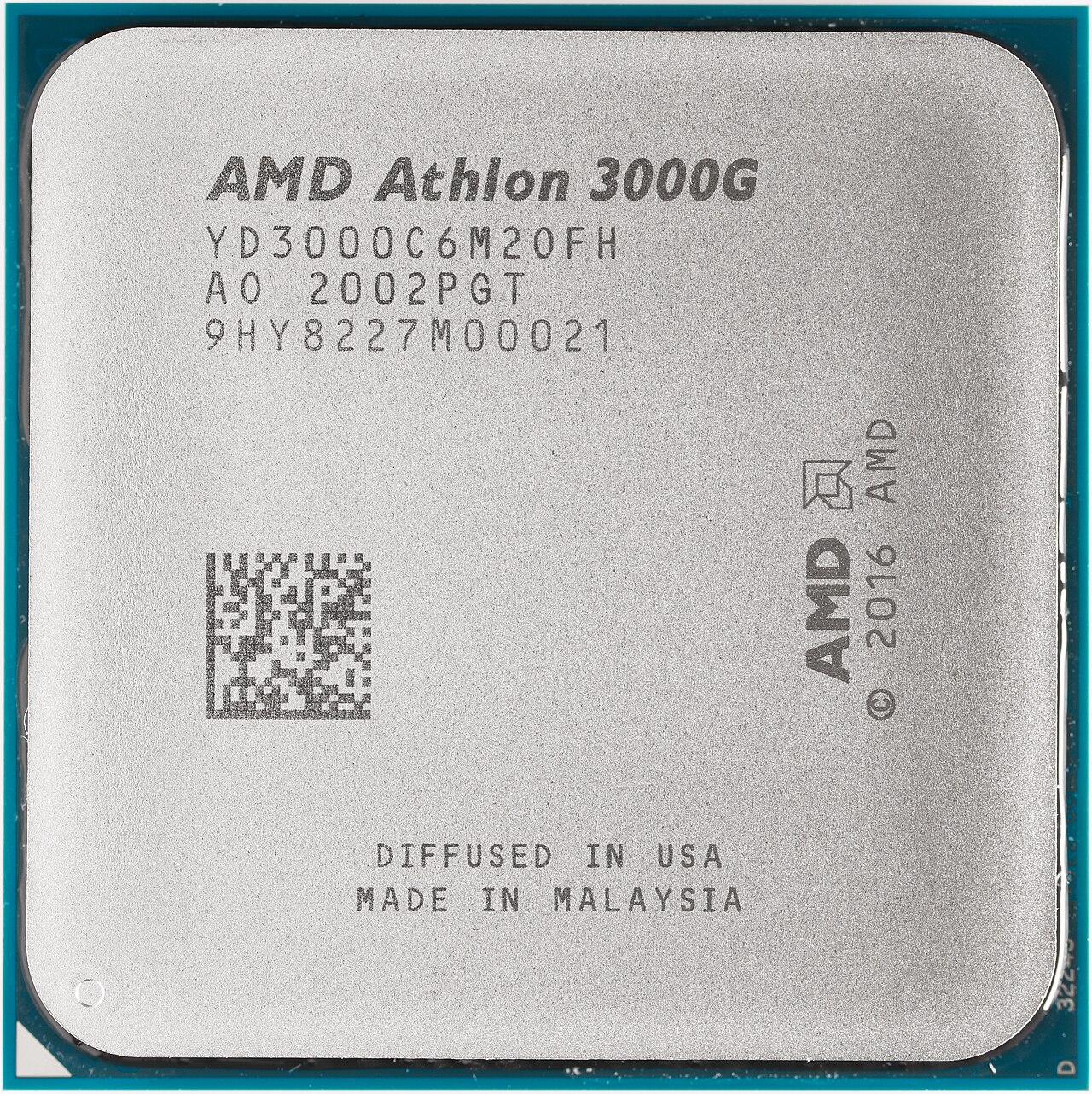
In September 2018, AMD introduced the $55 low-power Athlon 200GE with Radeon graphics, below the Ryzen 3 2200G. It used the Zen-based Raven Ridge core from Ryzen. AMD then used the Athlon brand for low-cost, high-volume products, similar to Intel's Celeron and Pentium Gold. The Athlon 3000G, launched in 2019, was positioned as AMD's highest-performance entry-level processor, competing with Intel's Pentium.
Quick Facts
- Produced-Start
- June 23, 1999
- Slowest
- 500
- Slow-Unit
- MHz
- Fastest
- 1400
- Fsb-Slowest
- 100
- Fsb-Fastest
- 133
- Predecessor
- K6-III
- Successor
- Athlon XP
Facts from the source article.
Lore & Background
The first Athlon processor was a result of AMD's development of K7 processors in the 1990s. AMD founder and then-CEO Jerry Sanders aggressively pursued strategic partnerships and engineering talent in the late 1990s, working to build on earlier successes with the AMD K6 processor line. One major partnership announced in 1998 paired AMD with Motorola to co-develop copper-based semiconductor technology, resulting in the K7 project being the first commercial processor to utilize copper fabrication technology. The K7 design team added to the previously acquired NexGen K6 team, which already included engineers such as Vinod Dham.
The AMD Athlon processor launched on June 23, 1999, with general availability by August 1999. From August 1999 until January 2002, this initial K7 processor was the fastest x86 chip in the world. The Athlon architecture used the EV6 bus licensed from DEC as its main system bus, allowing AMD to develop its own products without needing to license Intel's GTL+ bus. The Athlon Classic is a cartridge-based processor, named Slot A, using the same physical 242-pin connector used by Intel Slot 1 processors but rotated by 180 degrees. It contained 512 KB of L2 cache run at a divisor of the processor clock and accessed via its own 64-bit back-side bus.
Later Athlon iterations include the Thunderbird (2000), Athlon XP (2001), Athlon 64 (2003), Athlon 64 X2 (2005), Athlon X2, Athlon II (2009), and modern Zen-based Athlon with Radeon Graphics introduced in 2019 as AMD's highest-performance entry-level processor. The Athlon 3000G was introduced in 2019 and positioned against the Intel Pentium, using Radeon Vega graphics rated as more powerful than the Pentium's Intel UHD Graphics.
Reader's Guide
The Athlon brand has spanned multiple generations and architectures, from the original K7 Classic through the 64-bit Athlon 64, Athlon II, and modern Zen-based APUs. The original Athlon was notable for being the first seventh-generation x86 processor and the first desktop processor to reach 1 GHz, overtaking Intel's Pentium III in performance at launch. By working with Motorola, AMD refined copper interconnect manufacturing about one year before Intel, permitting 180-nanometer production and lower power consumption that enabled clock speeds to reach 1 GHz. The Athlon's use of the EV6 bus from DEC allowed AMD to avoid licensing Intel's GTL+ bus. The Athlon Classic was an enormous commercial success. Over the years, the Athlon name has been used for high-end processors, mid-range processors, and most recently for low-cost, high-volume entry-level products. The modern Zen-based Athlon with Radeon Graphics, introduced in 2019, is positioned as AMD's highest-performance entry-level processor, competing with the Intel Pentium and offering more powerful integrated graphics.
Did You Know?
- The original Athlon was the first desktop processor to reach speeds of one gigahertz (GHz).
- The Athlon Classic was the first commercial processor to utilize copper fabrication technology, developed with Motorola.
- The Athlon used the EV6 bus licensed from DEC, allowing AMD to avoid licensing Intel's GTL+ bus.
- The Slot-A Athlons were the first multiplier-locked CPUs from AMD.
A Name That Kept Reinventing Itself
The Athlon brand has never been a static label. When AMD first shipped its K7 "Argon" desktop processors, the name stood alone as a bold declaration of a new architecture. That era closed in 2001, when the company rebranded its lineup around the "Athlon XP" moniker, effectively retiring the bare name from consumer shelves for several years. During that stretch, "Athlon" existed only as a prefix to XP, 64, X2, and II designations. Then in 2008, AMD made a surprising move: it resurrected the standalone "Athlon" name for single-core 64-bit processors drawn from the existing Athlon X2 and Phenom product families. The brand continued to morph, eventually being applied to accelerated processing units that fused CPU and GPU silicon onto a single die. By the time Zen and Zen+ cores appeared under the Athlon banner in Raven Ridge and Picasso, the name had traveled from a pure CPU identity to a broad umbrella covering integrated graphics, mobile SoCs, and even 6-nanometer mobile parts like Mendocino. What began as one architecture's codename became a multi-decade family tree spanning desktops, laptops, and embedded platforms.
From Argon to Zen: A Microarchitectural Odyssey
The Athlon family traces a remarkable path through AMD's microarchitectures. It began with the K7 "Argon" core, fabricated at 250 nanometers, where the L2 cache ran at half the CPU's clock speed. The follow-on K75 "Pluto" and "Orion" designs moved to 180 nm but introduced variable cache ratios—50 percent at lower frequencies, dropping to 33 percent at 1 GHz. Thunderbird, also 180 nm, finally matched L2 cache speed to the CPU. Decades later, the Piledriver-based Trinity APU carried 1.303 billion transistors across a 246 mm² die, while the Steamroller-based Kaveri pushed that to 2.41 billion on 245 mm². The Excavator generation in Carrizo and Bristol Ridge reached 3.1 billion transistors on 250.04 mm². The journey culminated in Zen-based Raven Ridge at 14 nm, Zen+ Picasso at 12 nm, and the 6-nanometer Mendocino mobile chip built on TSMC's FinFET process. Each step represented a leap in transistor density, core count, and feature integration.
The APU Revolution: Fusing CPU and GPU
Starting with the 2012 Trinity launch on the "Virgo" platform, the Athlon name became synonymous with accelerated processing units. Built on a 32-nanometer GlobalFoundries SOI process and mounted on Socket FM2, Trinity paired Piledriver CPU cores with a Graphics Core Next GPU, supported up to four DIMMs of DDR3-1866 memory, and included an integrated PCIe 2.0 controller alongside Turbo Core technology for dynamic CPU and GPU scaling. Richland in 2013 refined the formula with Turbo Core 3.0, NX bit protection, and PowerNow! power management. Kabini, also 2013, took a different approach as a full system-on-chip on 28 nm, integrating memory controllers, PCIe, dual USB 3.0 ports, six USB 2.0 ports, Gigabit Ethernet, and dual SATA III controllers around Jaguar cores and a GCN GPU. Kaveri and its Godavari refresh brought Steamroller cores to Socket FM2+ with PCIe 3.0, while Carrizo and Bristol Ridge added DDR4 support, NVMe storage options, and PCIe 3.0 x8 connectivity.
Instruction Sets and Platform Capabilities
The technical feature set of Athlon processors expanded dramatically over the family's lifespan. Early K7 and K75 models supported only MMX and Enhanced 3DNow!, with Thunderbird maintaining that same baseline. By the Piledriver era, the instruction repertoire had grown to include the full SSE family through SSE4.2, AMD64, AMD-V virtualization, AES encryption, CLMUL, AVX, XOP, FMA3, FMA4, F16C, ABM, BMI1, and TBM. Carrizo and Bristol Ridge added AVX2, BMI2, and RDRAND to that list. Memory support evolved from the original double-data-rate front-side bus—where the true transfer rate was twice the physical clock—to dual-channel DDR3-1866, then DDR4 in later Excavator parts. The Zen 2-based Mendocino mobile processor represents the current frontier: 6-nanometer TSMC FinFET fabrication, LPDDR5-5500 dual-channel memory, 64 KB L1 cache per core, 512 KB L2 per core, four PCIe 3.0 lanes, and an integrated RDNA2 GPU, all on Socket FT6.
Gallery
Frequently Asked Questions
What is the AMD Athlon?
The Athlon is AMD's flagship brand for a family of x86-compatible desktop processors. It debuted as the company's top-tier chip and represented AMD's first seventh-generation x86 design.
What made the Athlon a historic milestone for desktop computing?
It was the very first desktop microprocessor to cross the 1 GHz clock-speed barrier. No other desktop chip had reached that threshold before the Athlon's arrival.
When did the Athlon first hit the market?
AMD officially launched the Athlon on June 23, 1999, positioning it as its premium processor brand. The initial K7 models ran at 500–700 MHz, while the follow-up K75 series stretched the range up to 1 GHz.
How was the Athlon's memory hierarchy structured?
The chip carried 64 KB of instruction cache and 64 KB of data cache on-die, with an additional 512 KB of L2 cache mounted on the processor module. That external L2 operated at 50%, 40%, or 33% of the core clock depending on the specific model.
Where did the Athlon project originate?
The design grew out of AMD's internal K7 development effort in the 1990s, driven by CEO Jerry Sanders' push to attract top engineering talent and strategic partnerships. A 1998 collaboration with Motorola on copper interconnect technology helped make the K7's advanced semiconductor process feasible.
More in Intel and AMD Microprocessors, Part 3 1-24
Spotted an error? Know more?
Reader corrections go straight into our review queue. Suggest an edit · How this site is sourced