
Mayer Amschel Rothschild
Founder of the Rothschild banking dynasty.

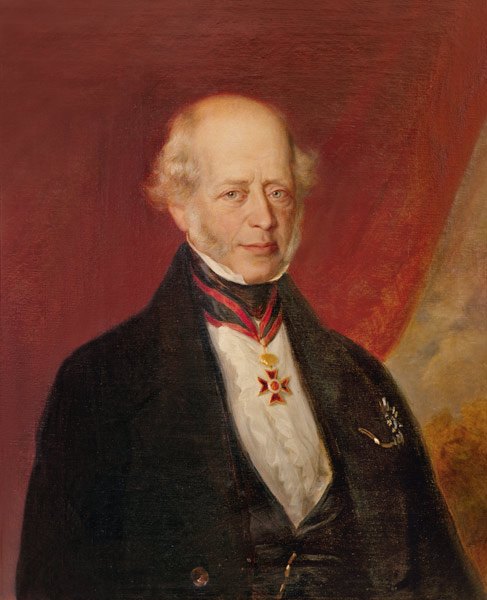
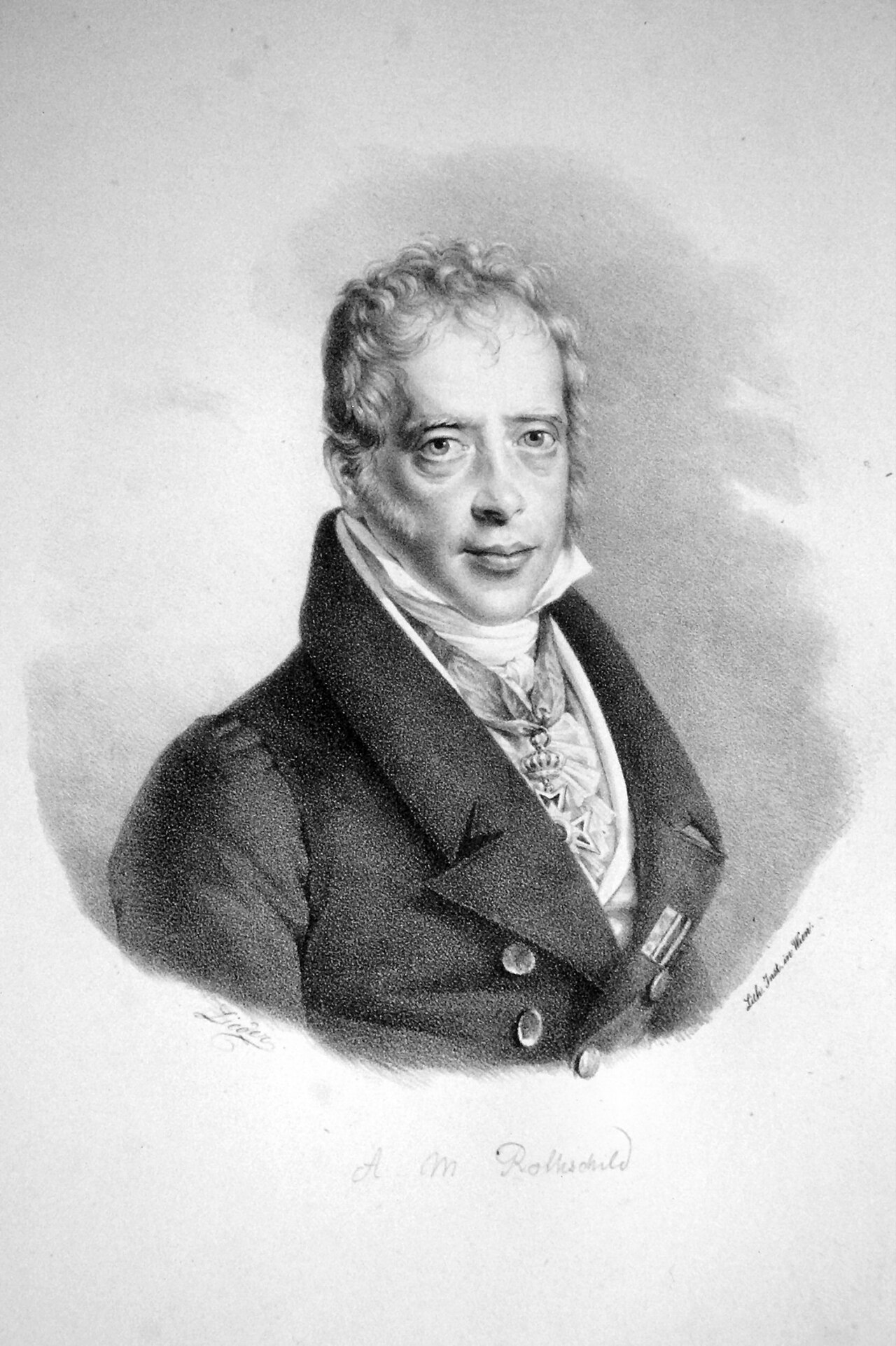
Friedrich Lieder · Public domain
Mayer Amschel Rothschild (born 23 February 1743 or 1744, died 19 September 1812; sometimes written Anschel) was a German Jewish banker who built the Rothschild banking dynasty. This family dominated European international finance from the 1820s through the 1870s. Often called a founding father of international finance, he was ranked seventh on Forbes magazine's 2005 list of the twenty most influential businesspeople of all time.
He was born in 1744 into an Ashkenazi Jewish family in the Judengasse, the Jewish ghetto of Frankfurt, then part of the Holy Roman Empire. He was one of eight children of Amschel Moses Rothschild (died 1755) and Schönche Rothschild (née Lechnich; died 1756). The Rothschild lineage traces back to 1569 and Izaak Elchanan Rothschild, whose name comes from the German "zum rothen Schild" (with old spelling "th"), meaning "with the red shield"—a reference to the house the family lived in for generations. At that time, houses were identified by signs with symbols or colors, not numbers. The Rothschild surname was already in use by the family long before Mayer Amschel's grandchildren; the move in 1664 to another Judengasse house, Hinterpfann, was made by earlier ancestors, not his grandchildren. That house remained the family home and business until the early 1800s. Mayer's father ran a business trading goods and exchanging currency, and he personally supplied coins to the Prince of Hesse. The family lived above the shop in a space with an 11-foot-wide front wall, where more than thirty people resided at once.
In 1757, with help from relatives, Rothschild secured an apprenticeship under Jacob Wolf Oppenheimer at the Hanover banking firm of Simon Wolf Oppenheimer. The grandson of Samuel Oppenheimer taught him about foreign trade and currency exchange. Rothschild returned to his brothers' business in Frankfurt in 1763. He began dealing in rare coins and gained the patronage of Crown Prince Wilhelm of Hesse, who had also supported his father. In 1769, Rothschild received the title of "Court Factor." His coin business attracted other princely patrons, then expanded into banking services for Crown Prince Wilhelm, who became Wilhelm IX, Landgrave of Hesse-Kassel in 1785. After the French Revolution, business grew rapidly as Rothschild handled payments from Britain for hiring Hessian mercenaries.
- Born
- 23 February 1743 or 1744
- Died
- 19 September 1812
- Field
- Banking, finance
- Nationality
- German (Holy Roman Empire)
- Known for
- Founder of the Rothschild banking dynasty
Lore & Background
Mayer Amschel Rothschild was born in 1744 to an Ashkenazi Jewish family in the Judengasse, the Jewish ghetto of Frankfurt, Holy Roman Empire, one of eight children of Amschel Moses Rothschild and his wife Schönche. The Rothschild name derives from the German 'zum rothen Schild' (with the old spelling 'th'), meaning 'with the red shield', referring to the house where the family lived for generations. His father had a business in goods and currency exchange and was a personal supplier of coins to the Prince of Hesse.
With the help of relatives, Rothschild secured an apprenticeship under Jacob Wolf Oppenheimer at the banking firm of Simon Wolf Oppenheimer in Hanover in 1757. He returned to his brothers' business in Frankfurt in 1763, became a dealer in rare coins, and won the patronage of Crown Prince Wilhelm of Hesse, gaining the title of 'Court Factor.'
Reader's Guide
Mayer Amschel Rothschild's significance lies in founding a banking dynasty that dominated international finance in Europe for decades. Starting from a modest background in the Frankfurt ghetto, he built a network of princely patrons and became the principal banker to the Landgrave of Hesse-Kassel. His strategic placement of sons in key European cities—Nathan in London, Jacob in Paris, Salomon in Vienna, Calmann in Naples, and Amschel Mayer in Frankfurt—created the 'five arrows' of banking, enabling the family to operate across borders and finance major state operations, such as Wellington's armies in Portugal. Rothschild's posthumous ennoblement by Emperor Francis I of Austria in 1817 reflected his lasting impact. His legacy includes the establishment of M. A. Rothschild & Söhne in 1810 and the expansion of international banking practices, including issuing loans and circumventing trade blockades. The Rothschild name remains synonymous with financial power and influence.
From the Judengasse to the Court
Mayer Amschel Rothschild was born in 1744 in the Judengasse, the Jewish ghetto of Frankfurt am Main, the son of Amschel Moses Rothschild, a money changer who had traded with the Prince of Hesse. The family's documented history stretches back to the 16th century, with the surname itself derived from the house Rothschild, built by Isaak Elchanan Bacharach in 1567 and identified by a red shield sign, the common method of marking buildings in that era. The first known member to bear the name was Isaak Elchanan Rothschild, born in 1577. Mayer grew up in this modest commercial world of money-changing and local trade, yet he would go on to serve as court factor to the German Landgraves of Hesse-Kassel in the Free City of Frankfurt, within the Holy Roman Empire. By the 1760s he had established his own banking business, transforming a family of local traders into the nucleus of what would become the largest private fortune in the world during the 19th century.
The Five-Arrow Strategy
Mayer Amschel Rothschild's most consequential decision was to distribute his five sons across Europe's principal financial capitals. Amschel Mayer remained in Frankfurt, Salomon Mayer went to Vienna, Nathan Mayer settled in London, Kalman Mayer took up post in Naples, and Jakob Mayer established himself in Paris. This arrangement was so central to the family's identity that it was immortalized in their coat of arms: a clenched fist gripping five arrows, drawn from Psalm 127's image of children as arrows in a warrior's hand. Beneath the shield, the family motto reads Concordia, Integritas, Industria — Unity, Integrity, Industry. The red shield from the original Frankfurt house sits at the centre of the heraldic design. Unlike earlier court factors whose fortunes were vulnerable to local violence or royal expropriation, this dispersed structure meant the family's wealth was spread across multiple jurisdictions, making it far harder for any single power to seize or destroy it.
An Impervious Financial Architecture
Paul Johnson observed that the Rothschilds were elusive, noting that libraries of nonsense had been written about them while the truth remained difficult to pin down. A key reason for their enduring power was a structural innovation: rather than holding wealth in land or local assets that could be confiscated, the family kept their fortune in financial instruments — stocks, bonds, and debts — circulating across borders. As Johnson put it, their real wealth became beyond the reach of the mob and almost beyond the reach of greedy monarchs. Mayer's insistence on keeping the banks in family hands also preserved strict secrecy about the size of their holdings. The Jewish Encyclopedia of 1906 noted that this model of brothers establishing branches in different financial centres was later imitated by other Jewish financiers such as the Bischoffsheims, Pereires, Seligmans, and Lazards, cementing the Rothschilds' role as the head of the international banking group. Their dominance of European finance lasted from the 1820s until joint-stock banks broke their hegemony in the 1870s.
Noble Status and the Question of Continuity
The five sons of Mayer Amschel Rothschild were elevated to the Austrian nobility, and the family also received noble rank in the United Kingdom, a distinction that set them apart from the merchant class of their origins. Mayer had carefully arranged marriages, often between first- or second-cousins, mirroring the intermarriage patterns of European royalty, to keep the fortune consolidated within the family. Yet by the late 19th century, nearly all Rothschilds had begun marrying outside the family, typically into the aristocracy or other financial dynasties. The family's wealth, which at its peak constituted the largest private fortune in modern world history, gradually declined and was divided among numerous descendants throughout the 20th century. Today, only the French and British branches subsist. Their assets now span financial services, real estate, mining, energy, agriculture, and winemaking, alongside philanthropic and nonprofit endeavours. Despite this, the family has frequently been the target of antisemitic conspiracy theories, a shadow that Johnson noted made accurate scholarship so difficult to produce.
Gallery
Frequently Asked Questions
Who is Mayer Amschel Rothschild?
He was a German Jewish banker born in the Frankfurt ghetto in the mid-1700s who established the Rothschild banking dynasty. He is widely regarded as a founding figure of modern international finance.
What is Mayer Amschel Rothschild's main role or contribution?
He is best known as the founder of the Rothschild banking dynasty, a family that went on to dominate European international finance from the 1820s through the 1870s. His early work laid the groundwork for what became one of history's most powerful financial houses.
Where and when was Mayer Amschel Rothschild born?
He was born on 23 February 1743 or 1744 in the Judengasse, the Jewish quarter of Frankfurt, then part of the Holy Roman Empire. He grew up in an Ashkenazi Jewish family as one of eight children.
Why is Mayer Amschel Rothschild important in business history?
Forbes magazine ranked him seventh among the twenty most influential businesspeople of all time in their 2005 list. He is frequently called a founding father of international finance because of the dynasty he built from a modest position in Frankfurt.
More in Innovators In Industry 1-24
Spotted an error? Know more?
Reader corrections go straight into our review queue. Suggest an edit · How this site is sourced