
Levi Strauss
German-born American who founded the first blue jeans company.

Levi Strauss · Public domain
Levi Strauss was a German-born American businessman who founded the first company to manufacture blue jeans. His firm, Levi Strauss & Co. (Levi's), began in 1853 in San Francisco, California, and became a global symbol of American workwear.
- Born
- February 26, 1829, Buttenheim, Kingdom of Bavaria, German Confederation
- Died
- September 26, 1902, San Francisco, California, United States
- Field
- Business, manufacturing
- Nationality
- German-born American
- Known for
- Founding the first company to manufacture blue jeans (Levi Strauss & Co.)
Lore & Background
Levi Strauss was born to a Jewish family in Buttenheim on February 26, 1829, in the Franconia region of the Kingdom of Bavaria. In 1847, aged 18, he traveled with his mother and two sisters to the United States to join his brothers Jonas and Louis, who had a wholesale dry goods business in New York City. After arriving, Strauss worked as an itinerant peddler of goods from his brother's store, selling kettles, blankets, and sewing goods. He later moved to Louisville, Kentucky, to sell his brothers' supplies there, and declared his intention to become a U.S. citizen in 1853, being naturalized at a later date.
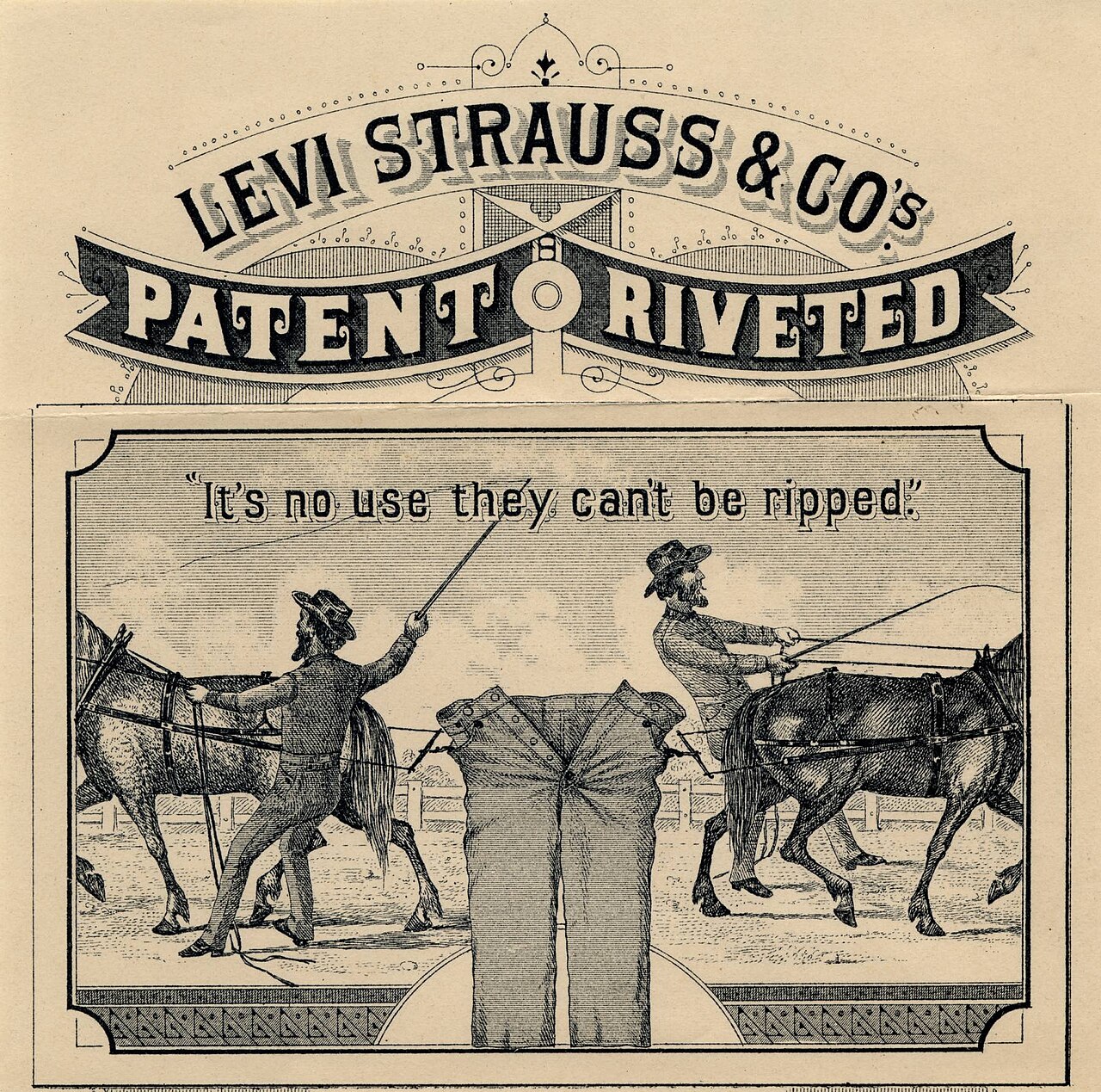
The family decided to open a West Coast branch of their dry goods business in San Francisco, the commercial hub of the California gold rush. Strauss was chosen to represent them, arriving in March 1853 via steamships through Panama. He opened his wholesale business as Levi Strauss & Co., importing fine dry goods from his brothers in New York, including clothing, bedding, combs, purses, and handkerchiefs. He made tents and later jeans while living with his sister Fanny's family. Tailor Jacob W. Davis of Reno, Nevada, one of his customers, invented a way to strengthen work pants using rivets in 1871, and went into business with Strauss to mass-produce them. The next year, Davis asked Strauss to help apply for a patent, which was issued in 1873, with one-half assigned to Levi Strauss & Co.
Levi Strauss never married and died on September 26, 1902, in San Francisco. His estate was worth about $30 million (equivalent to $877 million in 2024). His nephew Sigmund Stern's only child, Elise Fanny Stern, married Walter A. Haas, whose descendants are the current owners of Levi Strauss & Co.
Reader's Guide
Levi Strauss's significance lies in his founding of the first company to manufacture blue jeans, a garment that became a global cultural and fashion icon. His business, Levi Strauss & Co., began in 1853 in San Francisco during the California gold rush, initially as a wholesale dry goods operation. The pivotal innovation came in 1873 when Strauss partnered with tailor Jacob W. Davis to patent and mass-produce riveted work pants, which evolved into modern blue jeans. This collaboration established a durable workwear standard that later transcended its utilitarian origins.
Beyond his business, Strauss contributed to his community as a member of the Reform branch of Judaism, helping establish Congregation Emanu-El, the first Jewish synagogue in San Francisco. He also supported charities, including special funds for orphans, and the Levi Strauss Foundation began with an 1897 donation to the University of California, Berkeley, funding 28 scholarships. His legacy is preserved through the Levi Strauss museum in his birthplace of Buttenheim, Germany, and a visitors center at company headquarters in San Francisco. In 1994, he was inducted into the Hall of Great Westerners of the National Cowboy & Western Heritage Museum, reflecting his impact on American western heritage.
Did You Know?
- Levi Strauss was born Löb Strauß in Buttenheim, Kingdom of Bavaria, on February 26, 1829.
- The patent for riveted work pants, issued in 1873, was one-half assigned to Levi Strauss & Co.
- His estate was worth about $30 million at his death in 1902, equivalent to $877 million in 2024.
A Career Spanning Two Leagues
Ethan Casson has built a distinctive executive career that bridges both the NBA and the NFL, holding senior leadership positions in each league's business operations. His most recent appointment, announced in August 2025, placed him as president of the Dallas Mavericks, where he now directs the franchise's daily business functions and shapes its long-range strategic direction. Before that, he spent nine years as chief executive officer of the Minnesota Timberwolves, the Minnesota Lynx, and the G League's Iowa Wolves, a stretch that also saw him serve as the Timberwolves' alternate governor on the NBA Board of Governors. Earlier still, he held the role of chief operating officer at the San Francisco 49ers, where he was deeply involved in venue development and major event hosting. This cross-league experience—spanning basketball, football, and multi-property management—has positioned him as one of the sport business world's more versatile operators, recognized for contributions across business strategy, facility development, and community engagement.
Transforming Minnesota's Sports Ecosystem
During his nine-year tenure leading the Minnesota Timberwolves, Minnesota Lynx, and Iowa Wolves from 2016 to 2025, Casson drove record growth across virtually every major revenue and engagement metric. Season ticket sales, live attendance, corporate partnership revenue, television viewership, merchandise revenue, and digital audience engagement all climbed to new highs under his watch. The Timberwolves earned a finalist nod for Sports Business Journal's 2024 Sports Team of the Year, a testament to the breadth of that commercial expansion. Perhaps the most visible marker of his infrastructure vision was the $150 million renovation of Target Center, a project that modernized the arena's facilities and fan experience. The work drew industry attention, earning the venue a finalist spot for Sports Business Journal's 2018 Facility of the Year and a listing among Finance & Commerce's Top Projects of 2017. Together, these accomplishments painted a picture of an executive who could scale a multi-sport organization's commercial footprint while simultaneously investing in the physical spaces where fans gather.
Building Levi's Stadium and the 49ers' Future
Before his Minnesota chapter, Casson served as chief operating officer of the San Francisco 49ers, a role in which he played a central part in the creation of Levi's Stadium. One of his most consequential achievements there was negotiating a 20-year, $220 million naming rights agreement with Levi Strauss & Co., a deal that stood among the largest naming rights contracts ever signed in NFL history. He also contributed to the team's efforts in hosting marquee events, including Super Bowl 50. The stadium itself became an industry benchmark for sustainability: it was the first NFL venue to earn two LEED Gold certifications. That environmental distinction, combined with the facility's overall design, brought it multiple honors, including Sports Business Journal's 2015 Facility of the Year and the Green Sports Alliance's Environmental Innovators of the Year award in 2016. Casson's work on the 49ers demonstrated his ability to pair large-scale financial negotiations with forward-thinking facility planning, a combination that would later define his approach in Minnesota and Dallas.
Civic Leadership and a Life Beyond the Court
Casson's influence extended well beyond box office numbers and balance sheets. In Minnesota, he championed civic initiatives through partnerships with the National Basketball Social Justice Coalition and the Restore the Vote Coalition, efforts that helped push legislative changes restoring voting rights to roughly 50,000 Minnesotans who had been previously incarcerated or on parole. The organization's work in this area earned it the 2023–24 NBA Inclusion Leadership Award. His broader contributions to diversity and inclusion were further acknowledged when Sports Business Journal named him to its 2023 "ALL IN: Leaders in Diversity, Equity and Inclusion" list. Other honors include the Minneapolis/St. Paul Business Journal's Most Admired CEO in 2022, a spot on Sports Business Journal's "People Who Influenced Sports Business" in 2020, and an early-career nod as part of the publication's Forty Under 40 class of 2014. Off the field, Casson lives in Dallas with his wife Lisa and their two sons, Lucas and Miles. He earned his degree in Sports Management from Colby-Sawyer College and was inducted into both the New England Basketball Hall of Fame in 2013 and the Colby-Sawyer College Athletic Hall of Fame in 2015.
Gallery




Frequently Asked Questions
Who is Levi Strauss?
Levi Strauss was a German-born American entrepreneur who established the first company dedicated to manufacturing blue jeans. He founded Levi Strauss & Co. in San Francisco in 1853, turning a simple garment into a global icon of American workwear.
What was Levi Strauss's specific contribution to industry?
He is credited with creating the first company specifically built around producing blue jeans, transforming denim from a utilitarian fabric into a mainstream fashion staple. His San Francisco-based business set the template for modern apparel manufacturing.
Where and when was Levi Strauss born?
He was born on February 26, 1829, in Buttenheim, in the Kingdom of Bavaria (then part of the German Confederation). He later emigrated to the United States, where he built his career as a businessman and manufacturer.
How did Levi Strauss's life end?
Levi Strauss passed away on September 26, 1902, in San Francisco, California, the same city where he had launched his company nearly half a century earlier. He lived to see his brand become a lasting symbol of American culture.
Why is Levi Strauss considered important in industry history?
He is widely regarded as the person who turned blue jeans from a niche work garment into a worldwide fashion phenomenon. His founding of Levi Strauss & Co. in 1853 created a business that remains a global symbol of American workwear and innovation in manufacturing.
More in Innovators In Industry 1-24
Spotted an error? Know more?
Reader corrections go straight into our review queue. Suggest an edit · How this site is sourced