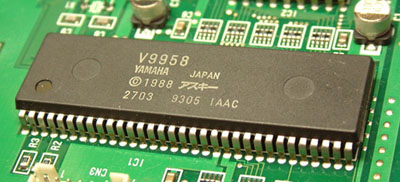
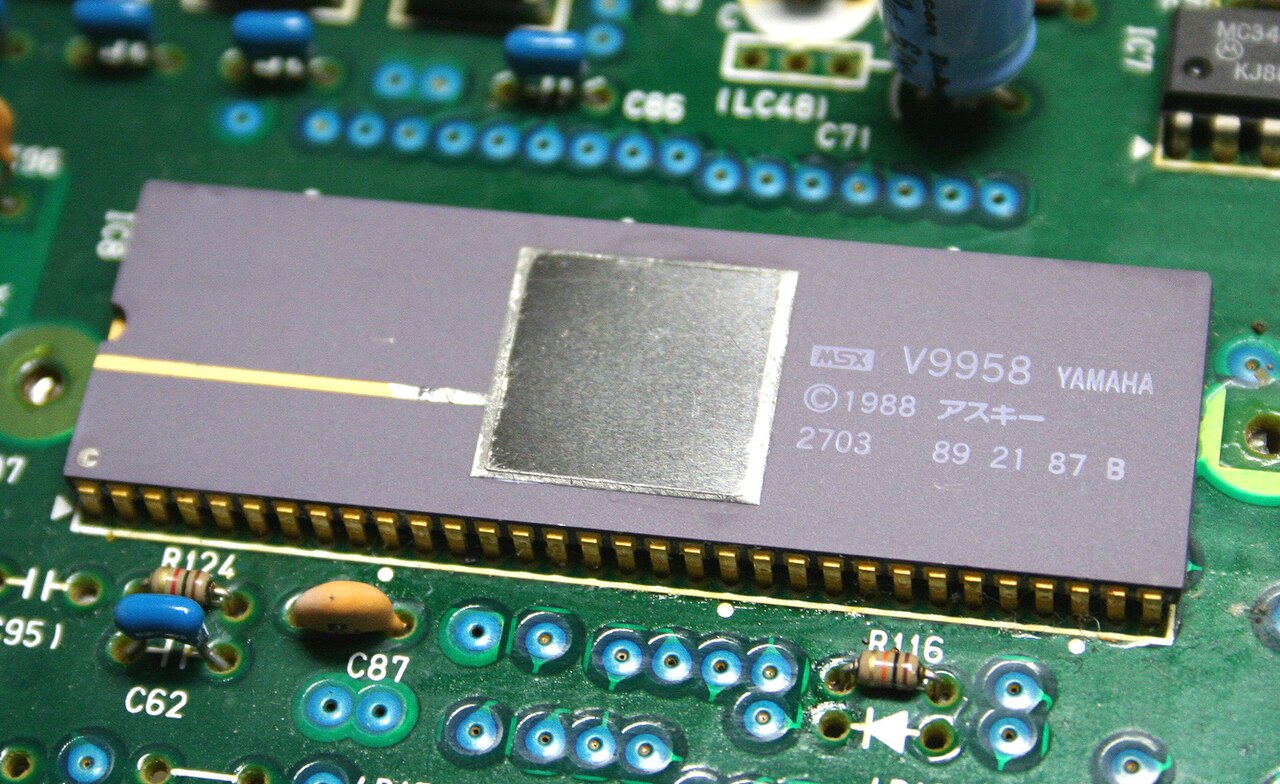
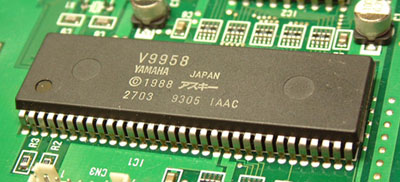
Yamaha V9958
Successor to V9938, adding YJK color modes and horizontal scrolling.

Yaca2671 · CC BY-SA 3.0
The Yamaha V9958 is a video display processor that succeeded the V9938. It appeared in MSX2+ and MSX turbo R home computers, and also in the TI Image Maker video expansion for the TI-99/4A. Its key additions over the earlier chip are three YJK graphical modes, which can display up to 19,268 colors, and registers for horizontal scrolling. The V9958 saw less widespread use than its predecessor.
- Video ram
- 128 KB + 64 KB of expanded VRAM
- Text modes
- 80 × 24 and 32 × 24
- Resolution
- 512 × 212 (4 or 16 colors out of 512) and 256 × 212 (16, 256, 12499 or 19268 colors)
- Sprites
- 32, 16 colors, max 8 per horizontal line
- Hardware acceleration
- copy, line, fill, etc.
- Interlacing
- to double vertical resolution
- Scroll registers
- horizontal and vertical
Lore & Background
The Yamaha V9958 was designed as the successor to the Yamaha V9938, which was used in the MSX2. It was employed in the MSX2+ and MSX turbo R series of home computers, and also appeared in the 'TI Image Maker' video expansion for the TI-99/4A home computer. The V9958 was not as widely adopted as the V9938.
Key additions over the V9938 include horizontal scrolling registers and three YJK graphics modes (similar to YUV): G7 + YJK + YAE (256 x 212, 12499 colors + 16 color palette) and G7 + YJK (256 × 212, 19268 colors). It also added the ability to execute hardware accelerated commands in non-bitmap screen modes. Removed features include lightpen and mouse functions, and composite video output.
On MSX systems, screen modes are often referred to by their assigned number in MSX BASIC. Screen 9 was reserved for South Korean MSX2 units.
Reader's Guide
The Yamaha V9958 is notable for introducing YJK graphics modes that allowed up to 19268 colors on screen, a significant leap from the V9938's capabilities. Its horizontal scrolling registers and ability to run hardware acceleration in non-bitmap modes expanded graphical flexibility. However, the article states it was not as widely adopted as the V9938, limiting its impact. The V9958 served as the video processor for the MSX2+ and MSX turbo R lines, as well as the TI-99/4A's 'TI Image Maker' expansion, but its legacy is overshadowed by its predecessor's broader use. The removal of lightpen, mouse, and composite video functions suggests a focus on digital RGB output and streamlined design for its target systems.
Did You Know?
- The V9958 added three YJK graphics modes with up to 19268 colors.
- It was used in the MSX2+, MSX turbo R, and the TI-99/4A 'TI Image Maker' expansion.
- The V9958 removed lightpen, mouse, and composite video output functions present in the V9938.
Gallery
Frequently Asked Questions
What is the Yamaha V9958?
The V9958 is a video display processor produced by Yamaha that served as the direct successor to the V9938 chip. It was designed to drive the graphics output of home computers and video expansion cards in the late 1980s and early 1990s.
Which computers featured the Yamaha V9958?
The chip was built into MSX2+ and MSX turbo R machines, and it also powered the TI Image Maker video expansion board for the TI-99/4A. Beyond those platforms it saw relatively limited adoption compared to its predecessor.
What improvements did the V9958 bring over the V9938?
The most notable additions were three YJK color modes capable of displaying up to 19,268 distinct colors, along with dedicated registers for hardware horizontal scrolling. These features gave developers more visual flexibility without relying on software workarounds.
What are the V9958's maximum resolution and color options?
At its highest graphical setting the chip outputs 256 × 212 pixels with 16, 256, 12,499, or 19,268 colors, and it can interlace frames to effectively double the vertical resolution. It also supports a wider 512 × 212 mode limited to 4 or 16 colors chosen from a 512-entry palette.
How many sprites can the V9958 handle simultaneously?
The chip supports up to 32 sprites at once, each rendered in 16 colors, with a maximum of eight sprites allowed on any single horizontal scanline. It also includes hardware-accelerated operations such as block copy, line drawing, and area fill to offload work from the CPU.
More in Graphics Hardware, Part 3 1-24
Spotted an error? Know more?
Reader corrections go straight into our review queue. Suggest an edit · How this site is sourced