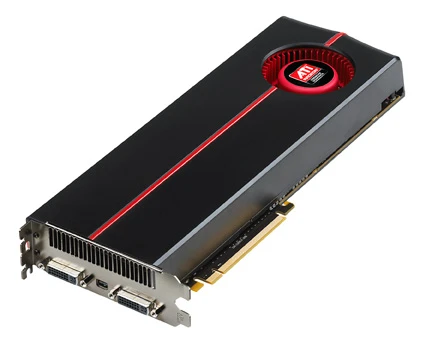
Voodoo 5
Last and most powerful graphics card line from 3dfx.

Infrogmation of New Orleans · CC BY-SA 3.0
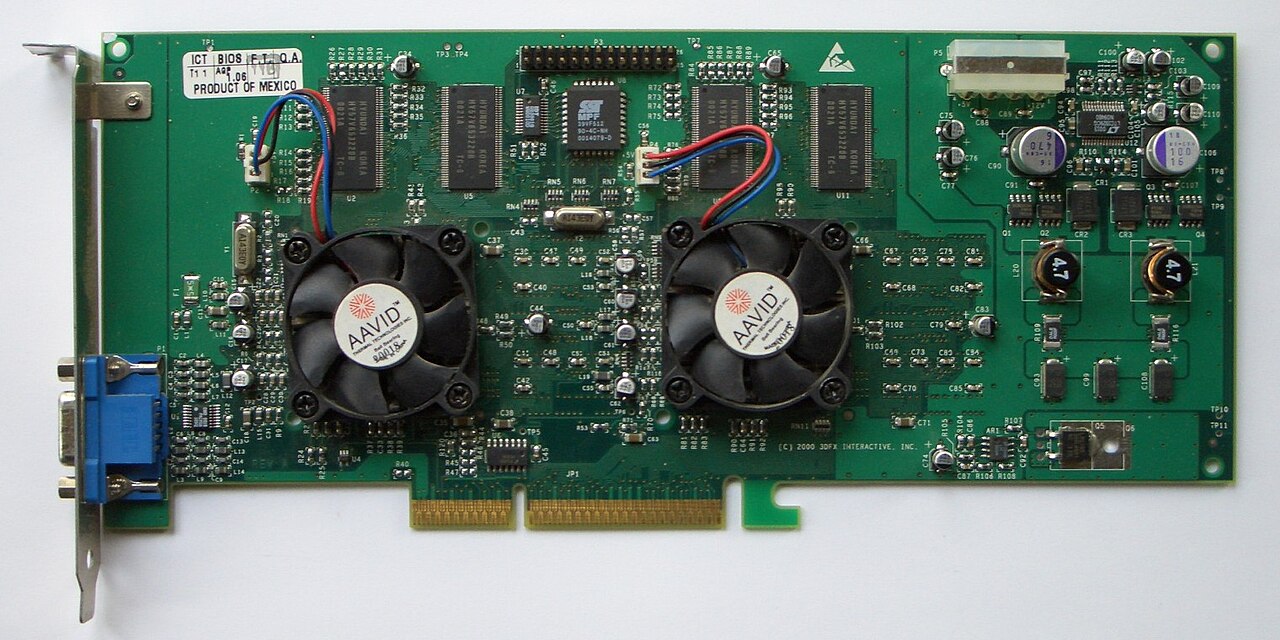
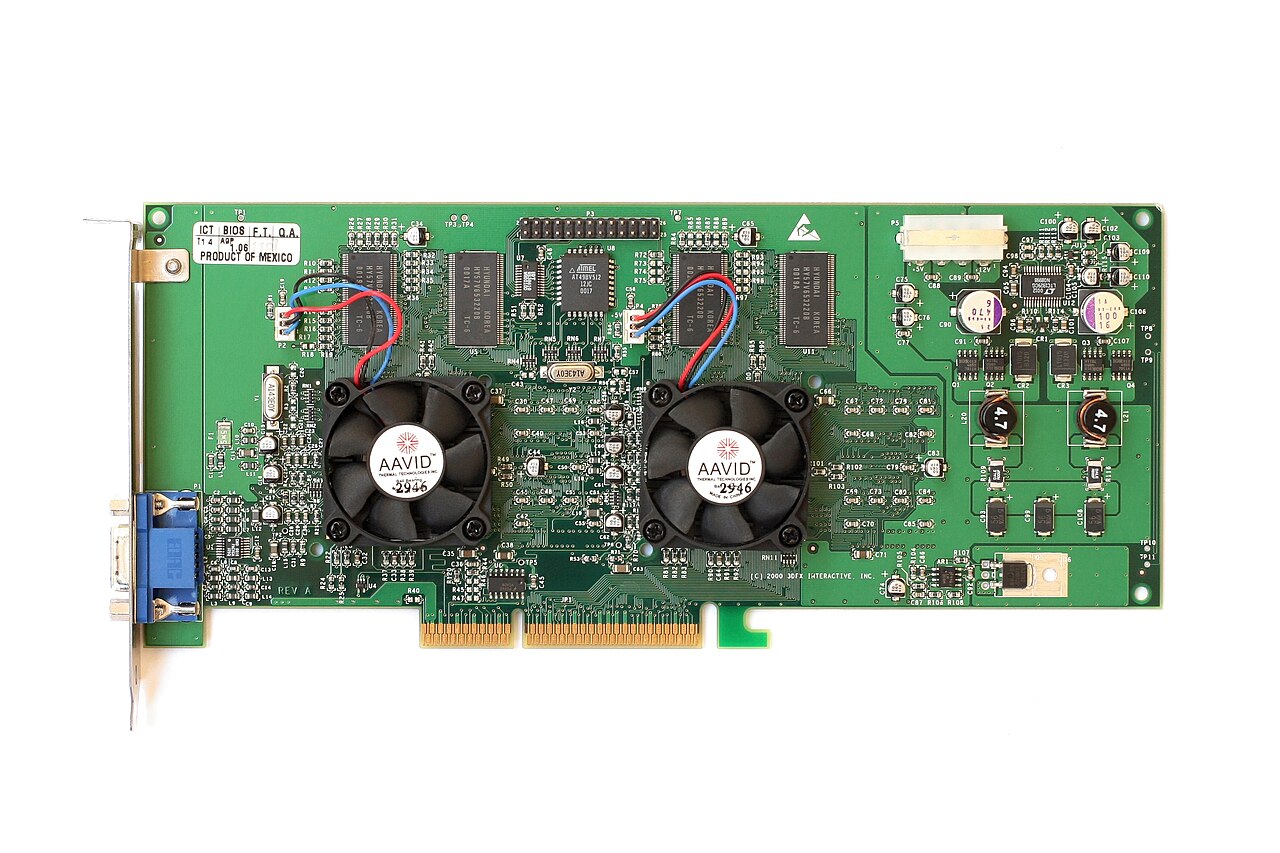
The Voodoo 5 family was the final and fastest series of graphics cards from 3dfx Interactive. All models used the VSA-100 processor, but only two versions actually went on sale: the single-chip Voodoo 4 4500 and the dual-chip Voodoo 5 5500.
The VSA-100 chip evolved from the "Avenger" design (the Voodoo3). It was built on the same 250 nm process, but with an extra metal layer for better density and speed, plus slightly shorter transistors and a thinner gate oxide. It contained about 14 million transistors, up from the Voodoo3's 8 million. The texture cache was larger, data paths were 32 bits wide (instead of 16), and rendering calculations ran at 40 bits internally, though operands and results were stored as 32-bit.
Scalability was a key goal—hence the name "Voodoo Scalable Architecture." A single VSA-100 chip design could be used in cards with anywhere from 1 to 32 processors running in parallel, with fill rate scaling proportionally. Multiple chips were linked via 3dfx's Scan-Line Interleave (SLI) technology. The downside was that hardware duplication increased board complexity and cost with each added chip.
The rendering pipeline changed from one pixel pipeline with two texture mapping units (as in the Voodoo2/3) to a dual pixel pipeline with one texture unit per pipeline. This 2×1 design could always output two pixels and two texels per clock, compared to the older 1×2 design's one pixel and two texels.
This was 3dfx's first chip to support full 32-bit color depth in 3D, up from 16-bit. The maximum texture size jumped from 256×256 pixels to 2048×2048. The chip also supported FXT1 and DXTC texture compression.
The VSA-100 included a hardware accumulation buffer called the "T-buffer." It stored combined outputs from several frames, enabling effects like motion blur (temporal) and anti-aliasing (spatial). It supported rotated-grid super-sampling anti-aliasing (RGSS AA), with the maximum AA level determined by the number of chips: one chip gave 2× AA, two gave 4×, four gave 8×, and so on. This method was considered higher quality than the ordered-grid over-sampling used by some competitors.
The chip used a 128-bit SDRAM interface, similar to the Voodoo3. Each VSA-100 processor had its own dedicated memory; capacity wasn't cumulative across the card, but bandwidth was effectively cumulative.
Quick Facts
- Codename
- VSA-100
- Created
- June 22, 2000
- Entry
- Voodoo4 4500
- Midrange
- Voodoo5 5500
- Predecessor
- Voodoo3
- Support Status
- Unsupported
Facts from the source article.
Lore & Background
The VSA-100 graphics chip is a direct descendant of 'Avenger', more commonly known as Voodoo3. It was built on a 250 nm semiconductor manufacturing process, tweaked with a sixth metal layer for better density and speed. The chip has a transistor count of roughly 14 million, compared to Voodoo3's ~8 million, and features a larger texture cache with 32-bit data paths. Rendering calculations are 40 bits wide but stored as 32-bit. One design goal was scalability: theoretically, 1 to 32 VSA-100 GPUs could run in parallel on a single card, linked via 3dfx's Scan-Line Interleave (SLI) technology, though this duplicated hardware and increased board complexity.
The VSA-100 introduced a dual pixel pipeline design (2×1 configuration), supporting full 32-bit color depth in 3D and texture sizes up to 2048px × 2048px. It implemented FXT1 and DXTC texture compression, and a hardware accumulation buffer called the 'T-buffer' for motion blur and anti-aliasing. The chip supported rotated-grid super-sampling anti-aliasing (RGSS AA), with maximum AA level determined by the number of chips: one chip allowed 2× AA, two chips 4× AA, four chips 8× AA, and so on. The Voodoo 5 5500 outperformed the Nvidia GeForce 256 and ATI Rage 128 MAXX, but was late to market against the GeForce 2 GTS and Radeon DDR, both of which easily outperformed it.
The unreleased Voodoo 5 6000 was to use four 166 MHz VSA-100 processors, each with 32 MB of 166 MHz SDRAM, resulting in the first 128 MB graphics card. Approximately 1000+ test cards were produced. It required a special external power supply called Voodoo Volts due to power exceeding AGP specifications. Performance tests showed it outperformed the GeForce 2 Ultra and Radeon 7500, and in some cases competed well with the GeForce 3. However, its projected $600 price tag and lack of DirectX 8.0 vertex and pixel shaders hampered its competitiveness.
Reader's Guide
The Voodoo 5 line represents the culmination of 3dfx's graphics hardware development, being the last and most powerful series released by the company. Its significance lies in the VSA-100's scalable architecture, which theoretically allowed up to 32 chips in parallel via SLI, though only single- and dual-chip models reached market. The Voodoo 5 5500 was competitive against earlier rivals like the GeForce 256 and Rage 128 MAXX, but its late arrival meant it faced newer, faster competitors such as the GeForce 2 GTS and Radeon DDR, which easily outperformed it. The unreleased Voodoo 5 6000, with four chips and 128 MB of RAM, demonstrated impressive performance against the GeForce 2 Ultra and Radeon 7500, and even competed with the next-generation GeForce 3 in some tests. However, its high production cost and projected $600 price tag, combined with the lack of DirectX 8.0 vertex and pixel shaders, made it uncompetitive. The precarious financial situation of 3dfx contributed to the 6000's demise, and the entire Voodoo 5 line ultimately failed to keep pace with rival developments from Nvidia and ATI, which offered more advanced features and better price-performance ratios.
Did You Know?
- The Voodoo 5 5500 came in three flavors: universal AGP, PCI, and a Mac Edition with dual link DVI-D and VGA-A outputs.
- The unreleased Voodoo 5 6000 was to be the first 128 MB graphics card, using four VSA-100 processors each with 32 MB of SDRAM.
- The Voodoo 5 6000 required a special external power supply called Voodoo Volts because it used more power than the AGP specification allowed.
Architecture & Scalability Philosophy
The VSA-100 chip, whose name stands for "Voodoo Scalable Architecture," represented 3dfx's most ambitious engineering effort. Built on a 250-nanometer process inherited from the Voodoo3, the design was refined with a sixth metal layer, shorter transistor gate lengths, and thinner gate oxide to push both density and speed. The result was roughly 14 million transistors—nearly double the Voodoo3's count. A core philosophy was modularity: the same chip could populate boards ranging from a single GPU up to a theoretical 32, with fillrate scaling linearly. Multi-chip cards used 3dfx's Scan-Line Interleave technology to link processors, though this approach duplicated hardware components and added board complexity with every additional chip. The rendering pipeline shifted from the earlier 1×2 texture-unit layout to a 2×1 dual-pixel design, guaranteeing two pixels and two texels per clock. For the first time in a 3dfx product, full 32-bit color depth was available in 3D, texture limits expanded to 2048×2048, and compression via FXT1 and DXTC was supported. The chip also introduced a hardware accumulation buffer called the T-buffer, enabling effects like motion blur and rotated-grid super-sampling anti-aliasing whose maximum level scaled with the number of chips in the SLI configuration.
Competitive Struggles & Market Timing
Despite its architectural strengths, the Voodoo 5 line arrived at a particularly unforgiving moment. The Voodoo 5 5500 could still best the GeForce 256 and Rage 128 MAXX in gaming benchmarks, but by the time it reached shelves, the GeForce 2 GTS and Radeon DDR had already set a higher performance bar that the 5500 could not match. The budget Voodoo 4 4500, a single-chip design requiring no auxiliary power connector, found itself outclassed by the GeForce2 MX and Radeon SDR at a lower price point. More fundamentally, the VSA-100 lacked the next-generation features that defined its rivals: no DirectX 8.0 vertex or pixel shaders as found in the GeForce 3 and Radeon 8500, and no hardware transform-and-lighting acceleration. While a fast CPU could partially compensate for the missing T&L, 3dfx's scalability model—adding more chips to close performance gaps—proved unrealistic against competitors who simply refined a single chip into multiple price tiers, as Nvidia did with the GeForce 4 Ti series and ATI with the Radeon 9000.
The Unreleased Voodoo 5 6000
The most ambitious member of the family never reached consumers. The Voodoo 5 6000 was designed around four VSA-100 processors each running at 166 MHz, paired with their own 32 MB of SDRAM, making it the first graphics card to offer 128 MB of video memory assembled from sixteen 8 MB chips. Over a thousand test cards were reportedly manufactured. A significant engineering challenge was power delivery: the card drew more current than the AGP specification permitted, necessitating an external power unit called Voodoo Volts that plugged into a standard AC outlet. Most prototypes instead used a conventional internal Molex connector. Performance details remained scarce until enthusiasts obtained pre-release hardware and conducted independent testing, revealing that the 6000 could outperform contemporary high-end rivals. A mid-tier Voodoo 5 5000, intended to carry half the RAM of the 5500 at 32 MB total, was also planned but never shipped. Later, unreleased board designs contemplated a 64-bit DDR memory interface to cut costs while maintaining comparable bandwidth.
Final Chapter for 3dfx
The Voodoo 5 line marked the definitive end of 3dfx Interactive's graphics card production. Every member of the family, from the single-chip Voodoo 4 4500 to the multi-chip 5500, was built around the same VSA-100 processor, a direct evolutionary step from the "Avenger" chip that powered the Voodoo3. The 5500 itself came in multiple configurations: a universal AGP version with full sideband support (with AGP 4× capable silicon, though 3dfx did not implement AGP texturing), a PCI variant, and a Mac Edition restricted to PCI slots at 66 MHz that offered dual-link DVI-D alongside VGA output, whereas the other versions provided only a single VGA connector. All models included MPEG-2 video acceleration. The memory subsystem used a 128-bit SDRAM interface clocked synchronously with the GPU, with bandwidth effectively cumulative across multiple chips—giving a dual-chip card bandwidth comparable to a single-chip design using 128-bit DDR. Yet for all its engineering pedigree, the Voodoo 5 could not reverse the company's fortunes, and no successor ever materialized.
Gallery

Frequently Asked Questions
What is the Voodoo 5?
The Voodoo 5 was 3dfx Interactive's final and most powerful line of dedicated 3D graphics accelerators. It represented the absolute peak of 3dfx's hardware design before the company ceased to exist as an independent GPU maker.
What processor powers the Voodoo 5?
Every card in the family uses the VSA-100 (Voodoo Scalable Architecture) chip, an evolution of the Voodoo3's Avenger design. It integrates roughly 14 million transistors on a 250 nm process that adds a sixth metal layer for tighter packing and higher clock speeds.
Which Voodoo 5 models actually reached retail?
Only two variants ever went on sale: the single-chip Voodoo 4 4500 and the dual-chip Voodoo 5 5500. Both shared identical VSA-100 silicon but differed in how many chips were paired on the board.
What are the headline specs of the Voodoo 5?
The card pairs a 128-bit SDRAM memory bus with texture support up to 2048 × 2048 pixels and full 32-bit color depth in 3D rendering. Those numbers placed it at the very top of consumer-grade dedicated GPUs at the time.
Why is the Voodoo 5 important in graphics history?
As 3dfx's last product family, the Voodoo 5 marked the end of the company that had coined the now-iconic "Voodoo" brand in PC gaming. Its retirement, alongside 3dfx's eventual absorption by NVIDIA, effectively closed the chapter on 3dfx as a standalone GPU designer.
More in Graphics Hardware, Part 3 1-24
Spotted an error? Know more?
Reader corrections go straight into our review queue. Suggest an edit · How this site is sourced