Voodoo2
Three-chip 3D accelerator with dual-texturing and SLI capability.

Trio3D · CC BY-SA 3.0
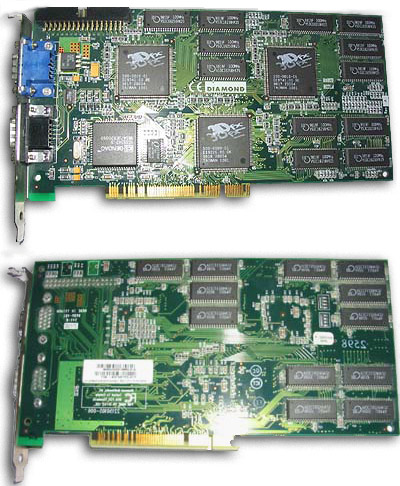
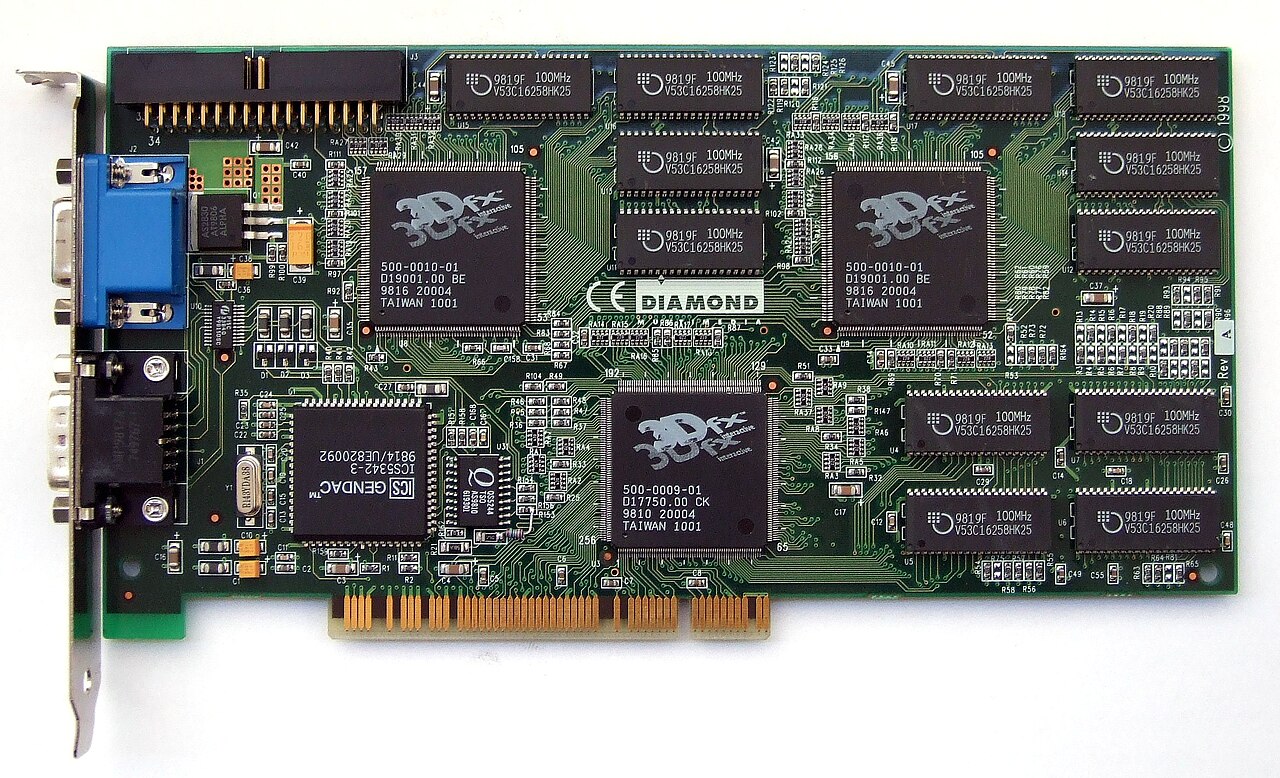
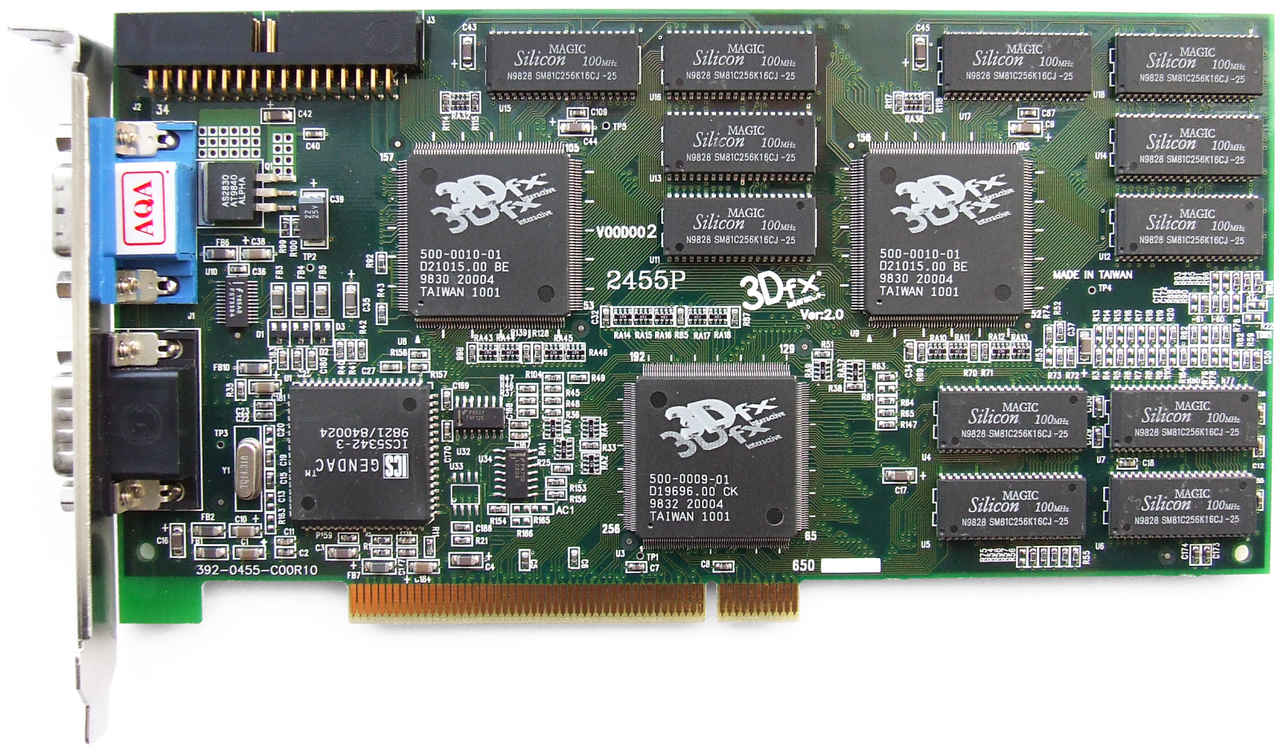
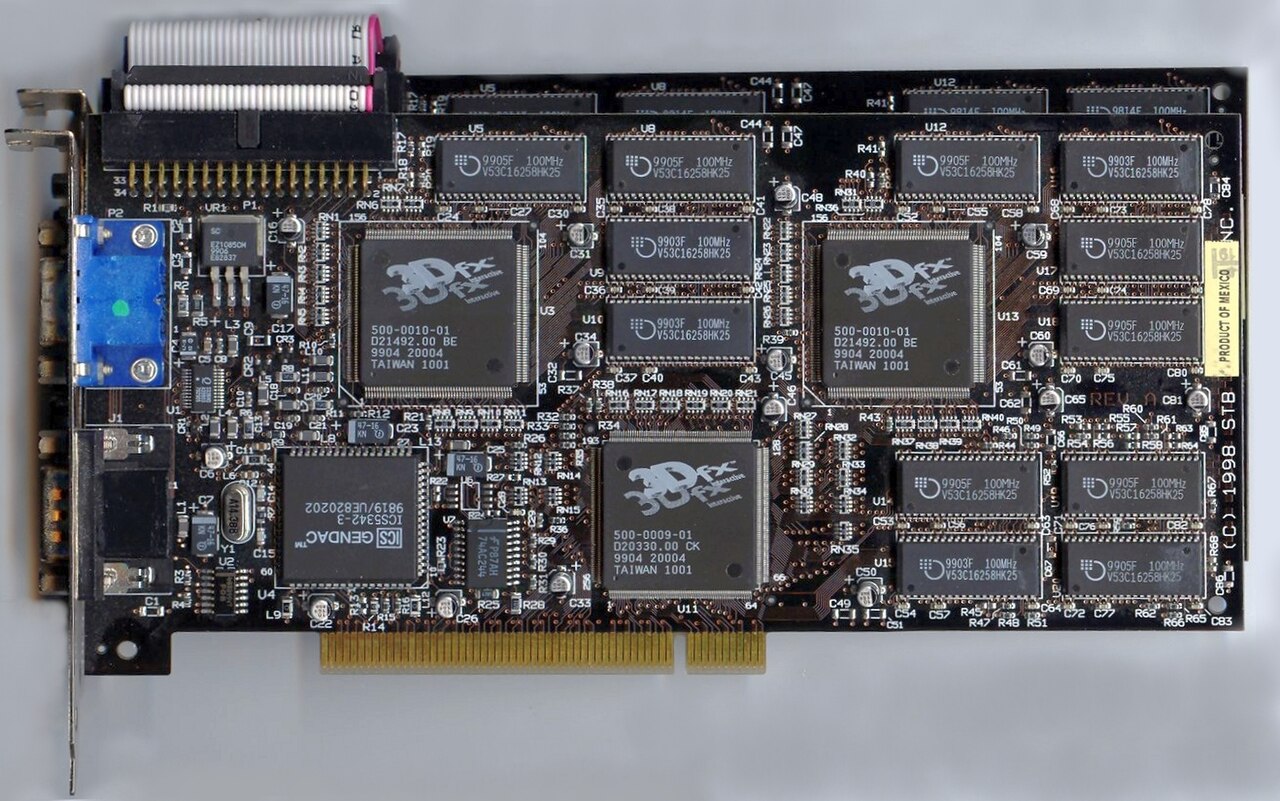
The Voodoo2 is a chipset from 3dfx, consisting of three specialized 3D graphics chips on a single setup. It launched in February 1998, succeeding the original Voodoo Graphics chipset. The chipset runs at 90 MHz and uses 100 MHz EDO DRAM, connecting via the PCI interface. Two models were available: one with 8 MB of RAM and another with 12 MB. On the 8 MB card, each texture mapping unit (TMU) gets 2 MB of memory, while the 12 MB model gives each TMU 4 MB. Both cards share a 4 MB framebuffer, capping screen resolution at 800 × 600, though the extra texture memory on the 12 MB version allows for more detailed textures. Some 8 MB boards could be upgraded to 12 MB using an additional daughterboard.
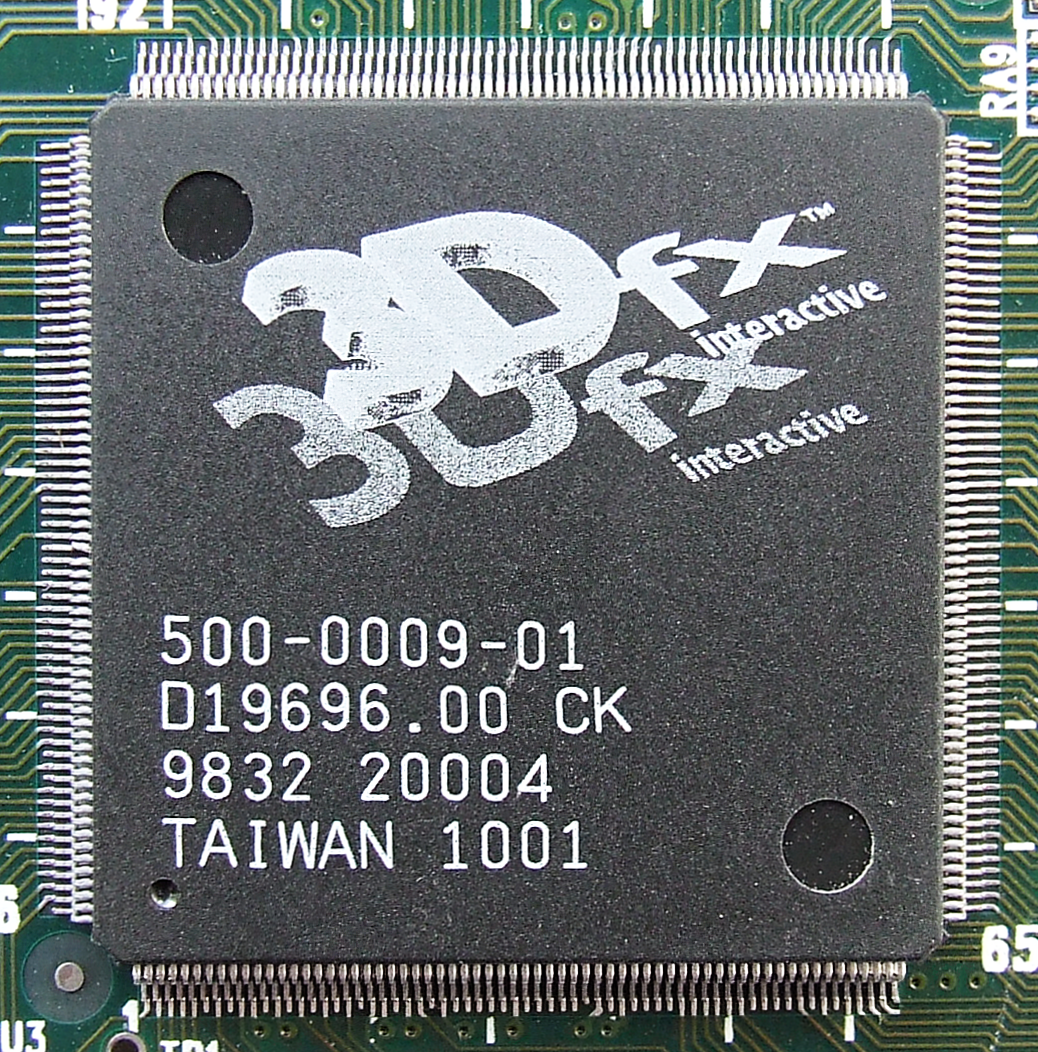
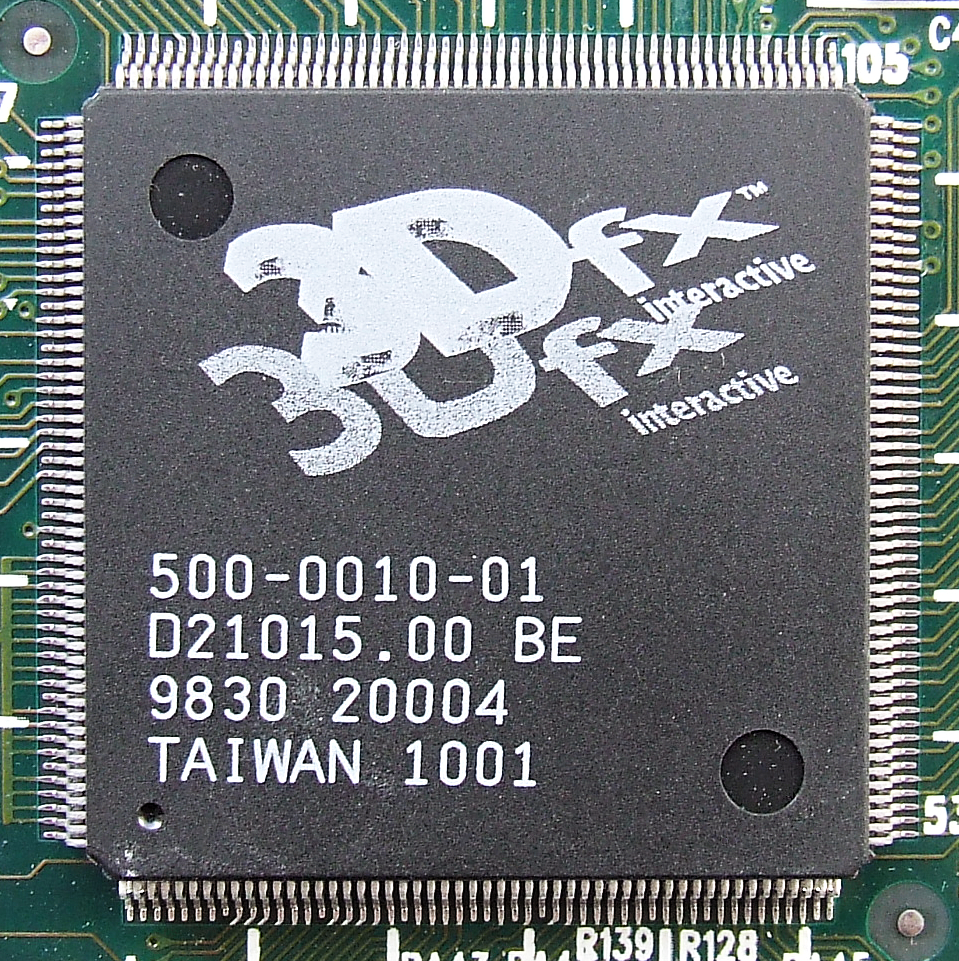
Each of the three chips has its own 64-bit RAM interface, giving the card a total bus width of 192 bits, or 800 MB/s per chip. The Voodoo2 has more chips than the original two-chip Voodoo card. Competitors like the ATI Rage Pro, NVIDIA RIVA 128, and Rendition Verite 2x00 were single-chip products with built-in 2D GUI/VGA accelerators. Like its predecessor, the Voodoo2 is a dedicated 3D accelerator and must be used alongside a separate 2D graphics card, connected via an external VGA pass-through cable.
The third chip on the Voodoo2 is a second TMU, enabling a second texture to be drawn in the same graphics engine pass without any performance hit. At launch, it was the only 3D card capable of single-cycle dual-texturing. Whether this second TMU gets used depends on the software; Quake II and Unreal made heavy use of it. In games that only use one texture layer, the Voodoo2 is faster than the original Voodoo solely due to its higher clock speed.
The Voodoo2 brought Scan-Line Interleave (SLI) to the PC market. With two Voodoo2 boards installed in parallel, each draws half the display lines. SLI doubles rendering throughput and increases total framebuffer memory, pushing maximum resolution to 1024 × 768—impressive for the time. However, texture memory doesn’t double, since each card must duplicate scene data. The original Voodoo Graphics also had SLI, but it was limited to arcade and professional markets.
In early 1999, 3dfx released the Voodoo3, which replaced the Voodoo2 as the company's flagship. The base Voodoo3 2000 offered slightly better performance than a Voodoo2 SLI setup plus a 2D card in some situations.
Quick Facts
- Codename
- SST2
- Created
- February 1998
- Midrange
- Voodoo2, Voodoo Banshee
- Predecessor
- Voodoo Graphics
- Successor
- Voodoo3
- Support Status
- Unsupported
Facts from the source article.
Lore & Background
The Voodoo2 runs at a chipset clock rate of 90 MHz and uses 100 MHz EDO DRAM, available for the PCI interface. It comes in two models: one with 8 MB RAM and one with 12 MB RAM. The 8 MB card has 2 MB of memory per texture mapping unit (TMU) vs. 4 MB on the 12 MB model. The 4 MB framebuffer on both cards supports a maximum screen resolution of 800 × 600, while the increased texture memory on the 12 MB card allows more detailed textures. Some boards with 8 MB can be upgraded to 12 MB with an additional daughter board. Each of the three chips has its own 64-bit RAM interface, giving the card a total bus width of 192 bits or 800 MB/s per chip. The Voodoo2 has an increased chip-count compared to the original two-chip Voodoo card. Competing products such as the ATI Rage Pro, NVIDIA RIVA 128, and Rendition Verite 2x00 are single-chip products, each with integrated 2D GUI/VGA accelerators. As with the original Voodoo, the Voodoo2 is a dedicated 3D accelerator and must be used with a conventional 2D graphics card via an external pass-through VGA cable.
Reader's Guide
The Voodoo2's third chip was a second TMU that allows a second texture to be drawn during the same graphics engine pass with no performance penalty. At time of introduction, it was the only 3D card capable of single-cycle dual-texturing. Usage of the second TMU depends on application software; Quake II and Unreal exploited dual-texturing to great effect. In games that did not use more than one texture layer, the Voodoo2 is only faster than Voodoo1 because of its higher clock speed. The Voodoo2 introduced SLI capability to the PC market, where two boards run in parallel, each drawing half the lines of the display. SLI not only doubles rendering throughput but also increases total framebuffer memory, raising maximum resolution to 1024 × 768; however, texture memory is not doubled because each card duplicates scene data. The Voodoo2 enjoyed remarkably long usage, as a Voodoo2 SLI setup was competitive with newer cards like NVIDIA's RIVA TNT2, Matrox's Millennium G400, and even NVIDIA's GeForce 256. 3dfx's Glide API played an essential role in this longevity because some games were still tailored more towards Glide than Direct3D or OpenGL. Long after obsolescence, some enthusiasts got later games working with a Voodoo2, e.g. Doom 3.
Did You Know?
- The Voodoo2 was the only 3D card at introduction capable of single-cycle dual-texturing.
- In SLI mode, two Voodoo2 boards draw half the lines each, doubling rendering throughput and raising max resolution to 1024 × 768.
- The Voodoo2 has three chips, each with its own 64-bit RAM interface, giving a total bus width of 192 bits.
Three-Chip Architecture and Dual Texturing
The Voodoo2, launched in February 1998 by 3dfx as the successor to the original Voodoo Graphics, took a fundamentally different architectural path from its rivals. Rather than consolidating everything into a single die, 3dfx populated the card with three specialized 3D chips, each equipped with its own 64-bit memory interface. This design yielded an aggregate bus width of 192 bits and a per-chip bandwidth of 800 megabytes per second, all running at a 90 megahertz core clock paired with 100 megahertz EDO DRAM. The most consequential of the three chips was the second texture mapping unit, which enabled what 3dfx called single-cycle dual-texturing—drawing two texture layers in the same engine pass with zero performance penalty. At the time of release, no other 3D card on the market could match this capability. Titles like Quake II and Unreal were specifically engineered to exploit the second texture channel, while games relying on a single texture layer saw only the modest gains from the higher clock speed over the first-generation Voodoo. The card was available in 8-megabyte and 12-megabyte configurations, with the larger model allocating 4 megabytes per texture unit instead of 2, allowing noticeably richer surface detail.
Scan-Line Interleave and the Two-Card Setup
One of the Voodoo2's most distinctive contributions to PC gaming was bringing Scan-Line Interleave to the consumer market. In SLI mode, two Voodoo2 boards were installed in a single system and operated in parallel, with each card responsible for rendering half of the display's scan lines. This arrangement effectively doubled the rendering throughput and combined the framebuffer memory of both cards, pushing the maximum supported resolution from 800 by 600 up to 1024 by 768—a genuinely impressive figure for the late 1990s. However, texture memory did not scale in the same way, because each card had to maintain a full duplicate of the scene data. It is worth noting that the original Voodoo Graphics chipset also supported SLI, but 3dfx restricted that feature to arcade and professional installations. The Voodoo2's dedicated 3D-only nature meant it could never function as a standalone display adapter. Every system required a separate 2D graphics card, connected to the Voodoo2 through an external analog pass-through VGA cable. This added a small amount of signal softening to the image but was the price of 3dfx's focused, high-performance 3D pipeline.
Competitive Landscape and Remarkable Longevity
When the Voodoo2 hit shelves in early 1998, its closest rivals—the ATI Rage Pro, NVIDIA RIVA 128, and Rendition Verite 2x00—were all single-chip designs that bundled a 2D GUI and VGA accelerator into the same package. 3dfx's decision to build a pure 3D accelerator with no integrated 2D engine set it apart, but it also meant a more complex system configuration. Despite that trade-off, the Voodoo2 enjoyed an unusually long period of relevance. A dual-card SLI setup remained competitive well into the era of NVIDIA's RIVA TNT2, Matrox's Millennium G400, and even the landmark GeForce 256. A major reason for this extended lifespan was 3dfx's proprietary Glide application programming interface. A significant number of titles were optimized more heavily for Glide than for Direct3D or OpenGL, giving Voodoo2 owners a performance edge that newer hardware could not always replicate. Even after the chipset was officially obsolete, dedicated enthusiasts managed to run later releases such as Doom 3 on Voodoo2 systems, a testament to how deeply the card was embedded in the PC gaming culture of the late 1990s.
Succession: Voodoo3 and the Banshee
By early 1999, 3dfx had moved on to the next generation. The Voodoo3 arrived as the new flagship, with the base 2000 model delivering slightly better performance than a Voodoo2 SLI rig in certain workloads, while the higher-end 3000 and 3500 variants surpassed Voodoo2 SLI in specific environments. Simultaneously, 3dfx introduced the Voodoo Banshee, a budget-oriented card that merged a 2D accelerator with an overclocked but incomplete Voodoo2 core—specifically, it was missing one of the two texture mapping units. This hybrid approach addressed the long-standing criticism that Voodoo2 required a separate 2D card, offering a more affordable all-in-one solution for casual gamers. The Voodoo2's own specification sheet, for reference, listed a sustained fill rate of 90 million fully featured pixels per second with bilinear textures, LOD mip-mapping, Z-buffering, alpha blending, and fogging all active, alongside 3 million textured triangles per second. In SLI configuration, the fill rate doubled to 180 million pixels per second. The card also supported bi-linear and tri-linear filtering, bump mapping through texture composition, edge anti-aliasing, and hardware triangle set-up, making it a remarkably complete 3D pipeline for its era.
Gallery
Frequently Asked Questions
What exactly is the Voodoo2?
The Voodoo2 is a three-chip 3D graphics accelerator made by 3dfx, shipped in February 1998 as the direct successor to the original Voodoo Graphics card. It places three dedicated rendering chips on a single PCI board, clocked at 90 MHz with 100 MHz EDO DRAM.
How does the Voodoo2 differ from the first Voodoo?
The original Voodoo relied on a single texture-mapping chip, whereas the Voodoo2 uses three specialized chips to perform simultaneous dual-texturing, blending two textures per pixel. It also added SLI, a proprietary link that lets two Voodoo2 cards share the rendering load.
What does SLI actually do on a Voodoo2?
SLI is a 3dfx-specific technology that joins two Voodoo2 cards with a dedicated cable so they split the frame workload. One card renders odd-numbered frames while the other handles even-numbered ones, effectively doubling the throughput.
Why is the Voodoo2 capped at 800×600 resolution?
Both the 8 MB and 12 MB variants share a fixed 4 MB framebuffer, which simply lacks the bandwidth for higher resolutions. The extra RAM on the 12 MB model is instead allocated to the texture-mapping units, giving each TMU 4 MB for larger texture sizes rather than 2 MB.
Why do retro-PC fans still talk about the Voodoo2?
It was the first widely available card that made smooth dual-textured 3D gaming feel accessible on a desktop, setting the visual bar for titles like Quake II and Unreal. Its three-chip layout and SLI link also became a benchmark that later GPU makers had to match or surpass.
More in Graphics Hardware, Part 3 1-24
Spotted an error? Know more?
Reader corrections go straight into our review queue. Suggest an edit · How this site is sourced