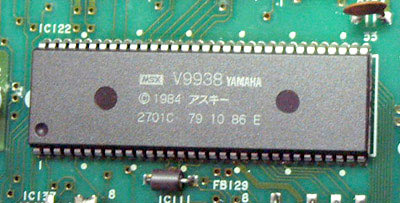
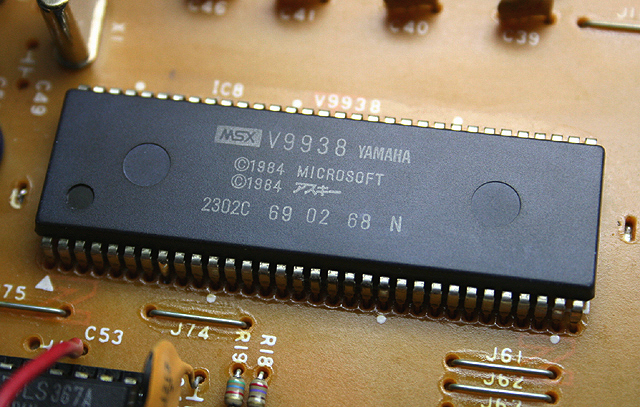
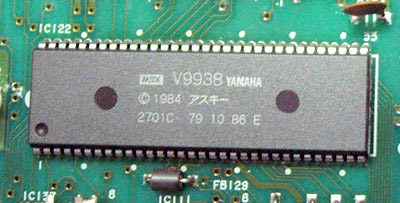
Yamaha V9938
Video display processor for MSX2 and other systems.

Yaca2671 · CC BY-SA 3.0
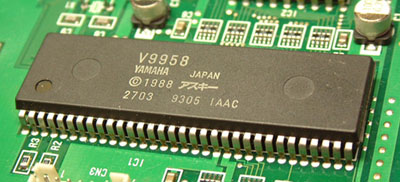
The Yamaha V9938, also known as MSX-Video or VDP, is a video display processor used in the MSX2 home computer, the Geneve 9640 enhanced TI-99/4A clone, the Tatung Einstein 256, a few MSX1 computers with 16 kB VRAM, and the Zemmix Super V console. It is notable as the successor to the Texas Instruments TMS9918 and was succeeded by the Yamaha V9958.
- Video ram
- 16–192 KB
- Text modes
- 80 × 24, 40 × 24 and 32 × 24
- Resolution
- 512 × 212 (16 colors from 512), 256 × 212 (16 colors from 512) and 256 × 212 (256 colors)
- Sprites
- 32, 16 colors, max 8 per horizontal line
- Hardware acceleration
- copy, line, fill and logical operations
- Interlacing
- doubles vertical resolution
- Vertical scroll register
- present
Lore & Background
The Yamaha V9938 was designed as the successor to the Texas Instruments TMS9918, which was used in the MSX1 and other systems. It was used in the MSX2 home computer, the Geneve 9640 enhanced TI-99/4A clone, the Tatung Einstein 256, and the Zemmix Super V console. A few MSX1 computers also used it in a configuration with 16 kB VRAM. The V9938 was in turn succeeded by the Yamaha V9958.
The V9938 supports multiple video RAM configurations: 16 kB, 64 kB, 128 kB (the most common), and 192 kB (with 64 kB as extended-VRAM for back-buffer use in G4 and G5 modes). It offers a variety of screen modes including text modes (T1: 40×24 with 2 colors, T2: 80×24 with 4 colors), pattern modes (G1, G2, G3, MC), and bitmap modes (G4, G5, G6, G7). All vertical resolutions can be doubled by interlacing. The chip includes hardware acceleration for copy, line, fill, and logical operations, a vertical scroll register, and support for a lightpen and mouse.
Reader's Guide
The Yamaha V9938 is significant as the video display processor that powered the MSX2 home computer, providing enhanced graphics capabilities over its predecessor, the Texas Instruments TMS9918. Its support for multiple VRAM configurations (up to 192 kB) and a range of screen modes—including 512×212 resolution with 16 colors from a palette of 512, and 256×212 with 256 fixed colors—allowed for more detailed and colorful graphics than earlier systems. The inclusion of hardware acceleration for copy, line, fill, and logical operations, along with a vertical scroll register and sprite support (32 sprites, up to 8 per horizontal line), made it a versatile chip for its era. Its use extended beyond the MSX2 to the Geneve 9640, Tatung Einstein 256, and Zemmix Super V, and it was succeeded by the Yamaha V9958. The V9938's legacy lies in its role as a key component in the MSX2 standard, enabling a generation of home computer software and games with improved visual fidelity.
Did You Know?
- The V9938 supports 16 to 192 KB of video RAM, with 128 KB being the most common configuration.
- It can display 512 × 212 resolution with 16 colors selected from a palette of 512.
A Century of Hammered Strings
Yamaha's piano-making story stretches back to 1900, when the company first took up the craft of building these instruments. Over more than two decades of the twentieth century, the grand piano lineup cycled through several naming conventions before settling into the structures we recognize today. The full-length concert grand lineage traces from the original FC and CF models of the late 1940s and 1960s, through the CFIII of the 1980s and the CFIIIS of the 1990s, all the way to the current CF4, CF6, and CFX introduced in 2010. The C series, which also absorbed the older G-series designations such as the G1, G2, G5, and G7, represents the workhorse tier of concert and studio grands. From the compact C1x to the towering C7x, each generation has been refreshed roughly every decade or so. Below the grands sit the baby grand GB1K, the most space-efficient model in the current range at just 151 centimetres of depth, and a vast family of uprights spanning the B, U, UX, and YUS lines.
Silence, Sound, and the Hybrid Frontier
Yamaha has spent the past two decades quietly revolutionizing how a piano can be heard. The silent piano system, available in SG, SC, and SH tiers, allows a player to perform acoustically while routing the sound through headphones or speakers. The SC modules occupy the entry-level territory, fitted into the B1, B2, B3 uprights and the GB1K baby grand, while the more refined SH modules are reserved for premium instruments such as the U1, U3, YUS1 through YUS5 uprights and the S3X through S7X, C1X through C6X, and GC1 and GC2 grands. A particularly inventive twist is the TransAcoustic system, which bolts a transducer onto the soundboard so the instrument itself becomes a speaker, eliminating the need for external amplification entirely. Alongside these, the hybrid piano category blends acoustic hammers with digital sound engines. The AvantGrand line of hybrid grands has run from the N1 and N2 introduced in 2009 through the N3X and N1X of the 2010s and 2019, while the upright hybrid family traces from the early DUP series of the late 1990s through the NU1, NU1X, and the current NU1XA.
From FM Synthesis to the Stage
The story of Yamaha's stage and digital pianos is inseparable from its pioneering work in electronic sound. The GS1 and GS2, released in 1980, marked the company's first foray into frequency-modulation synthesis, a technology that would go on to define an era of electronic music. On the stage piano front, the analog CP series began in the mid-1970s with the CP-30, followed by the CP-20, CP-10, and CP-7, before the iconic CP-80 took the throne from 1978 to 1986. The digital CP line arrived in the 2000s and 2010s with models like the CP33, CP1, CP5, CP40, CP50, CP4, CP73, and CP88, each offering progressively refined key actions and sound engines. In 2015, the Reface series distilled the spirit of the CP-80, the CS analog synthesizer, the YC-45D organ, and the DX7 FM synthesizer into compact, affordable units. The 2023 CK61 and CK88 brought that Reface philosophy back to full-sized 61- and 88-key formats. Meanwhile, the Clavinova digital piano family, launched in 1983 with the YP-10, YP-20, and YP-30, has grown into an enormous range spanning the CVP, CGP, and CLP sub-lines, while the MODUS series added a colorful, consumer-friendly tier in the late 2000s.
A Labyrinth of Letters and Numbers
No piano manufacturer has a more bewildering naming architecture than Yamaha, and the product list makes the complexity vivid. The C series of grands absorbed the older G-series designations, while the A series branched off from the C line in 1993. The GC1 grand, offered in finishes ranging from Polished Ebony to Georgian Brown mahogany and French Provincial Brown Cherry, became a textbook case of regional confusion: in North America the original GC1 shipped without a sostenuto pedal, substituting a bass-sustain pedal instead, whereas the European version always included the sostenuto. When the model was refreshed in 2007, North America received a GC1M to distinguish the new version, yet the European GC1M was actually identical to the North American GC1, while the European GC1 remained a different instrument altogether. Beyond the naming tangle, the broader Yamaha family includes the German Bösendorfer brand, a wholly owned subsidiary since early 2008, and the Hosseschrueders HC 10 and HC 30 uprights. Yamaha Motor Company, despite sharing the same brand name, has operated as a separate entity since 1955, producing motorcycles rather than instruments.
Gallery
Frequently Asked Questions
What is the Yamaha V9938?
The Yamaha V9938, commonly nicknamed MSX-Video or simply VDP, is a video display processor chip built to drive all graphical output on the MSX2 home computer. It manages text rendering, bitmap graphics, and sprite drawing for the machines it was installed in.
Which computers and consoles used the Yamaha V9938?
Beyond standard MSX2 machines, the chip was found in the Geneve 9640 enhanced TI-99/4A clone, the Tatung Einstein 256, a handful of MSX1 computers fitted with 16 kB of VRAM, and the Zemmix Super V console.
What display modes and sprite capabilities does the Yamaha V9938 support?
It offers 512 × 212 at 16 colors from a 512-color palette, 256 × 212 at 256 colors, plus text modes of 80 × 24, 40 × 24, and 32 × 24. Up to 32 sprites can be drawn simultaneously, with a maximum of 8 per horizontal scanline, and interlacing can double the effective vertical resolution.
How does the Yamaha V9938 relate to the TMS9918 and V9958?
The V9938 is the direct successor to Texas Instruments' TMS9918, delivering more colors, higher resolutions, and additional hardware-accelerated operations. It was in turn superseded by Yamaha's own V9958, which expanded the feature set further.
What hardware-accelerated operations does the Yamaha V9938 perform?
The chip can execute bitmap copy, line drawing, area fill, and logical operations entirely in hardware, offloading those common graphics tasks from the main CPU. This made it a meaningful upgrade over the TMS9918 it replaced.
More in Graphics Hardware, Part 3 1-24
Spotted an error? Know more?
Reader corrections go straight into our review queue. Suggest an edit · How this site is sourced