AMD
American semiconductor company competing with Intel since 1975.

Advanced Micro Devices, Inc., known as AMD, is a U.S. semiconductor company based in Santa Clara, California. It makes CPUs, GPUs, FPGAs, SoCs, and other high-performance computing parts for personal computers, gaming, data centers, and embedded systems. Its products include microprocessors, embedded processors, graphics processors for servers, workstations, PCs, and embedded applications, plus motherboard chipsets. AMD has moved into data centers, gaming, and high-performance computing, and its processors appear in PCs, servers, laptops, and gaming consoles. After spinning off its manufacturing arm GlobalFoundries in 2009, AMD outsources production. The 2022 purchase of Xilinx brought FPGA products into its lineup.
AMD was founded on May 1, 1969, by Jerry Sanders and seven former Fairchild Semiconductor colleagues—Ed Turney, John Carey, Sven Simonsen, Jack Gifford, Frank Botte, Jim Giles, and Larry Stenger. Sanders, an electrical engineer and Fairchild’s marketing director, left due to frustration with the company’s lack of support and flexibility, following Robert Noyce and Gordon Moore, who had started Intel in July 1968. AMD began in a temporary Santa Clara location, then moved in September 1969 to a new $500,000, 15,000-square-foot headquarters at 901 Thompson Place in Sunnyvale, which housed its 8-mask, 7-micrometer, 2-inch wafer production line. To build a customer base, AMD initially acted as a second-source supplier for Fairchild’s 5-volt TTL “9300” logic series and National Semiconductor chips. It focused on logic chips, guaranteeing quality to U.S. military standards—a key selling point in an era when chip unreliability worried computer makers, telecom firms, and instrument manufacturers.
In November 1969, AMD produced its first product, the Am9300, a 4-bit MSI shift register that went on sale in 1970. That same year, it released its first proprietary product, the Am2501 logic counter, which sold well. Its top seller in 1971 was the Am2505, the fastest multiplier then available. Also in 1971, AMD entered the RAM market with the Am3101, a 64-bit bipolar RAM, and boosted sales of linear integrated circuits, ending the year with $4.6 million in total revenue. The company went public in September 1972. By 1973, it was a second source for Intel’s MOS/LSI circuits, including the Am14/1506 and Am14/1507 dual 100-bit dynamic shift registers.
Quick Facts
- Trade Name
- AMD
- Traded As
- AMD · Nasdaq-100 component · S&P 100 component · S&P 500 component
- Industry
- Semiconductors · Computer hardware
- Founded
- 1969-05-01
- Founder
- Team led by Jerry Sanders
- Hq Location City
- Santa Clara, California
- Hq Location Country
- U.S.
- Area Served
- Worldwide
- Key People
- Lisa Su (chair & CEO) · Mark Papermaster (CTO) · Jean Hu (CFO) · Phil Guido (CCO)
- Products
- AMD CPUs / AMD GPUs / AMD FPGAs
- Brands
- Ryzen · Radeon · Athlon · Epyc · Threadripper · Virtex · Vivado · Sempron · Duron · AMD Instinct
- Revenue
- 34.6 billion (2025)
Facts from the source article.
Lore & Background
AMD was founded in 1969 by Jerry Sanders and seven colleagues from Fairchild Semiconductor. The company initially focused on producing logic chips and became a second-source supplier for Fairchild and National Semiconductor. Its first product was the Am9300 shift register in 1969, and it entered the RAM chip market in 1971. AMD went public in September 1972. In 1975, it entered the microprocessor market with the Am9080, a reverse-engineered clone of the Intel 8080, and the Am2900 bit-slice family. A cross-licensing agreement with Intel in 1976 allowed AMD to legally clone Intel processors. In 1981, IBM required Intel to provide a second-source manufacturer for its x86 processors, leading to a 10-year technology exchange agreement between Intel and AMD in 1982. AMD then produced Intel-licensed 8086, 8088, 80186, and 80188 processors, and its own Am286 clone of the 80286. The company faced a severe downturn in the mid-1980s due to Japanese trade practices and a crowded chip market, but rode it out by aggressively innovating.
Reader's Guide
AMD's significance lies in its role as a persistent competitor to Intel in the x86 microprocessor market, which shaped the personal computer industry. The company's early success came from reverse-engineering Intel's 8080 and later securing a cross-license agreement that allowed it to produce legal clones of Intel's x86 processors. A seven-year legal battle over the i386 ended in AMD's favor in 1994, forcing AMD to develop its own x86 microprocessors in-house. In the early 2000s, AMD experienced growth with its Athlon and Opteron processors, but struggled in the late 2000s and early 2010s. It regained market share in the late 2010s through a penetration pricing strategy for its Ryzen processors, offering competitive performance at lower costs than Intel. In 2022, AMD surpassed Intel by market capitalization for the first time. The company outsourced its manufacturing after spinning off GlobalFoundries in 2009, and expanded into FPGAs through its 2022 acquisition of Xilinx.
Did You Know?
- AMD's first product was the Am9300, a 4-bit MSI shift register, which began selling in 1970.
- AMD entered the microprocessor market in 1975 with the Am9080, a reverse-engineered clone of the Intel 8080.
Frequently Asked Questions
Who is AMD in the graphics-hardware world?
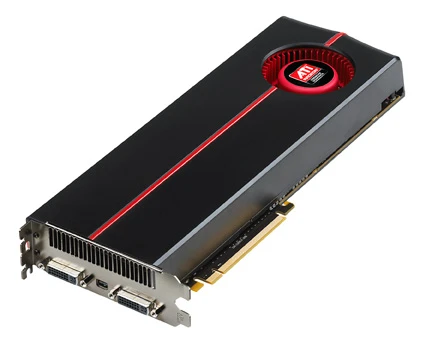
AMD is a U.S. semiconductor company out of Santa Clara, California, best known to enthusiasts for its Radeon GPUs but also a major designer of CPUs, FPGAs, SoCs, and chipsets. It serves personal computers, gaming rigs, workstations, data centers, and embedded systems.
What was AMD's very first product?
The company shipped the Am9300, a 4-bit shift register built to Motorola's spec, back in November 1969. A year later, in 1970, it rolled out the Am2501 logic counter, its first fully proprietary design.
When and by whom was AMD founded?
Jerry Sanders founded AMD in 1969, and the company went public in September 1972. That early start put it on a collision course with Intel, which it has been directly competing against in the x86 space since 1975.
How does AMD fit into the gaming and console scene?
Radeon graphics cards are a core choice for PC gamers and are also used inside several popular gaming consoles. AMD's GPU lineup spans entry-level desktop cards all the way up to high-end workstation and data-center accelerators.
Why does AMD matter to someone building or buying a PC?
Because AMD offers a credible alternative to Intel on the CPU side and to NVIDIA on the GPU side, giving buyers real competition and more options. Its chipsets and embedded processors also quietly power a huge share of laptops, servers, and industrial hardware.
More in Graphics Hardware, Part 3 1-24
Spotted an error? Know more?
Reader corrections go straight into our review queue. Suggest an edit · How this site is sourced