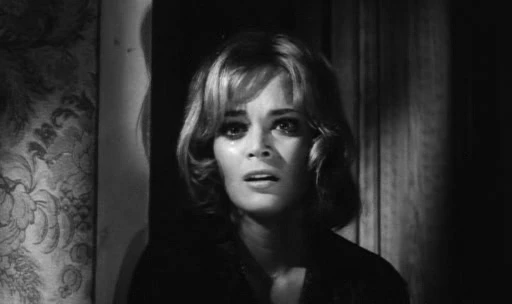
Arabella Black Angel
A 1989 Italian erotic horror film by Stelvio Massi.

Arabella Black Angel (Italian: *Arabella l'angelo nero*) is a 1989 Italian erotic horror film directed by Stelvio Massi. The film follows Tinì Cansino as Deborah Veronesi, a married woman who is dissatisfied with her home life and secretly works as a sex worker, becoming the prime suspect in a string of murders.
The story begins with Deborah fleeing a blackmailer named Nick. She attends a warehouse sex party, but a police raid forces her to hide. Officer Alfonso de Rosa stays behind, mistakes her for a prostitute, handcuffs and rapes her while Nick photographs the assault. De Rosa releases her, but she leaves her purse behind. The next morning, Deborah’s husband Francesco, paralyzed since their wedding day, rages at her. A flashback reveals his paralysis resulted from a car accident that occurred while Deborah performed oral sex on him. De Rosa tracks Deborah down, apologizes for mistaking her, but then blackmails her for sex by threatening to tell Francesco about her “arrest.” Deborah leads de Rosa to a storage shack; while he performs oral sex on her, Francesco watches, and Deborah kills the officer with a mallet. The couple buries him in the yard.
Inspired, Francesco orders Deborah to prostitute herself to various men so he can write a book about a sensual female lead. She objects repeatedly, but he forces her to continue. Francesco’s mother, Martha, manages the household and cares for the couple. Meanwhile, Nick tries to sell photos of Deborah and de Rosa, but an unseen attacker stabs him with scissors and castrates him after his death. Deborah picks up a man at a Western-themed bar; after they have sex in a hotel room, the killer stabs and emasculates him. Lead investigator Gina is haunted by the crime scenes, which trigger childhood trauma from when her mother killed her father. Gina has recurring nightmares of being stabbed and mutilated. Her girlfriend, journalist Agnese Borden, publicly reveals details of Gina’s involvement, insults her, and breaks up with her. Gina confronts Borden at a park, where they fight; that night, the killer slits Borden’s throat and mutilates her genitals.
In the final sequence, Francesco has Deborah pick up a male street prostitute. It is revealed Francesco has been faking his paralysis; he follows her. Gina reunites with her estranged mother, Martha, who was institutionalized for years.
- Director
- Stelvio Massi
- Year
- 1989
- Country
- Italy
- Genre
- Erotic horror
- Star
- Tinì Cansino
- Running time
- 88 minutes (Japanese release)
Lore & Background
The film follows Deborah Veronesi, a married woman whose husband Francesco was paralyzed on their wedding day. She evades a blackmailer named Nick and attends a warehouse sex party, where a vice squad raid leads to her being raped by a cop named Alfonso de Rosa. Deborah later kills de Rosa with a mallet in an outdoor shack, and she and Francesco bury him in the yard. Francesco, inspired, forces Deborah to prostitute herself to various men to inform his writing, despite her repeated objections. A series of murders occur, with victims stabbed and mutilated, investigated by Inspector Gina, who is haunted by childhood trauma involving her mother killing her father. The killer is revealed to be Martha, Francesco's mother, who kills Francesco after discovering his faked paralysis and mistreatment of Deborah.
Reader's Guide
Arabella Black Angel is a late entry in the Italian giallo tradition, directed by Stelvio Massi under the pseudonym Max Steel. The film was released in 1989 and later distributed by Penthouse Video in Japan as Black Angel with an 88-minute runtime. It was included in Vinegar Syndrome's Forgotten Gialli: Volume Four box set alongside The Killer is Still Among Us and The Sister of Ursula. Retrospective critics, including Roberto Curti and Adrian Luther Smith, found the film derivative of Ken Russell's Crimes of Passion (1984) and noted that Massi's earlier visual flair was absent. Both critics also judged Tinì Cansino's acting weak, particularly in sexual scenes, with Smith calling her an 'unassured actress.' The film's plot involves themes of sexual exploitation, blackmail, and trauma, with a twist revealing the killer as the protagonist's mother-in-law. Its significance lies in representing the declining phase of the Italian giallo genre, blending erotic horror with a convoluted murder mystery.
Did You Know?
- Tinì Cansino was best known in Italy for her appearances on the television series Drive In.
- The killer is revealed to be Martha, the mother of the protagonist's husband.
- The film was released by Penthouse Video in Japan under the English title Black Angel.
Origins and Genre Formation
The giallo emerged as a distinctly Italian cinematic form during the mid-to-late 1960s, carving out a unique niche at the intersection of multiple genres. Rather than belonging purely to one category, it wove together the atmospheric tension and suspenseful pacing characteristic of thrillers with the visceral shock of horror elements, including slasher-style violence, while simultaneously incorporating erotic undertones. This blending of suspense, terror, and sensuality created a tonal palette that set it apart from straightforward murder mysteries or pure horror pictures. The genre's Italian roots gave it a particular cultural flavor, and its emergence in the latter part of the 1960s positioned it to become one of the most recognizable European film movements of the following decade. By combining narrative structure borrowed from mystery filmmaking with the visual and emotional intensity of horror, giallo established a template that would influence filmmakers far beyond Italy's borders.
Signature Conventions and Aesthetic Identity
Giallo films are immediately recognizable through a constellation of recurring plot devices and visual motifs that became almost ritualistic within the genre. Central to nearly every entry is the presence of a mysterious killer whose true identity remains concealed until the climactic reveal, often operating under a disguise that obscures their face or body. The image of the assassin wearing black gloves has become perhaps the most iconic visual shorthand associated with the form, lending an air of calculated, almost theatrical menace to each act of violence. Beyond the killer figure, the genre consistently layers in eroticism alongside its horror, treating sensuality not as a separate element but as an integral thread woven through the suspense. These conventions—the disguised perpetrator, the black-gloved hand, the delayed unmasking, the interplay of desire and dread—created a cohesive aesthetic language that audiences could identify instantly, making giallo one of the most visually and narratively codified film genres of the twentieth century.
The Arc of Popularity
The commercial trajectory of giallo followed a classic pattern of rapid ascent, sustained dominance, and gradual retreat from the mainstream. After its formation in the mid-to-late 1960s, the genre surged to its peak of popularity during the 1970s, a decade in which it produced a dense concentration of films that defined the form for international audiences. This was the era when the genre's conventions were most fully realized and when its influence radiated outward most powerfully. Following that golden decade, however, giallo experienced a steady decline in commercial mainstream filmmaking over the subsequent decades. It did not vanish entirely; rather, it receded from the center of the industry's attention while continuing to be produced in smaller numbers. The 1980s, 1990s, and 2000s each yielded new entries, and the genre even saw a 2022 release, demonstrating that while its commercial dominance waned, a persistent creative community continued to work within its framework.
Enduring Legacy and Influence
Perhaps the most significant long-term contribution of giallo to global cinema is its role as a direct predecessor to the slasher film genre. The conventions it pioneered—the masked or disguised killer, the escalating sequence of violent murders, the suspenseful hunt for the perpetrator's identity—became foundational building blocks that later American and international slasher filmmakers adapted and expanded upon. This lineage is well documented in scholarship on the slasher form, cementing giallo's place as a creative ancestor rather than merely a regional curiosity. The genre's influence also persists in the continuous, if diminished, production of new films. Directors such as Dario Argento returned to the form repeatedly across decades, releasing titles as late as 2022, while other filmmakers continued to explore its narrative and visual vocabulary into the 2010s and beyond. This sustained creative engagement ensures that giallo remains a living tradition, a wellspring of ideas that continues to inform new generations of thriller and horror filmmaking.
Frequently Asked Questions
What is Arabella Black Angel?
Arabella Black Angel (Arabella l'angelo nero) is a 1989 Italian erotic horror film directed by Stelvio Massi. It runs approximately 88 minutes in its Japanese release cut.
Who plays the lead in Arabella Black Angel?
Tinì Cansino stars as Deborah Veronesi, a married woman whose secret work as a sex worker pulls her into a dangerous spiral of violence and suspicion.
What is the basic plot of Arabella Black Angel?
Deborah, unhappy in her marriage, secretly earns money as a sex worker and quickly becomes the prime suspect in a string of murders. The story kicks off with her on the run from a blackmailer named Nick, which sets off a chain of escalating events.
What happens during the warehouse party scene?
A police raid on a warehouse sex party forces Deborah to hide, but Officer Alfonso de Rosa stays behind, mistakes her for a prostitute, handcuffs and assaults her while Nick photographs the entire incident.
Why do fans consider Arabella Black Angel a cult title?
It blends exploitation-era erotic horror with a grim, victim-centered narrative, giving it a raw and unsettling tone that sets it apart from more polished Italian productions of the late 1980s.
More in Giallo films 1-24
Spotted an error? Know more?
Reader corrections go straight into our review queue. Suggest an edit · How this site is sourced