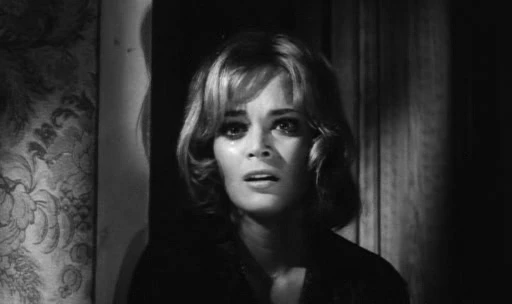
A Black Veil for Lisa
A narcotics detective hires a hitman to kill his wife.

A Black Veil for Lisa (Italian: La morte non ha sesso, lit. 'Death has no sex') is a 1968 giallo film directed and co-written by Massimo Dallamano. The film stars John Mills, Luciana Paluzzi, and Robert Hoffmann, and follows a narcotics detective who investigates a drug ring and hires a hitman to kill his wife, suspecting her involvement. It was shot in Hamburg under the working title Vicolo cieco and released in Italy in September 1968.
- Release year
- 1968
- Country
- Italy
- Director
- Massimo Dallamano
- Genre
- Giallo
- Original title
- La morte non ha sesso
- Running time (original)
- 95 minutes
- Running time (u.s. cut)
- 88 minutes
Lore & Background
The plot centers on Inspector Franz Buloff, a narcotics detective for Interpol in Hamburg, who becomes paranoid about his wife Lisa's possible involvement with a drug ring led by Harry Schouermann. After a key informant is murdered, Buloff hires hitman Max Lindt to kill Lisa, but later attempts to call off the plan. Lindt instead has an affair with Lisa and ultimately kills Buloff. The film ends with Lisa attending Buloff's funeral, where her own role remains ambiguous.
Reader's Guide
A Black Veil for Lisa stands as a notable entry in the giallo genre, though film scholar Roberto Curti described its style as 'remarkably different' from typical Italian gialli of the period, closer to American and German models. The film was re-edited for U.S. release by Commonwealth United, shortened from 95 to 88 minutes, with its original score replaced by music by Richard Markowitz. Contemporary reviews, such as one in Variety, called it an 'okay programmer' and praised the direction and color cinematography. The film was also released under the titles Das Geheimnis der jungen Witwe in Germany and Showdown in the United States.
Did You Know?
- The film's Italian title translates to 'Death has no sex'.
- It was shot in Hamburg in 1968 under the working title Vicolo cieco ('Dead end').
- The U.S. cut replaced most of the original score with new music by Richard Markowitz.
- The film was promoted in Germany as an Edgar Wallace-style krimi.
Plot & Narrative Architecture
The story opens with Lisa Buloff, veiled in black, attending a funeral for an unnamed loved one, before the narrative flashes back weeks earlier to the murder of Willie Zoll, a key informant in Inspector Franz Buloff's Hamburg narcotics investigation. Zoll is stabbed in an alley, leaving behind his weapon and a cheap disguise, just as two other potential witnesses are silenced before they can testify. Buloff, the lead investigator for Interpol's Hamburg narcotics division, is under pressure from his superior Ostermeyer to produce new leads against the major drug figure Harry Schouermann. His paranoia about his wife Lisa—who had prior ties to Schouermann before their marriage—drives him to surveil and dominate her. The plot weaves in hitman Max Lindt, his employer Olaf, the target Kurt Mueller, and a string of clues involving tulips, a red Porsche, and an informant called The Rabbit. Buloff ultimately coerces Lindt into killing Lisa, but the affair between Lindt and Lisa complicates everything. In the end, Lindt slits Buloff's throat in the woods, and Schouermann reveals Buloff's machinations to Lisa at their final meeting.
Production & Stylistic Distinction
Filmed in 1968 in Hamburg under the working title Vicolo cieco, which translates to Dead end, A Black Veil for Lisa was both directed and co-written by Massimo Dallamano. The production stands apart from the broader Italian giallo tradition of the era. Film scholar Roberto Curti, in his 2022 study Italian Giallo in Film and Television, characterized the film's visual and narrative approach as remarkably different from the conventions typically associated with Italian gialli of that period. Instead, Curti noted, the film aligns more closely with American and German models of the thriller and crime genres. The color cinematography, handled by Angelo Lotti, was singled out by contemporary critics for its effectiveness. The Hamburg setting and the involvement of English actor John Mills alongside Italian star Luciana Paluzzi and German actor Robert Hoffmann further underscore the film's transnational production identity, distinguishing it from the more domestically focused Italian crime pictures of the late 1960s.
International Release & Distribution
The film's journey to audiences varied considerably by territory. In Italy, it premiered in September 1968 under its original title. In Germany, it was marketed as Das Geheimnis der jungen Witwe, meaning Mystery of the Young Widow, and promoted specifically as an Edgar Wallace-style krimi, aligning it with the popular German crime fiction tradition. In the United States, the distribution path was more interventionist. Commonwealth United, the American distributor, re-edited the picture from its original 95-minute runtime down to 88 minutes and replaced most of the original musical score with new compositions by Richard Markowitz. The U.S. release also carried the alternate title Showdown. These changes—trimming the narrative, swapping the soundtrack, and rebranding the title—reflect the common practice of the era in which foreign thrillers were reshaped for domestic audiences. Despite these alterations, the core story of the narcotics detective, his suspicious wife, and the hired killer remained intact across all versions.
Reception & Home Media Legacy
Contemporary critical response to A Black Veil for Lisa was modest but positive. Writing in Variety, a critic signing as Whit. labeled the picture an okay programmer and commended Massimo Dallamano's direction as sturdy, noting that the color camera work by Angelo Lotti was particularly effective. The review acknowledged that Dallamano's collaboration on the script set the ceiling for how strong the direction could be. Decades later, the film found renewed scholarly attention. Roberto Curti included it in his 2022 monograph Italian Giallo in Film and Television, where he highlighted its stylistic departure from the genre's Italian norms. Adrian Luther-Smith had earlier catalogued the film in his 1999 reference Blood and Black Lace: The Definitive Guide to Italian Sex and Horror Movies. For home viewing, Olive Films issued the 88-minute U.S. cut on Blu-ray in October 2015, making the film accessible to a new generation of giallo enthusiasts and home-video collectors.
Frequently Asked Questions
What is A Black Veil for Lisa?
A 1968 Italian giallo directed and co-written by Massimo Dallamano, known in Italy by its original title "La morte non ha sesso" (literally "Death has no sex"). The 95-minute film blends noir detective work with the genre's signature stylized menace.
What is the plot of A Black Veil for Lisa?
A narcotics detective digging into a drug ring grows convinced his wife is complicit and, instead of confronting her, secretly hires a hitman to eliminate her. The story then spirals as his investigation and his personal obsession collide.
Who stars in A Black Veil for Lisa?
John Mills leads the cast as the narcotics detective, with Luciana Paluzzi playing his wife and Robert Hoffmann in a supporting role. The ensemble was assembled for a production shot on location in Hamburg.
Why do fans consider A Black Veil for Lisa significant?
Its premise of a law-enforcement investigator turning into the very criminal he hunts gives it a distinctly noir edge within the giallo framework. The film also showcases Dallamano's early authorial voice before he became better known for his later work.
What was the working title of A Black Veil for Lisa?
During production in Hamburg, the film went by the Italian title "Vicolo cieco." It was subsequently released in Italy in September 1968 under the more evocative "La morte non ha sesso."
More in Giallo films 1-24
Spotted an error? Know more?
Reader corrections go straight into our review queue. Suggest an edit · How this site is sourced