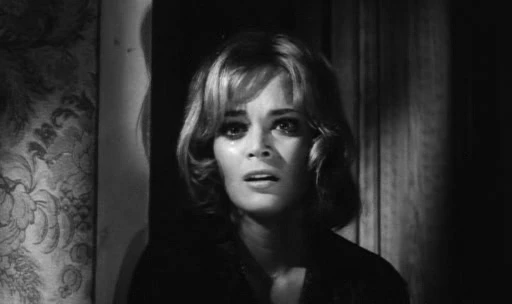
A Blade in the Dark
A giallo film too gruesome for Italian television.

A Blade in the Dark (Italian: La casa con la scala nel buio, lit. 'The House with the Dark Staircase') is a 1983 Italian giallo film directed by Lamberto Bava. Originally planned for television as a nearly two-hour piece split into four parts each ending with a murder scene, the film was re-edited into a feature after being deemed too gruesome for Italian television censors. It stars Andrea Occhipinti, Michele Soavi, and Valeria Cavalli.
- Title
- A Blade in the Dark
- Director
- Lamberto Bava
- Release year
- 1983
- Country
- Italy
- Genre
- giallo
- Original language
- Italian
- Runtime original
- nearly two hours (television version); theatrical cut shorter
Lore & Background
The film was commissioned for Italian television by producer Mino Loy, intended to air in four 30-minute segments. Director Lamberto Bava aimed to have a shocking murder at the end of each segment. Producer Luciano Martino offered his villa as a filming location. The writing team of Dardano Sacchetti and Elisa Briganti wrote the screenplay; Bava and Sacchetti had a difficult collaboration, with differing approaches to the film.
Reader's Guide
A Blade in the Dark is notable as a giallo that was originally conceived for television but rejected by censors for its gore, leading to a theatrical release. The film's plot involves a musician hired to compose a soundtrack for a horror film, who becomes entangled in a series of murders linked to a missing woman named Linda. The killer is revealed to be Tony, the property owner, who adopts a female alter-ego named Linda to murder women. The film received mixed critical reception; Robert Firsching of AllMovie noted that Bava 'eschews complex mystery in favor of elaborate stalk-and-slash sequences, with only partial success.' The English dubbing was described by Troy Howarth as 'some of the worst to be inflicted upon any giallo.' The film has seen multiple home video releases, including a 2023 4K UHD extended cut by Vinegar Syndrome.
Did You Know?
- The film was originally planned as a television miniseries in four 30-minute parts, each ending with a murder.
- Producer Luciano Martino offered his own villa as the filming location.
- The killer's motive is revealed to be that Tony was too insecure and childlike to stave off his alter-ego Linda, so he murdered women out of rage.
Defining the Giallo Aesthetic
The giallo stands as a distinctly Italian contribution to the murder-mystery screen, weaving together the taut suspense of the thriller with the visceral shock of horror and the charged sensuality of eroticism. What sets the form apart from a straightforward whodunit is its visual and narrative grammar: a killer who operates behind a mask of disguise, fingers sheathed in black gloves, whose true face is withheld until the final act. This concealment is not merely a plot device but the emotional engine of the genre, transforming every shadow and every masked figure into a potential threat. The blend of slasher-style violence with erotic undercurrents creates a tonal register that resists easy categorization, placing the giallo in a space where dread and desire are inextricable. It is this particular alchemy—suspense, gore, and sensuality fused into a single Italian-produced narrative—that gives the genre its unmistakable identity and separates it from both pure horror and pure mystery.
From Emergence to Long Twilight
The giallo did not arrive fully formed. Its roots took shape in the mid-to-late 1960s, a period when Italian filmmakers began experimenting with the intersection of suspense, graphic violence, and erotic tension in ways that had no direct precedent in mainstream cinema. By the 1970s, the genre had reached its commercial zenith, dominating Italian screens and building a devoted international following. What followed was a gradual but unmistakable retreat from the mainstream. Over the decades that succeeded the 1970s, the giallo's box-office presence in commercial filmmaking steadily eroded, and the form became increasingly niche. Yet the tradition never fully extinguished itself. Filmmakers continued to produce examples well into the 2000s, 2010s, and even the 2020s, suggesting that the genre's DNA—its particular mix of masked menace, erotic dread, and Italian cinematic flair—retains a pull strong enough to sustain a living, if quieter, creative lineage long after its peak had passed.
The Giallo as Slasher Ancestor
Few genres in modern cinema owe as much to the giallo as the slasher. The Italian murder-mystery tradition, with its emphasis on a concealed killer meting out stylized, often grotesque violence, functioned as a direct precursor to the slasher wave that would sweep global screens in the decades that followed. The black-gloved, disguised murderer whose identity is unmasked only at the climax is a template that countless later slasher films would inherit, adapt, and sometimes strip of its erotic and suspenseful layers. Scholars of the slasher form, including Justin A. Kerswell in his 2012 reference work The Slasher Movie Book, have traced this line of influence, acknowledging that the giallo's specific fusion of thriller pacing, horror spectacle, and sexual tension laid the groundwork for what would become a dominant subgenre of American and international horror. Without the Italian experiment of the 1960s and 1970s, the slasher as we know it would likely look very different.
A Living Canon Across Six Decades
The breadth of the giallo filmography, stretching from the 1960s through the 2020s, testifies to the genre's stubborn vitality. In the 2000s alone, a remarkable cluster of titles emerged: Dario Argento returned with Sleepless in 2001, followed by The Card Player in 2004 and Do You Like Hitchcock? in 2005, before directing a film simply titled Giallo in 2009. That same decade also saw contributions from Giacomo Cimini's Red Riding Hood, Pierfrancesco Campanella's Bad Inclination, Eros Puglielli's Eyes of Crystal, and Alex Infascelli's The Vanity Serum. The 2010s brought Luigi Pastore's Symphony in Blood Red, Carlo Vanzina's The Last Fashion Show, Federico Zampaglione's Tulpa (with a screenplay by Dardano Sacchetti), and three films from Luciano Onetti—Sonno Profondo, Francesca, and Abrakadabra. The tradition carried into the 2020s with Argento's Dark Glasses in 2022, a full half-century after the genre first took shape.
Frequently Asked Questions
What is A Blade in the Dark?
It is a 1983 Italian giallo directed by Lamberto Bava, originally conceived as a four-part television piece before being re-cut into a single feature-length film. The movie stars Andrea Occhipinti, Michele Soavi, and Valeria Cavalli.
Why was A Blade in the Dark turned from a TV show into a movie?
Italian television censors judged the material too graphic for broadcast, so the nearly two-hour, four-part production was re-edited into a theatrical feature after it was deemed unsuitable for Italian TV.
What is the original Italian title of A Blade in the Dark?
The film is called La casa con la scala nel buio, which translates literally as 'The House with the Dark Staircase.'
Who directed A Blade in the Dark and what year was it released?
Lamberto Bava directed the film, and it was released in 1983 in Italy.
Why do giallo fans consider A Blade in the Dark worth watching?
It is a late-era entry from the Bava family that carries an unusual production backstory, having been reshaped from a censored television project into a standalone feature, giving it a distinctive place among 1980s gialli.
More in Giallo films 1-24
Spotted an error? Know more?
Reader corrections go straight into our review queue. Suggest an edit · How this site is sourced