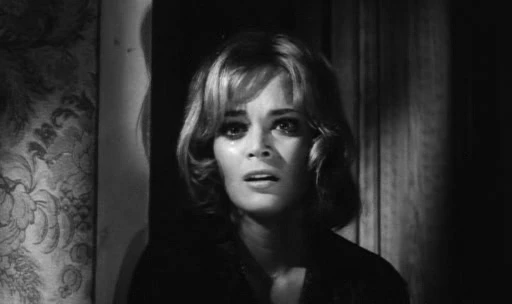
A Bay of Blood
A 1971 Italian giallo that shaped the slasher genre.

A Bay of Blood (originally titled *Reazione a catena*, later reissued as *Ecologia del delitto*, and also known as *Carnage*, *Twitch of the Death Nerve*, and *Blood Bath*) is a 1971 Italian giallo film. Mario Bava co-wrote and directed it. The cast includes Claudine Auger, Luigi Pistilli, Claudio Volonté, Anna M. Rosati, Laura Betti, Leopoldo Trieste, Brigitte Skay, Chris Avram, and Isa Miranda. The plot follows a series of unexplained killings that take place around a bay.
This film is regarded as Bava’s most violent work. Its focus on graphic murder sequences, crafted by special effects artist Carlo Rambaldi, had a major impact on the slasher film genre that emerged about ten years later. In 2005, *Total Film* magazine listed *A Bay of Blood* among the 50 greatest horror films ever made.
**Plot**
One night, Countess Federica Donati is strangled to death in her bayside mansion by her husband, Filippo, who makes it look like a suicide. Soon after, Filippo is stabbed by an unknown person, who removes his body. Police find what seems to be a suicide note from the countess but cannot locate Filippo. Architect Franco Ventura arrives to get Filippo to sign over the bay’s ownership, unaware that Filippo is dead. Filippo’s daughter, Renata, and her husband, Alberto, travel to the bay with their two children to find out what happened to him.
Four friends—Luca, Roberto, Sylvie, and Louise—trespass and break into the empty mansion. Louise goes skinny-dipping alone and finds Filippo’s corpse in the bay. While looking for the others, she is chased and killed with a billhook. The same weapon is used to murder Roberto, and then Luca and Sylvie are impaled with a spear while having sex.
Alberto and Renata meet an eccentric entomologist, Paolo Fossati, and his fortune-teller wife, Anna. They learn about Simone, the countess’s illegitimate son, who lives by the bay as a fisherman. Alberto and Renata question Simone about Filippo and discover Filippo’s body in Simone’s boat, though Simone claims he found it in the bay. Alberto leaves Renata at Ventura’s cottage while he gets their car. Renata finds the bodies of the four friends in Ventura’s bathroom. Ventura attacks her with an axe, but she stabs him with scissors and leaves him for dead. Paolo and Anna separately discover the bodies at the cottage and are killed by Alberto and Renata before they can call the police.
- Release year
- 1971
- Country
- Italy
- Director
- Mario Bava
- Genre
- giallo
- Known for
- Influential on the slasher film subgenre
- Special effects artist
- Carlo Rambaldi
Lore & Background
The film's genesis began when screenwriter Dardano Sacchetti fell out with director Dario Argento. Sacchetti and Bava collaborated on a story about parents committing murder to secure a better future for their children, with the children eventually killing them. The 13 murders were conceived as isolated sequences. Sacchetti wrote the first draft, but arguments led to his departure, and producer Giuseppe Zaccariello took over, with Filippo Ottoni writing the final shooting script. The film was shot under severe budgetary restrictions, with Bava acting as his own cinematographer and using a child's wagon for tracking shots. Location shooting was mostly at Zaccariello's Sabaudia beach house, and Bava used camera tricks to suggest a forest where only a few trees existed.
Reader's Guide
A Bay of Blood is significant for its direct influence on the slasher film subgenre, particularly through its graphic murder set pieces created by effects artist Carlo Rambaldi. The film's emphasis on bloody, inventive kills—such as a spear impalement during sex and a billhook murder—set a template for later slasher films. In 2005, Total Film magazine named it one of the 50 greatest horror films of all time. The film was released under multiple titles in Italy and internationally, including Carnage, Twitch of the Death Nerve, and Blood Bath. Its legacy endures as a key precursor to the slasher boom of the late 1970s and early 1980s.
Did You Know?
- The film was originally titled Cosi imparano a fare i cattivi ('That Will Teach Them to Be Bad') after a line spoken by the children after killing their parents.
- Bava shot alternate dialogue takes in both Italian and English for ease of dubbing.
- The illusion of a character being stabbed in the face with a billhook was achieved with a prop blade sculpted to conform to the actor's profile.
- The film's budget was so low that Bava used a simple child's wagon for tracking shots.
Chaotic Production & Development
The making of A Bay of Blood was anything but smooth. Producer Dino De Laurentiis initially connected screenwriter Dardano Sacchetti, fresh off a falling-out with Dario Argento on The Cat o' Nine Tails, with Mario Bava to craft a giallo. Their early concept centered on two parents committing murder after murder in a chain reaction, eventually abandoning their children, who then kill them out of starvation and terror. The thirteen murders were designed as standalone set pieces with no initial plan for how they would interlock. Sacchetti and his partner Franco Barbieri wrote the first draft under the title Cosi imparano a fare i cattivi. However, spectacular arguments led to Barbieri's firing, and Sacchetti quit in solidarity. De Laurentiis, disappointed by The Cat o' Nine Tails' weak international performance, also walked away. Bava, burdened by massive back taxes, turned to Giuseppe Zaccariello, who had quietly financed his earlier films. Zaccariello insisted on screenwriter Filippo Ottoni, who was reluctant to work in exploitation. Multiple hands ultimately shaped the final script.
Plot & Narrative Architecture
The film's narrative is a meticulously constructed web of deception. What begins as a seemingly straightforward mystery, a string of killings around a bayside property, unravels into a far darker scheme. Architect Franco Ventura, driven by greed, manipulates the situation to secure ownership of the bay. His plan involves seducing Filippo Donati through his secretary Laura, ultimately leading to Filippo's murder of his wife Countess Federica. The chain of violence spirals outward: Filippo is killed by the countess's illegitimate son Simone, who then murders the four trespassing friends with a billhook and a spear. The devastating twist reveals that Alberto and Renata, the apparent victims, are actually the masterminds behind the entire scheme, killing Paolo and Anna to prevent them from alerting police. The final, darkly comic beat, in which Alberto and Renata are shot dead by their own son who mistakes their shotgun for a toy, underscores the film's theme of inherited violence and the absurdity of greed.
Visual Violence & Cinematic Legacy
A Bay of Blood stands as Mario Bava's most viscerally violent work, and its impact on the horror landscape cannot be overstated. The film's elaborate murder sequences, crafted by the legendary effects artist Carlo Rambaldi, pushed the boundaries of what audiences had previously seen on screen. The billhook killings, the impalement with a spear during an intimate moment, and the axe-and-scissors confrontation all became iconic set pieces that demonstrated a new level of graphic, choreographed violence in Italian cinema. This emphasis on bloody, meticulously staged kills proved enormously influential on the slasher subgenre that would explode roughly a decade later, with filmmakers drawing direct inspiration from Bava's approach to turning death into spectacle. The film's reputation has only grown over time; in 2005, Total Film magazine included it among the fifty greatest horror films of all time, cementing its status as a landmark bridging the giallo tradition and the modern horror era.
Casting & Creative Context
The ensemble cast of A Bay of Blood brought together a remarkable array of Italian and international talent, including Claudine Auger, Luigi Pistilli, Claudio Volonté, Anna M. Rosati, Laura Betti, Leopoldo Trieste, Brigitte Skay, Chris Avram, and Isa Miranda. Laura Betti's involvement was particularly significant, as she and Bava had developed a strong working relationship during his earlier film Hatchet for the Honeymoon. At the time De Laurentiis first approached Bava about the project, the two had been exploring a very different idea together: a film called Odore di carne, roughly translating to stench of flesh, concerning cannibalism on Los Angeles college campuses. The production itself cycled through multiple titles, Cosi imparano a fare i cattivi, Reazione a catena, and La baia d'argento, before settling on the various international names like Carnage, Twitch of the Death Nerve, and Blood Bath. The original Italian title, Ecologia del delitto, translates as Ecology of Crime, a phrase that aptly captures the self-sustaining cycle of violence at the story's core.
Frequently Asked Questions
Who directed A Bay of Blood?
Mario Bava co-wrote and directed the 1971 Italian giallo. It is frequently cited as the most graphically violent film in his career.
What makes A Bay of Blood stand out among other giallos?
The film is best known for its elaborate, choreographed murder sequences, with special effects designed by Carlo Rambaldi. Its unflinching depiction of violence set it apart from much of the giallo work of that era.
Why is A Bay of Blood considered important to horror film history?
It is widely regarded as a key influence on the slasher subgenre that emerged in the late 1970s and 1980s. Its focus on a hidden killer and stylized, effects-driven murders became a blueprint for later horror filmmakers.
What are the alternate titles for A Bay of Blood?
The original Italian title is Reazione a catena, and it was later reissued as Ecologia del delitto. English-language releases used names including Carnage, Twitch of the Death Nerve, and Blood Bath.
More in Giallo films 1-24
Spotted an error? Know more?
Reader corrections go straight into our review queue. Suggest an edit · How this site is sourced