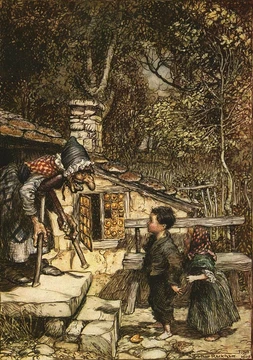
The Cold Heart
A fairy tale of a charcoal burner who trades his heart for wealth.

Wikimedia Commons · CC0
"The Cold Heart" (German: "Das kalte Herz") is a fairy tale written by Wilhelm Hauff, published in 1828 within a collection of tales framed by the narrative of The Spessart Inn. The story follows Peter Munk, a charcoal burner who trades his heart for wealth and later seeks redemption. It is notable for its adaptation into German films, including versions in 1924 and 1950.
- Published
- 1828
Lore & Background
The tale is set in the Black Forest and centers on Peter Munk, called Coal-marmot Peter, who inherits his father's charcoal business but despises its low status. He seeks out the little glass-imp, Schatzhauser, who grants three wishes to Sunday-born children. Peter's first wish—to dance better than the dance floor king and have as much money as Ezechiel—is foolish; his second wish for a glass factory is granted, but he lacks the brains to manage it. After losing everything, he turns to the dangerous Dutch-Mike, who gives him money in exchange for his heart, replacing it with a stone. Peter becomes cold and cruel, driving away his wife Lisbeth and his mother. Eventually, with the glass-imp's help, he tricks Dutch-Mike into returning his heart, and Lisbeth is revived. Peter becomes a hard-working charcoal burner, and the glass-imp becomes godparent to his son.
Reader's Guide
The story draws on Washington Irving's "The Devil and Tom Walker" as a source, retold as a Black Forest legend. It reflects Romantic-era themes: the pursuit of happiness through longing (Sehnsucht), self-destruction from greed, and eventual redemption. The tale uses mystical-eerie elements, the uncanny, and folk motifs. Psychological analysis by Mathias Jung suggests Peter's struggles mirror Hauff's own life—Hauff's father died when he was seven, possibly causing a mother fixation. Peter's journey to the "wrong father" (Dutch-Mike) stems from lack of trust in his industry, reflecting Erikson's stage of industry vs. inferiority. The name Peter was chosen for its commonness, allowing universal identification. The glass-imp represents a positive guiding force.
Did You Know?
- The story was published in 1828 as part of a collection framed by The Spessart Inn.
- It was adapted into German films in 1924 and 1950, both titled "Das kalte Herz."
- Wilhelm Hauff used Washington Irving's "The Devil and Tom Walker" as a source for the second part of the tale.
- The protagonist's name, Peter, was chosen because it was very common, allowing readers to identify with him.
Gallery



Frequently Asked Questions
Who wrote The Cold Heart and when was it published?
Wilhelm Hauff penned this fairy tale, which saw the light of day in 1828 as one of several stories embedded within the frame narrative of The Spessart Inn.
What is the plot of The Cold Heart?
The tale follows Peter Munk, a charcoal burner who sells his heart to gain enormous wealth, and then desperately tries to undo the bargain and restore his humanity.
Who is Peter Munk in The Cold Heart?
He is the story's protagonist, a working-class charcoal burner whose desire for riches drives him to make a dark deal that strips him of his emotional capacity.
What is the moral of The Cold Heart?
The tale serves as a cautionary warning about how the pursuit of material wealth can hollow out a person's soul, yet it also offers the hope that genuine remorse and self-sacrifice can lead to redemption.
Has The Cold Heart been adapted into a movie?
Yes, German filmmakers have brought the story to the screen on at least two occasions, with versions appearing in 1924 and again in 1950.
More in German folklore 1-24
Spotted an error? Know more?
Reader corrections go straight into our review queue. Suggest an edit · How this site is sourced