Bieresel
A beer-drinking donkey spirit of German folklore.

Neulich im Roxy Kino · CC BY 3.0
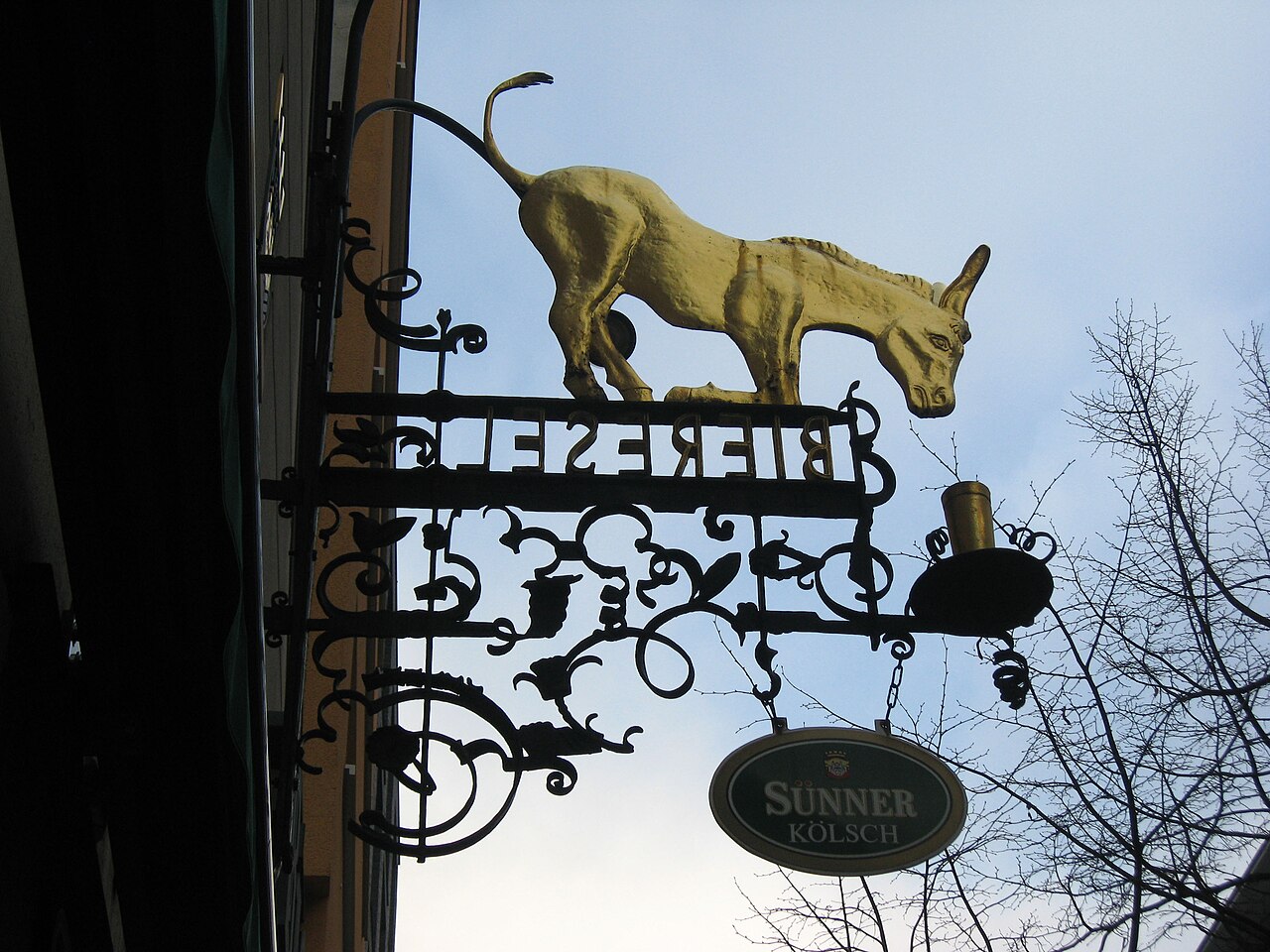
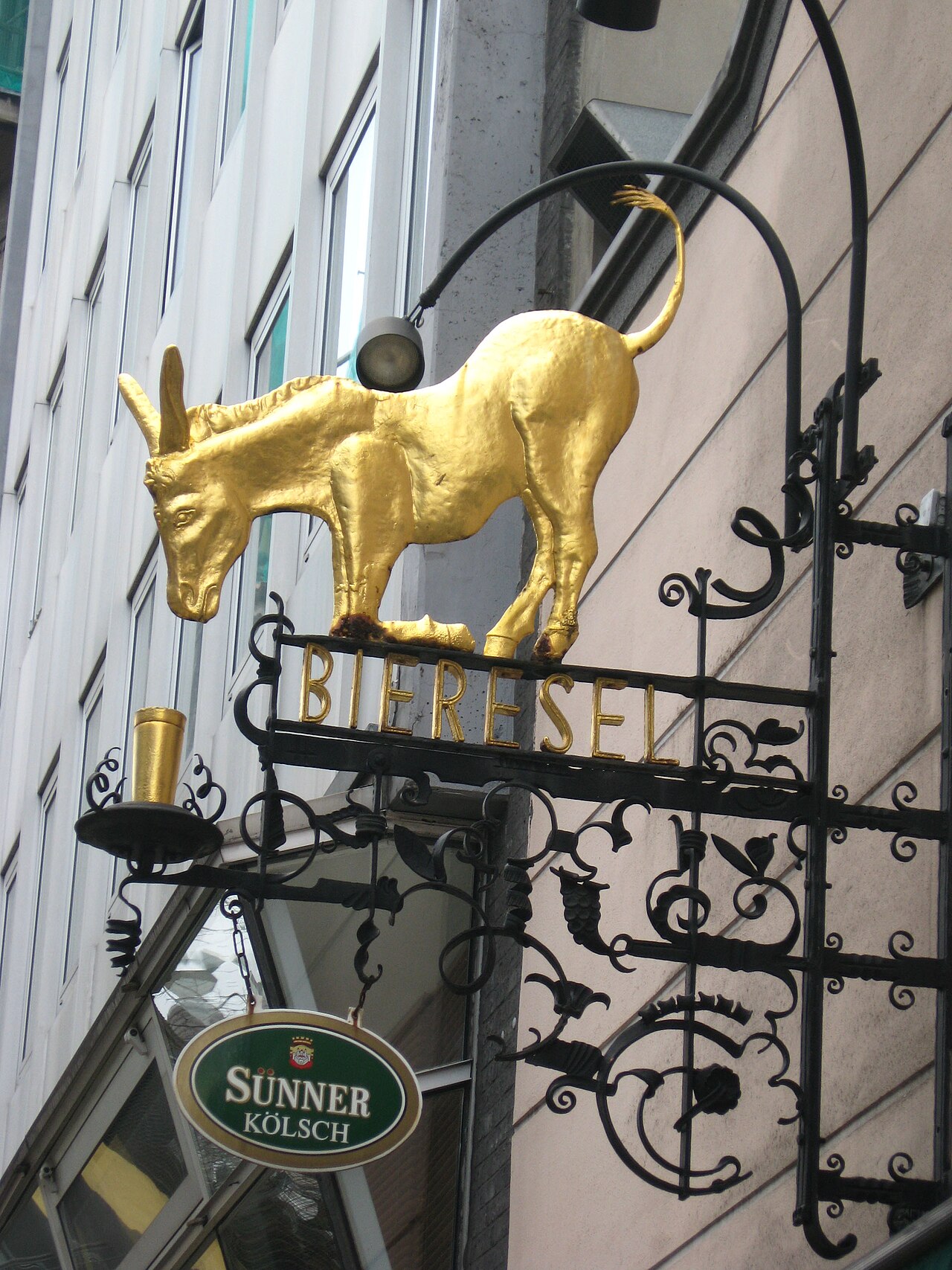
The bieresel (German: Bieresel, 'beer donkey') is a type of kobold (house spirit) in German folklore, first mentioned in the 1705 work *Die gestriegelte Rockenphilosophie* by apothecary and natural historian Johann Georg Schmidt. It is described as a devil or kobold taking the shape of a donkey that drinks beer by night, and the term is attested as an insult as early as 1597 in Bürgel. The bieresel appears in various regional traditions, particularly in Thuringia, Saxony, and former German-speaking Bohemia, with attributes ranging from a three-legged donkey spirit that leaps onto drunkards' backs to a household helper that demands beer as payment.
- Type
- Kobold (house spirit)
- First mentioned
- 1705 (in *Die gestriegelte Rockenphilosophie*)
- Earliest attested insult
- 1597 (in Bürgel)
- Region
- Germany (Thuringia, Saxony, Vogtland, former German-speaking Bohemia)
- Known for
- Appearing as a donkey (often three-legged), drinking beer, leaping onto drunkards' backs, or performing household chores in exchange for beer
Lore & Background
The bieresel is generally described as a spirit with donkey legs, sometimes only three, hence its name meaning 'beer donkey.' In Ruhla, Thuringia, a bieresel with the appearance of a three- or four-legged donkey would roam the streets looking for beer-drinkers, reputedly practicing 'aufhocken'—leaping upon a person's back and forcing them to carry the spirit, usually all the way to the drinker's house door. Its victims were drunkards or tavern visitors returning late at night. A similar tale was recorded in Steinbach, also in Thuringia, where the bieresel hops on the back of someone who gets drunk at the pub and forces him to carry the spirit. The bieresel is also reputedly found in other parts of Thuringia.
In the Vogtland, when a child laughs loudly, people say he laughs like a bieresel. There, the bieresel goes into pubs and mingles with the crowd drinking beer, doing no particular harm. However, the notion of a bieresel in the Vogtland is different from elsewhere, and the folklorist Grässe guesses it may not be held to take on the typical three-legged donkey form. In Grochwitz near Torgau in Saxony, the bieresel brings beer inside the house like a Drak and also does other household chores like a Kobold, expecting only a glass of beer every evening; if it doesn't get its beer, it will break everything. In Grimma, Saxony, there was a legend of a bieresel dwelling in a cellar under one of the barns, and it did not tolerate anyone staying overnight.
A tale set in a mill called the Katzenmühle or 'Cat-mill' at Schwanditz near Altenburg, Thuringia, tells of a mill haunted by a bieresel, where a portion of beer had to be put out each night until a bear-handler stayed over with his bear and drove the bieresel out in a fight. The spirit later asked the miller if the nasty cats were still around, giving the mill its name. In former German-speaking Bohemia, unscrupulous barkeepers are said to turn into the bieresel, a noisy Poltergeist monster. In one village of the Braunau District, a story tells of the monster taking occupancy in a room at a tavern, with encounters reputed to be deadly. A servant lad who investigated was found dead with a broken neck, and a girl who saw it described it as a gray ox with a thick red human head characterized by giant horns. A farmstead called 'Muschick' in Settenz (Řetenice), Teplice, was reputedly haunted by a bieresel that was donkey-headed and hooved, committing mischief such as throwing maids out of bed and breaking milk vats.
Reader's Guide
The bieresel occupies a distinctive niche in German folklore as a household spirit specifically tied to beer and brewing, reflecting the cultural importance of beer in German-speaking regions. Unlike many kobolds that are generalized house spirits, the bieresel's identity is defined by its association with alcohol—it either drinks beer, demands beer as payment, or preys on drunkards. This specialization makes it a folkloric embodiment of the consequences of excessive drinking, as seen in the 'aufhocken' tradition where it forces drunkards to carry it home. At the same time, the bieresel can be a helpful spirit, cleaning bottles and performing chores in breweries and beer cellars, provided it receives its due portion of beer. This duality—helpful when respected, mischievous or dangerous when neglected—is a common theme in Germanic household spirit lore. The bieresel also shows regional variation: in Thuringia it is a donkey-shaped tormentor of drunkards, in Saxony a domestic helper, and in Bohemia a deadly poltergeist monster. Its parallels with the dorftier ('village animal') and the English brewery spirit Hodfellow suggest a broader European motif of beer- or wine-related house spirits. The bieresel thus serves as a lens into local customs, moral warnings about drunkenness, and the folk imagination's way of explaining mishaps in breweries and taverns.
Did You Know?
- In Ruhla, Thuringia, the bieresel would practice 'aufhocken'—leaping onto drunkards' backs and forcing them to carry it home.
- A tale from the Katzenmühle mill near Altenburg describes a bieresel being driven out by a bear-handler's bear.
Bieresel's Place Among the Household Spirits
Bieresel occupies a specific niche within the vast taxonomy of German folkloric beings: it is classified as a variant of the Kobold, a category of household spirits. This grouping places it alongside a constellation of similarly named domestic entities—Gütel, Heinzelmännchen, Hinzelmann, Hödekin, Jack o' the bowl, Nis Puk, and Petermännchen—all of which share the fundamental role of inhabiting the domestic sphere. The broader household-spirit category also encompasses the Drak and the Klabautermann, the latter specifically associated with ships rather than land-based dwellings. Bieresel's position within this family reflects a wider pattern in German folklore, where a single archetypal figure branches into numerous regional and dialectal variants, each carrying local color while retaining the core identity of a spirit bound to the home. This proliferation of names for essentially the same type of being illustrates how oral tradition adapted a shared Germanic mythological inheritance to the particularities of individual communities across the many polities that historically comprised the German-speaking world.
Germanic Heritage and the Persistence of Old Beliefs
The spiritual landscape in which Bieresel resides did not emerge in isolation. German folklore shares deep structural parallels with the folk traditions of Scandinavia and England, all three drawing from a common wellspring of Germanic mythology. The resulting body of belief is a layered composite: a pre-Christian pantheon of gods and supernatural beings stands alongside magical figures that became entangled with Christian liturgical calendars, while regional character stories add a further stratum of local narrative. A defining feature of this tradition is persistence. Even after genuine belief in the old deities faded from daily life, the mythological framework did not simply vanish. Instead, fragments survived in the form of household spirits, water beings, mountain guardians, and nightmare-causing entities—each one a remnant of a once-living cosmology. Because Germany was politically fragmented into numerous small states for most of its history, this folk tradition developed across a wide geographic canvas, encompassing not only the territory of modern Germany but also the German-speaking regions of Austria, Liechtenstein, Switzerland, Luxembourg, Belgium, and Italy.
Scholarly Recovery and the Forging of National Narrative
The survival of figures like Bieresel owes much to a deliberate scholarly effort that began in the eighteenth and nineteenth centuries. Early collectors such as the Saxon writer Johann Karl August Musäus (1735–1787) and, later, Bernhard Baader, who in 1851 published a volume of oral-history-based folklore from Baden and neighboring regions, helped transfer these traditions from living speech into written record. The Prussian poet and philosopher Johann Gottfried von Herder played a particularly influential role by arguing that folklore served a function in ethnic nationalism—not merely as the heritage of scattered German-speaking communities, but as the cultural property of a unified German nation. This vision inspired the Brothers Grimm, Goethe, and a generation of writers and composers. Richard Wagner wove folkloric elements such as the Rhine Maidens into his opera cycle Der Ring des Nibelungen, while Washington Irving drew on German tale material for works like Rip van Winkle and The Legend of Sleepy Hollow. In this way, household spirits and their kin became building blocks of a national literary and artistic identity.
Folklore Co-opted: The Twentieth-Century Shadow
The same nationalist framing that once inspired collectors and composers carried a darker potential, one fully realized during the National Socialist period. In that era, the academic discipline of Volkskunde—folklore studies—was deliberately repurposed as a propaganda instrument. As scholar James R. Dow has documented, folklore was weaponized in the service of anti-democratic and anti-socialist agendas that culminated in extreme inhumanity. The search for authentic traditional customs was redirected toward constructing a narrative of unbroken historical continuity with an idealized Germanic past, a narrative that excluded and dehumanized those who did not fit the prescribed ethnic mold. Antisemitic legends, including the blood libel, were given renewed emphasis within this framework. For a figure like Bieresel, a humble household spirit rooted in local oral tradition, this political instrumentalization represents a profound distortion: what was once a small, regionally specific element of domestic folklore became entangled in a machinery of state ideology that used the entire corpus of Germanic myth to justify terror.
Gallery



Frequently Asked Questions
What is a Bieresel?
The Bieresel is a type of kobold, or house spirit, in German folklore. It is essentially a beer-drinking donkey spirit that haunts households and taverns.
What does a Bieresel look like and how does it behave?
It typically appears as a donkey, often described as having only three legs. At night it drinks beer, and in some versions it leaps onto the backs of drunkards or performs household chores in exchange for a drink.
Where does the Bieresel first appear in written records?
The earliest attested use of the term as an insult dates to 1597 in Bürgel. The spirit is first described in a folklore context in Johann Georg Schmidt's 1705 work *Die gestriegelte Rockenphilosophie*.
In which regions is the Bieresel found?
The creature is most strongly associated with Thuringia, Saxony, and the Vogtland area. It also appears in traditions from the former German-speaking parts of Bohemia.
Why is the Bieresel considered significant in German folklore?
It represents the intersection of household spirits and the cultural centrality of beer in German daily life. Its name itself became a colloquial insult for a clumsy or heavy-drinking person well before it was catalogued as a supernatural being.
More in German folklore 1-24
Spotted an error? Know more?
Reader corrections go straight into our review queue. Suggest an edit · How this site is sourced