Cultural depictions of Frederick Barbarossa
Holy Roman emperor whose legacy inspired legends and political symbolism.

No machine-readable author provided. Colhogan1 assumed (based on copyright claim · Public domain
Frederick I, known as Barbarossa, was a prominent Holy Roman emperor whose political and cultural influence was strongly felt in both Germany and Italy. His life and reign have inspired extensive scholarly study and artistic representation. During the 19th and early 20th centuries, various political movements and regimes—including the Italian Risorgimento, the Wilhelmine government in Germany (particularly under Emperor Wilhelm I), and the National Socialist movement—used him as a political symbol. In modern times, scholars such as Kurt Görich argue that a tradition-building form of commemoration is no longer necessary and caution against any instrumentalization of the historical figure, whether for nationalist or other purposes. Contemporary historians generally reject nationalist myths, instead portraying Barbarossa as an influential ruler who faced many setbacks but often recovered. He strengthened the imperial position in Germany but made errors in his attempts to assert authority over the North Italian communes, leading to a prolonged conflict. After his defeat at the Battle of Legnano, he adjusted his policies and developed a better working relationship with those communes. His diplomatic successes, combined with changing circumstances, opened new opportunities for the empire—most notably through the marriage of his son Henry VI to Constance of Sicily. Recent German scholarship has focused on Barbarossa’s connection to the chivalrous and courtly culture of his time.
**Legends and anecdotes**
After the conquest of Milan in 1164, the relics of the Three Kings were sent to Cologne, where they remain venerated today in the city’s cathedral. Because Barbarossa died suddenly without receiving confession—a death considered in medieval times a divine punishment—various myths emerged to help people cope. Some chroniclers altered the story so that the emperor could repent before his death. The most famous legend is the Kyffhäuser legend, which claims Barbarossa is not dead but asleep with his knights in a cave in the Kyffhäuser mountains in Thuringia or on Mount Untersberg at the border of Bavaria, Germany, and Salzburg, Austria. He will awaken and restore Germany to a Golden Age when the ravens stop flying around the mountain.
- Born
- Not specified in source
- Died
- Not specified in source
- Field
- Holy Roman Emperor
- Nationality
- Holy Roman Empire
- Known for
- Reestablishing imperial position in Germany, struggle with North Italian communes, and the Kyffhäuser legend
Lore & Background
Frederick I, nicknamed Barbarossa, reestablished imperial authority in Germany and enhanced the imperial position, but made mistakes when trying to assert his authority over North Italian communes, leading to a prolonged struggle. After being humbled in the Battle of Legnano, he changed his policies and attained a better working relationship with the Italian communes. His successful diplomatic efforts, together with developing circumstances, opened new possibilities for the imperial position, notably through the marriage of his son Henry VI with Constance of Sicily.
Various legends arose around Barbarossa. The most famous is the Kyffhäuser legend, which says he is not dead but asleep with his knights in a cave, and will awaken to restore Germany to a Golden Age. Another legend states that when seizing Milan in 1158, his wife Beatrice was humiliated, and Barbarossa forced magistrates to remove a fig from a donkey's anus with their teeth, or excrement, giving rise to the insulting gesture called fico. During the Risorgimento, Frederick became a symbol of the foreign oppressor defeated by the Lombard League.
Modern historians generally reject nationalist myths, portraying Frederick as an influential ruler who suffered many setbacks but often managed to recover. Recent German scholarship emphasizes his relationship with the chivalrous-courtly culture of the time. Scholars like Kurt Görich call for neutrality and warn against instrumentalization of the historical person.
Reader's Guide
Frederick Barbarossa's cultural depictions span centuries and vary widely between Germany and Italy. In Germany, he became a political symbol for the Wilhelmine government and the National Socialist movement, with the Kyffhäuser Monument declaring Kaiser Wilhelm I his reincarnation. In Italy, his image remains ambivalent: cities destroyed by him see him as a foreign oppressor, while others like Como and Pavia view him favorably as a supporter of their traditions. The Kyffhäuser legend, where he sleeps awaiting Germany's golden age, was promoted by the German Empire after 1871. His legacy also appears in literature, such as in Gargantua and Pantagruel, and in Italian historiography influenced by Risorgimento narratives. Modern scholarship, as summarized by Professor Gianluca Raccagni, notes his profound influence on public law and his near success in reestablishing imperial control over the papacy and Italian city-states.
Did You Know?
- After the 1162 conquest of Milan, the remains of the Three Kings were sent to Cologne, where they are still venerated in the Cologne Cathedral.
- The Kyffhäuser legend says Barbarossa's red beard has grown through the table at which he sits while he sleeps in a cave.
- During the Risorgimento, Frederick became a symbolic barbarian and foreign oppressor defeated by the Lombard League.
- In Brienno, Italy, Frederick Barbarossa even has a holy image.
The Kyffhäuser Legend and Its Political Mobilization
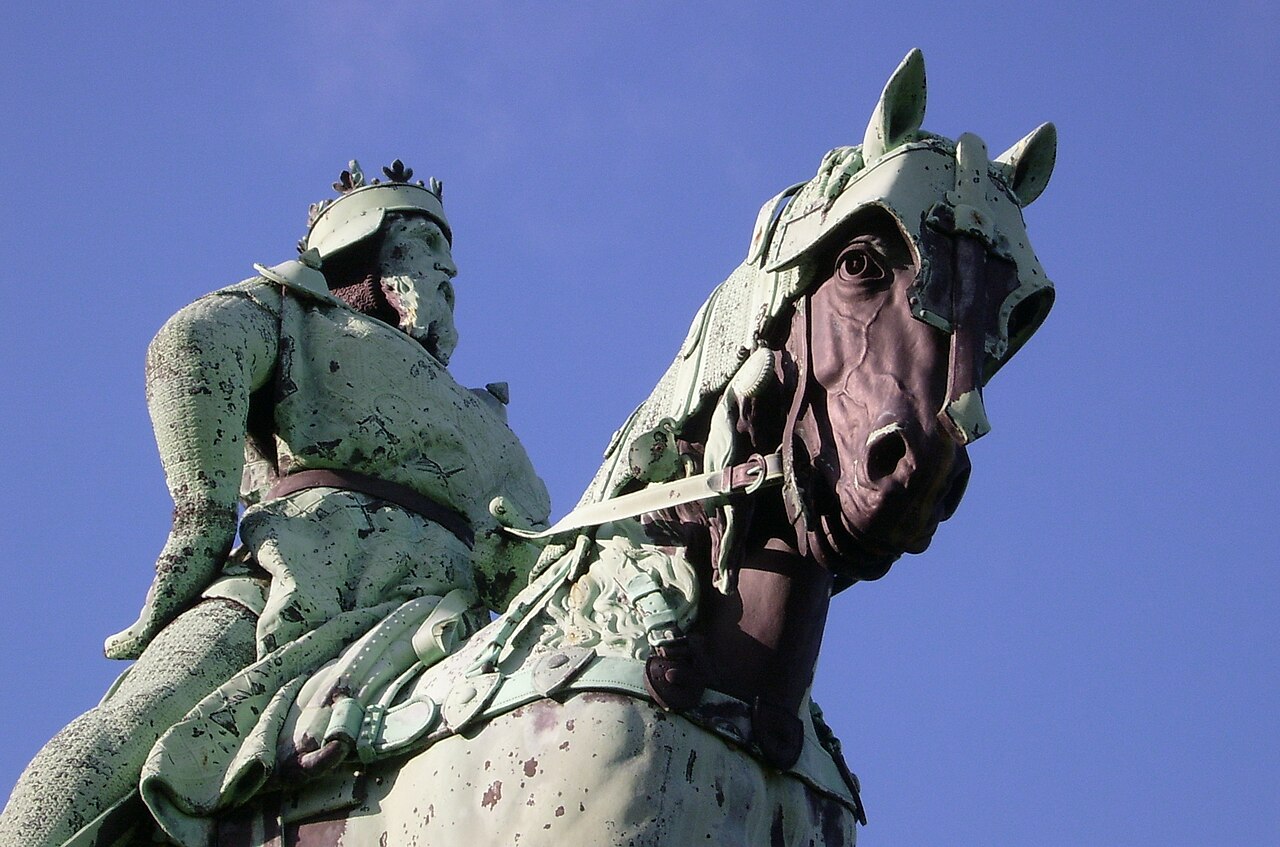
The most enduring myth surrounding Frederick I is the Kyffhäuser legend, which holds that the emperor never truly died but sleeps in a mountain cave—either in Thuringia or at the Bavarian-Austrian border—alongside his knights. In this tale, his red beard has grown long enough to pass through the table where he sits, and he periodically dispatches a boy to check whether the ravens circling the peak have finally ceased their flight, the sign that would rouse him to restore Germany to a Golden Age. A parallel Sicilian variant was recorded earlier concerning his grandson Frederick II. The legend became a powerful political tool: the German Empire erected the Kyffhäuser Monument atop the mountain, declaring Kaiser Wilhelm I a reincarnation of Frederick, with the 1896 dedication timed to the anniversary of Barbarossa's coronation. Interestingly, Prussian authorities were initially lukewarm toward the Barbarossa cult, which had originally served Southern princes seeking a voice in central governance. Only after 1871, when Wilhelm I became German emperor, did the state actively promote the sleeping-king narrative.
The Italian Mirror: Oppressor, Barbarian, and the Fico Legend
In Italian cultural memory, Frederick I occupies a far more conflicted position than in German tradition. During the Risorgimento, he was recast as the archetypal foreign barbarian whose armies were ultimately defeated by the heroic Lombard League, a narrative that shaped Italian historiography for generations. Writers like Cesare Cantù amplified this image, recounting episodes in which Frederick returned Milanese captives with severed hands or gouged-out eyes. Some Italian schoolbooks, as Cardini notes, still portray him as a proto-fascist figure. A particularly vivid legend surrounds the 1158 siege of Milan, when his wife Empress Beatrice was allegedly captured by the Milanese and paraded through the streets on a donkey in public humiliation. In retaliation, the story goes, Frederick forced the city's magistrates to extract a fig—or, in darker versions, excrement—from a donkey's anus using only their teeth, while they cried 'Ecco la fica.' This tale, referenced in Rabelais's Gargantua and Pantagruel, is sometimes cited as the origin of the Italian insulting gesture known as the fico. Unlike Germany, where the legend tends toward reverence, Italy's Barbarossa remains ambivalent and emotionally charged, with contrasting accounts persisting in cities like Milan, Tortona, and Asti.
Messianic Prophecy and the 'Good King' Archetype
From the earliest centuries after his death, Frederick I was woven into eschatological narratives that cast him as a prophetic figure. The medieval Golden Legend, refined by Jacobus de Voragine, structured the end of the world around three stages: catastrophic natural disasters, the rise of the Antichrist, and the emergence of a righteous king to defeat him. Barbarossa appeared in this final role—not merely a new ruler but the ultimate one, an emperor of peace tied to the latter days. This Messianic reading surfaces in the Italian Sibyla Eritrea, the Sächsische Weltchronik of 1260, and Salimbene di Adam's Cronica of 1280. In later centuries, German propaganda amplified these popular fables, pairing Frederick I and his grandson Frederick II as embodiments of the 'good king' ideal. This cult of the national leader was later absorbed by figures as diverse as Martin Luther, Frederick the Great of Prussia, and Bismarck, and ultimately mobilized by the National Socialists. The roots of these end-time accounts stretch back thousands of years, entering Christian thought through the writings of the Apostle Peter, and the millennial fables were freely exchanged across Continental Europe.
Modern Historiography and the Call for Neutrality
Contemporary scholarship has largely moved beyond the nationalist and propagandistic frameworks that dominated earlier centuries. Historians today generally reject the mythologized narratives, instead presenting Frederick as a complex and influential ruler who, despite numerous setbacks, repeatedly managed to recover and reassert his position. He reestablished imperial authority in Germany and strengthened the imperial office, yet his attempts to impose direct control over the North Italian communes provoked a prolonged and costly conflict. The decisive turning point came at the Battle of Legnano, where his humiliation prompted a significant policy shift toward a more cooperative relationship with the Italian cities. His diplomatic acumen, combined with favorable circumstances, opened new avenues for the imperial position, most notably through the marriage of his son Henry VI to Constance of Sicily. Recent German scholarship has also turned attention to Frederick's engagement with the chivalrous and courtly culture of his era, exploring dimensions of his personality beyond pure political analysis. Scholars such as Kurt Görich now urge a measured, neutral approach, warning against both the old instrumentalization by political movements and any new form of myth-making that would reduce the historical person to a symbol.
Gallery
Frequently Asked Questions
Who is Frederick Barbarossa in German folklore and cultural memory?
Barbarossa is a Holy Roman Emperor whose historical reign has been transformed into a powerful folk legend, most famously the story of him sleeping inside Kyffhäuser Mountain. In that tradition, he sits enthroned with his court, his beard growing through the stone, waiting for the moment Germany needs him to rise again.
What exactly happens in the Kyffhäuser sleeping legend?
According to the tale, Barbarossa and his retinue rest in a hidden cavern beneath the Kyffhäuser peak, and he will awaken only when a flock of eagles circles the mountain seven times. At that signal, he will emerge to restore imperial order and reunite the German lands.
How did different political movements use Barbarossa as a symbol?
From the Italian Risorgimento to Wilhelmine Germany under Emperor Wilhelm I and later the National Socialist movement, various regimes seized on his image to project ideas of imperial authority and national destiny. His figure became a flexible banner that each era reshaped to fit its own political narrative.
Why does Barbarossa keep appearing in German art, literature, and public monuments?
His legend offers a narrative of deferred greatness—a ruler who will return when the nation most needs him—which resonates across centuries of cultural production. Scholars such as Kurt Görich note that this commemorative tradition allows successive generations to project their own aspirations onto his figure.
What made Barbarossa's cultural legacy different from other medieval emperors in German folklore?
Unlike many historical rulers who faded into academic obscurity, Barbarossa acquired a living folk narrative centered on the Kyffhäuser legend, giving him a quasi-mythic status. This combination of real political achievement—reasserting imperial power in Germany and clashing with the northern Italian communes—and fantastical legend made him uniquely adaptable as a cultural symbol.
More in German folklore 1-24
Spotted an error? Know more?
Reader corrections go straight into our review queue. Suggest an edit · How this site is sourced