
Jupiter Icy Moons Explorer
ESA's first interplanetary mission to orbit a moon other than Earth's.

European Space Agency · CC BY-SA 3.0 igo
The Jupiter Icy Moons Explorer, or Juice, is a European Space Agency spacecraft currently traveling to study three of Jupiter’s large, icy moons: Ganymede, Callisto, and Europa. These moons are believed to hold vast oceans of liquid water beneath their frozen crusts, making them possible homes for alien life. Juice is notable as the first interplanetary mission to the outer Solar System built by a multinational agency rather than a single nation, and it will be the first spacecraft ever designed to enter orbit around a moon that is not Earth’s own.
The mission grew out of an earlier proposal called the Jupiter Ganymede Orbiter, which was part of a larger, now-canceled joint project with NASA. In 2012, Juice was chosen as the first large-class mission under ESA’s Cosmic Vision program, beating out two other proposals—an X-ray telescope and a gravitational wave observatory—both of which later got their own missions. Airbus Defence and Space became the main contractor in 2015, building the probe in Toulouse, France. By 2023, the mission’s total cost was estimated at 1.5 billion euros.
The spacecraft’s design was driven by Jupiter’s extreme distance from the Sun, the need for solar power, and the planet’s intense radiation. To reach Jupiter and then enter orbit around Ganymede, Juice carries about 3,000 kilograms of chemical propellant, giving it a total velocity-change capability of roughly 2,700 meters per second. It has a fixed 2.5-meter high-gain antenna and a steerable medium-gain antenna, using both X- and K-band radio frequencies. The spacecraft can send about 2 gigabits of data per day back to Earth and store up to 1.25 terabits onboard. Its main engine is a 425-newton thruster that burns hypergolic fuels, and a 100-kilogram layer of insulation controls its temperature. Juice is stabilized in three axes using momentum wheels, and its electronics are shielded to withstand 50 kilorads of radiation. The science payload weighs 280 kilograms and includes cameras, spectrometers, a radar sounder, a laser altimeter, a magnetometer, and several other instruments. A 10.6-meter boom holds the magnetometer and radio wave sensors, while a 16-meter antenna is used for radar sounding.
Juice launched on 14 April 2023 from French Guiana aboard an Ariane 5 rocket—the second-to-last flight of that rocket and the final ESA science mission to use it.
Quick Facts
- Names List
- Juice
- Mission Type
- Jupiter orbiter
- Operator
- European Space Agency
- Manufacturer
- Airbus Defence and Space
- Launch Mass
- 6070 kg
- Dry Mass
- 2420 kg
- Dimensions
- 16.8 × 27.1 × 13.7 meters
- Power
- 850 watts
- Launch Date
- 14 April 2023 12:14:36UTC
- Launch Rocket
- Ariane 5 ECA+ (VA-260)
- Launch Site
- Kourou ELA-3
- Launch Contractor
- Arianespace
Facts from the source article.
Lore & Background
Juice was launched on 14 April 2023 from the Guiana Space Centre on an Ariane 5 rocket, after a one-day delay due to poor weather. The spacecraft carries about 3,000 kg of chemical propellant and has a total delta-V capability of about 2,700 m/s. Its science payload includes instruments such as the JANUS camera, MAJIS spectrometer, RIME radar sounder, and J-MAG magnetometer, mounted on deployable booms up to 16 meters long.
In August 2024, Juice performed the first-ever gravity assist using both the Moon and Earth, saving up to 150 kg of fuel. During this maneuver, it tested many instruments, including capturing a radargram of the lunar surface visible in the famous Earthrise photo. In August 2025, Juice flew by Venus, using its high-gain antenna as a thermal shield due to intense solar flux, and experienced a communication anomaly that was resolved within 20 hours.
In November 2025, Juice observed the interstellar comet 3I/ATLAS, the third known interstellar object in the Solar System, using its cameras, spectrometers, and particle sensor. The observations generated 11.18 Gbits of data, with a preliminary picture released in December 2025 showing the comet's coma and tails.
Reader's Guide
Juice represents a landmark in European space exploration as the first interplanetary spacecraft to the outer Solar System not built by the United States. Its mission to study Ganymede, Callisto, and Europa—icy moons with subsurface liquid water—addresses fundamental questions about habitability beyond Earth. By entering orbit around Ganymede in December 2034, Juice will become the first spacecraft to orbit a moon other than Earth's Moon. Its operations will overlap with NASA's Europa Clipper mission, launched in October 2024, enabling complementary observations. The mission's complex trajectory, involving four gravity assists and more than 25 flybys, demonstrates advanced navigation and propulsion capabilities. Juice's observations of the interstellar comet 3I/ATLAS in 2025 highlight its versatility as a scientific platform even during its cruise phase. The mission, costing ESA 1.5 billion euros, underscores Europe's growing role in deep-space exploration and its commitment to investigating the potential for life in the outer Solar System.
Did You Know?
- Juice is the first interplanetary spacecraft to the outer Solar System planets not launched by the United States.
- Juice observed the interstellar comet 3I/ATLAS in November 2025, generating 11.18 Gbits of data.
Mission Purpose and Scientific Ambition
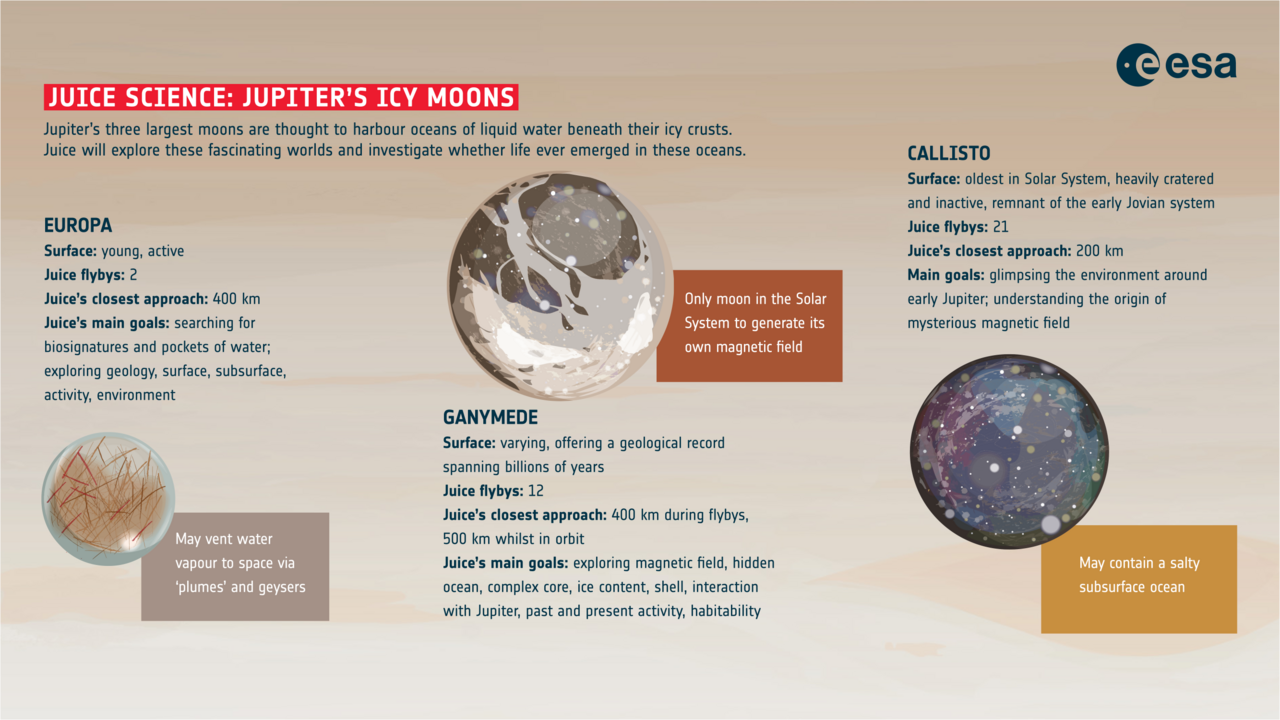
JUICE is ESA's interplanetary spacecraft designed to orbit and study three of Jupiter's icy moons—Ganymede, Callisto, and Europa. These planetary-mass bodies are considered prime targets because scientists believe they harbor substantial liquid water beneath their frozen crusts, making them candidates for hosting extraterrestrial life. The mission represents a first in several ways: it is the first non-American spacecraft sent to the outer Solar System planets, and the first ever intended to orbit a moon other than Earth's. Launched in April 2023, JUICE will spend eight years traveling to Jupiter, arriving in July 2031 after four gravity assists. Its close-up science operations begin in December 2034, when it enters orbit around Ganymede. Notably, this period of operations will overlap with NASA's Europa Clipper mission, launched in October 2024, creating a rare window for coordinated study of Jupiter's icy satellite system.
From Cancelled Joint Venture to Flagship L-Class Mission
JUICE did not begin life under its current name. The mission originated as the Jupiter Ganymede Orbiter proposal, which was ESA's contribution to the Europa Jupiter System Mission – Laplace, a joint venture that was ultimately cancelled. When that program fell through, the concept was reformulated and entered the competition for ESA's first L-class Large mission, designated L1, under the Cosmic Vision Programme. On 2 May 2012, JUICE was selected, beating out the X-ray telescope ATHENA and the gravitational wave observatory LISA, then known by the working name NGO. Both of those losing proposals were later approved and are under development as of 2025. In July 2015, Airbus Defence and Space was chosen as prime contractor, with assembly taking place in Toulouse, France. By 2023, the mission's estimated cost had reached 1.5 billion euros. In 2024, Airbus received ESA's Excellence Award for its work on the spacecraft.
Engineering for the Harsh Jovian Environment
Designing JUICE required overcoming several extreme challenges. The vast distance from the Sun necessitated solar power generation, while Jupiter's intense radiation environment demanded robust shielding—electronics must tolerate 50 kilorad at the equipment level. The complex trajectory, involving more than 25 gravity assists and two Europa flybys, along with orbit insertions at Jupiter and Ganymede, requires approximately 3,000 kg of chemical propellant and a total delta-V of about 2,700 m/s. The main engine is a 425 N hypergolic thruster using mono-methyl hydrazine and mixed nitrogen oxides. The spacecraft carries a 280 kg science payload comprising over a dozen instruments, including the JANUS camera, MAJIS spectrometer, RIME radar, GALA altimeter, and J-MAG magnetometer. A 10.6-meter boom holds the magnetometer, a 16-meter antenna supports RIME, and four 3-meter booms carry parts of the RPWI instrument. The spacecraft is 3-axis stabilized with momentum wheels and carries 1.25 Tb of on-board data storage.
Launch, Early Hiccups, and a Historic Double Flyby
JUICE lifted off on 14 April 2023 from the Guiana Space Centre aboard an Ariane 5 rocket—the final ESA science mission to use that vehicle. The launch had been scheduled for 13 April but was delayed by poor weather; the successful attempt saw liftoff at 12:14:36 UTC, with radio contact established by 13:04 UTC and solar arrays deployed roughly half an hour later. However, post-launch commissioning revealed a problem: the RIME radar antenna failed to deploy from its bracket. After weeks of attempts, it was finally freed on 12 May 2023. The spacecraft's first major milestone came in August 2024, when it executed a double gravity assist using both the Moon and Earth—the first time any spacecraft had used both bodies in a single maneuver. This boosted its speed by 0.9 km/s near the Moon and reduced it by 4.8 km/s near Earth, saving up to 150 kg of fuel and deflecting its path by 100 degrees. During the flyby, ten instruments were active at the Moon and eight at Earth, with RIME capturing a radargram of the same lunar patch visible in the famous 1968 Earthrise photograph.
Gallery
Frequently Asked Questions
What is the Jupiter Icy Moons Explorer?
JUICE is a European Space Agency spacecraft en route to Jupiter's system, tasked with close-up study of three of the gas giant's large icy satellites. It is the first interplanetary mission to the outer Solar System developed by a multinational body rather than a single country.
Which moons does JUICE visit and why?
The spacecraft will conduct detailed observations of Ganymede, Callisto, and Europa, all of which are thought to harbor subsurface oceans of liquid water beneath their ice shells. Those hidden oceans make the moons prime candidates in the search for extraterrestrial life.
When and where did JUICE launch?
It lifted off on 14 April 2023 aboard an Ariane 5 rocket from the Guiana Space Centre in French Guiana. Airbus Defence and Space served as the prime contractor building the craft for ESA.
What makes JUICE a historic first?
It will be the very first spacecraft ever placed into orbit around a moon other than Earth's, specifically Ganymede. It also marks ESA's debut as an operator of an interplanetary mission to the outer Solar System.
Why do fans consider JUICE important?
By probing the hidden oceans beneath Ganymede, Callisto, and Europa, the mission directly tests whether conditions suitable for life exist beyond our own planet. Its multinational, multi-agency development model also set a new precedent for how spacefaring nations can collaborate on deep-space exploration.
More in Extraterrestrial orbiters 1-21
Spotted an error? Know more?
Reader corrections go straight into our review queue. Suggest an edit · How this site is sourced